'There isn't anything' - Students facing tough job market
Tertiary qualifications typically take years of hard work and cost thousands of dollars, but many students and graduates are struggling to find work to pay rent and even get enough to eat.
That's according to employment agency Student Job Search (SJS), which says in the past financial year it had 434,000 applications for just 53,000 positions.
It says the student employment market has undergone major structural changes, and what appeared to be a short-term response to tough economic times is now baked into the employment landscape.
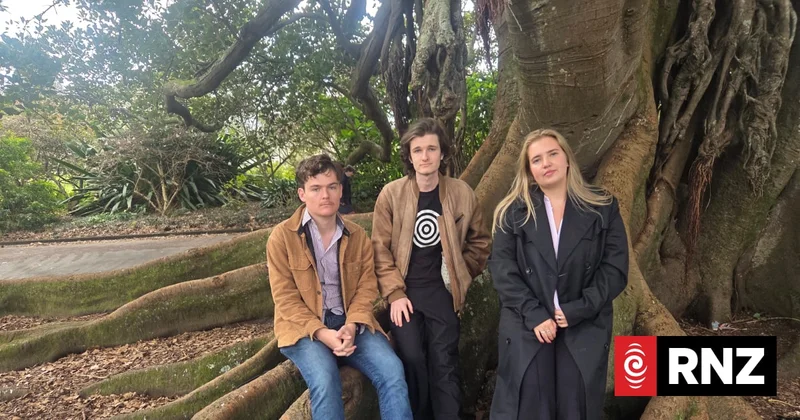
When George Davidson-Sims completed a degree in screen production and radio last November, he didn't think he'd be waiting tables and delivering room service. Yet he considers himself one of the lucky ones.
"It's always a bit hard because you apply for so much stuff and nothing ever pops up and it's just, there isn't anything, at least for screen production," he said. "A lot of it is [having] to know the right people to get jobs."
The last time he checked the Crewlist website, a key site for screen production jobs, there were only about three positions advertised that fell within his parameters.
"They were all advanced roles or they were closed," Davidson-Sims said.
Oddly, it's his classmates who went on a benefit after studying who have had the most success.
"The Ministry [of Social Development] fund a creative arts programme to get people into film or art jobs but it's only available to people on unemployment benefits.
"I'd probably be more likely to get a job if I were to [get the unemployment benefit] which is, you know, crazy."
Wellingtonian Gabriel Murphy has applied for hundreds of jobs since graduating with a Bachelor of Arts some nine months ago. He said he's lucky to even get a reply, which is disheartening.
"It is quite tough to get almost complete radio silence from every avenue I look down," he said.
"I do try and rationalise it and be like, 'No this is just the economic conditions of the city and of New Zealand'. But it can be like, 'You're an idiot, Gabriel! Everyone hates you, no-one wants you to work'."
He's started to apply for jobs that are completely unrelated to his degree, everything from supermarket work to weeding gardens.
"There are so many other applicants that employers have huge swathes of people to choose from, so they can pick the most highly-qualified or people with the most experience."
Alicia Lemmer completed a Bachelor of Communications majoring in public relations last year and is about to graduate with a Bachelor of Business.
After a long slog applying for work, she managed to find a job through a university connection. She told RNZ having the right contacts seems to matter more than your degree.
"Students put this investment into coming to university for a better future and for better job outcomes and that kind of opportunity feels like it's been taken away," she said. "I think it's really upsetting for a lot of students."
It also means we're losing many of our brightest and best graduates to overseas.
"A particular friend of mine did a Bachelor of Communication and now has moved to Europe to do some yachting ... gone to be a stewardess," she said.
"They couldn't find a job and couldn't remain unemployed for any longer."
It's not only graduates struggling to find work. The Auckland University of Technology Students Association (AUTSA) says current students are finding it incredibly tough too.
In the past three months alone, it's had 700 students seeking help just to get enough food to eat.
"I took a photo of the food shelf last Friday and I stood there for about 10 seconds [thinking] this was full just a couple of days," said AUTSA president James Portegys.
And it's not only paid work that is increasingly hard to come by.
"We are hearing about students who are really struggling to find unpaid placements - any placement in general," he said. "That's a very genuine thing that students are having to deal with."
In a surreal sign of the times, Portegys says students are using artificial intelligence to help them apply for hundreds of jobs, while employers are using AI to screen applications - meaning there can be zero human interaction during the entire process.
"It's just due to the sheer multitude, and bizarrely, what we're finding is it's about the connections you hold in that certain business, so it's potentially [needing to] shoulder tap your friend's dad who's in that company [and ask] 'Hey can you put this behind the AI. Don't go through that process, just read it'."
As well as the huge discrepancy between the number of applicants and jobs available, SJS found casual and one-off jobs are now the dominant form of student employment.
SJS chief executive Louise Saviker said they'd never seen a student work environment like this before.
"This is being driven by quite a significant convergence of issues that we don't think has been seen in the history of student working over the last, say, 50 years. Certainly in our data," she said.
"The issues are relating to the economic environment, the employment market, the tertiary settings which are becoming more expensive every year for students to study. And then the cost of living for students as well."
She said while job vacancy levels are actually back to pre-Covid levels, because the roles are short term or casual, students now need more than one to earn the same amount as they previously would have.
"Application rates are definitely the highest we've ever seen in Student Job Search's data records over 40 years," she said.
"What that tells me is that students are really motivated, really committed and exceptionally committed. We hear from students every day who have applied for more than 50, sometimes even a hundred jobs."
Saviker urged students or graduates struggling to find work to take any job they can get because it will make them more attractive to employers in the field they ultimately want to work in.
"They've got to hustle. And our data shows that they are."