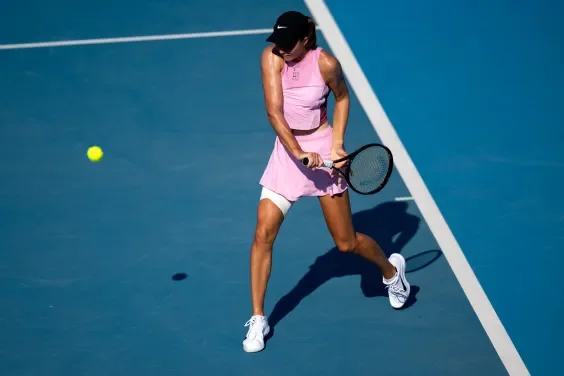
In antiquity, tennis players could win with a diverse mix of skillsets, with some even relying on speed, anticipation, net touch. This variety is often mourned by the old heads. Because in the sport's present—and, given the arc of string and racket tech, its foreseeable future—the skill that looms above all else is mighty ball-striking from the baseline. Though I do mourn the loss of off-speed demons on grass, for example, I have made my peace with this reality, and perhaps because I had my own tastes shaped by this evolution in the game, I am content to watch a punishing groundstroke all day. But I'd enjoy it even more if there's at least some neat technical twist. My ideal would be a player who thrives in the today's power-baseline meta, but does it while cultivating a technique at risk of extinction—like, say, the one-handed backhand. Today, I present one to you one brilliant pupil: an 18-year-old Austrian named Lilli Tagger, who won the WTA 250 in Prague on Sunday, her first tour-level title.
Tagger grew up skiing in the Alps, like Jannik Sinner, only on the other side of the border—her East Tyrol to his South Tyrol. At age 13 she crossed that border to train full-time in Italy, where she is now coached by Francesca Schiavone, whose 2010 Roland-Garros title was the most recent won by a WTA one-hander, and hopefully not the last. It's not too grandiose to say that Tagger is the most likely active player to end that drought; it's mostly just a commentary on the shot's scarcity. But there's already enough depth to her game that I'm increasingly willing to back that part of the prediction, too.
Though a newcomer to the tour, Tagger already lords above almost all her colleagues at 6-foot-1, and those long levers grant her crackling power. When on her front foot, she can snap off comical winners off the backhand side, including the ultra-rare inside-out backhand return winner, which feels like glimpsing an endangered species of bird when seen in action. In general, the cost of height is agility, and while Tagger can surely be wrong-footed, she changes directions more smoothly than the similarly statured Elena Rybakina. If, as most one-handers do, she develops great feel with her slice, that will also shore up her defensive repertoire. Though her serve is still developing, I'm willing to bet that any player this tall can arrive at an elite delivery, if not one of Rybakina's historic quality. Above all, you can tell that Tagger is still growing up and adjusting her tactics in real time to meet her physical tools. With that size, shot-making, and skills in flux, Tagger makes for a rewarding prospect to follow. As with any player at this phase, it's more fun to imagine the eventual destination without getting too caught up in the current state of things.
Even so, the current state of things is already lethal. During Indian Wells, I wrote about Tagger in the context of dwindling one-handers. Since then, she inched up the rankings and into the top 100, entering last week as the world's No. 74 player. Whenever I tuned in during the spring and summer, Tagger could look like a very different player from match to match, her form bobbing, but on the hard courts of Prague she found her rhythm against two consecutive qualifiers and only dialed in as the week progressed. In the semifinals Tagger took out world No. 26 Barbora Krejcikova, which was the second top-30 win of her career. On Sunday, playing in her first WTA final, she beat No. 54 Daria Snigur, digging out of a 2-5 hole in the first set to win the title 7-6(3), 6-2. (The highlights don't embed but you are forcefully encouraged to click the links and watch those backhands in context.) Once the points from the Prague title kick in, Tagger will become the youngest player in the top 50. I would have predicted she'd win her first title on clay or on slow hard courts, but doing it on medium-speed hard is a good sign for anyone worried that the one-hander might get rushed.
The more I think about it, the more mysterious I find it that the one-hander vanished so thoroughly from the women's tour. Two of the biggest pitfalls of the shot are difficulty timing the returns of serve, and the difficulty wrangling high balls. These are more pressing concerns on the men's side, which sees faster serves and higher-kicking topspin. (Tagger's height makes the latter issue even less concerning, though of course, if you could be certain of a player's eventual physical dimensions, childhood skill development would be a lot easier.) If it's a question of role models, based on a corpus of hundreds of rote interview questions about idols, all living professional players worship Roger Federer, but perhaps only the men were allowed to follow his example, and even then, just a tiny subset of them. Tagger has said that she first tried to switch to a one-hander at age 10 but was discouraged. Then at 12 she bet her coach that if she won that week's tournament, she'd make the switch or otherwise let it drop. Good thing for us all that she won that bet.