The number of aircraft given permission to land at Sydney Airport during an overnight curfew will be slashed once its new competitor on the city’s western fringe becomes fully operational over the coming months.
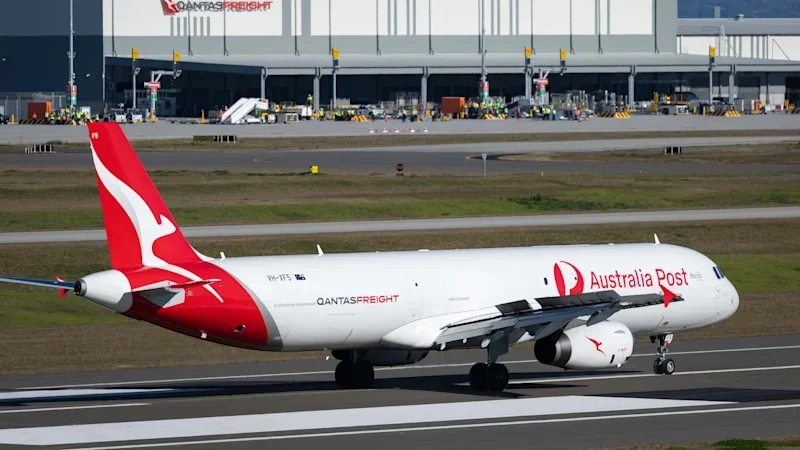
The curtailing of flight dispensations during the curfew at Kingsford Smith comes as a Qantas aircraft will make the first commercial cargo flight from Western Sydney Airport on Monday, marking the opening of its freight hub.
Up to 74 freight flights a week that have been permitted to fly in over Botany Bay to land at Sydney Airport during the 11pm to 6am curfew will be forced to use the new $6 billion international airport at Badgerys Creek from November 1. But the prospect of planes flying in and out of the curfew-free airport in the city’s west during the middle of the night worries some nearby residents.
Luddenham Progress Association president Wayne Willmington said he was concerned that cargo planes, which passed over water to land at Sydney Airport late at night, would now be forced to fly over houses in the city’s west to reach the new airport in the early hours.
“It is very disappointing. It is the people in St Clair and Silverdale at the ends of the runway [who will be most disrupted],” he said.
Apart from cargo flights, the number of large passenger aircraft granted exemptions to land during a so-called shoulder period at Sydney Airport between 5am and 6am is also being cut.
Qantas, Singapore Airlines and British Airways have long used the exemption to land aircraft during the morning shoulder period. Like the overnight cargo planes, the passenger aircraft fly over Botany Bay on approach to land.
Lately, British Airways flight BA15 and Singapore Airlines flight SQ221 have been re-timed to land at Sydney Airport after 6am. Qantas flight QF2, flown with A380 superjumbos from Singapore, will continue to land at about 5.10am each day until October, but thereafter will be touching down after 6am.
The federal Department of Transport said a gazettal of the new airport for nighttime aircraft movements from November 1 would affect approval criteria for international flights at Sydney Airport during the shoulder period but would “not directly stop them”.
A spokesperson said the gazettal would end flights into and out of Sydney Airport between the 11pm and 6am curfew unless they were emergencies, permitted movements or granted an exceptional circumstances dispensation.
Blue Mountains Labor Mayor Mark Greenhill reiterated concerns that flight paths for the new airport risked compromising the area’s world heritage listing. “There is every chance that these cargo flights will begin eroding it,” he said.
Liverpool’s Liberal Mayor Ned Mannoun is sympathetic to concerns of residents near the new airport, but said he supported its curfew-free status. “This is clearly a 24-hour airport – that’s its competitive advantage,” he said.
The federal Transport Department said flight paths would be carefully monitored as the airport became operational, adding that 288 homes and other buildings were eligible for noise insulation.
The start of cargo flights on Monday comes three months before Western Sydney Airport opens to passengers. Jetstar will become the first airline to fly from the airport on October 25, followed by Air New Zealand a day later.
Singapore Airlines will begin flying to Australia’s first major new airport in more than 50 years on November 23, while Qantas domestic flights will start on March 28 next year.
Qantas, Menzies Aviation and Dubai-owned dnata are setting up facilities at the airport’s new freight precinct near the southern end of the 3.7-kilometre runway. Aviation charter company Texel Air will also fly Boeing 737-800 freighter aircraft there.
The launch of freight flights comes two weeks after a Qantas A321 became the first cargo plane to land at the airport as part of trials.
Western Sydney Airport chief executive Simon Hickey said the new cargo hub would be a massive boost to the city’s air freight capacity and high-value industries that relied on rapid international connections.
“This means that a fish caught in Forster can be served fresh at a restaurant in Singapore the next day,” he said.
The 733,000-square-metre cargo precinct is large enough to handle eight large Boeing 747 freighters or 16 smaller Airbus A320 planes, simultaneously.
In its draft master-plan, the new airport has forecast it will handle 293,000 tonnes of cargo by 2030, increasing to 546,700 tonnes within the next two decades. In comparison, Sydney Airport estimates it will handle 1.4 million tonnes of freight by 2045, up from about 600,000 tonnes today.
A large proportion of freight is carried in the holds of passenger aircraft, commonly referred to as “belly freight”.
More: