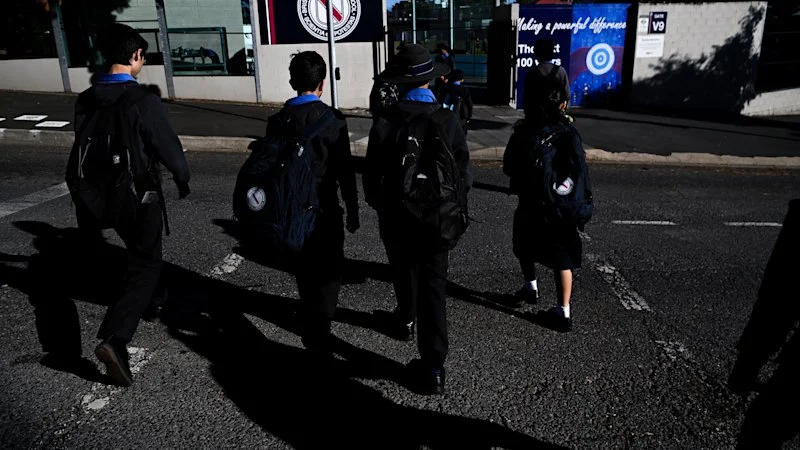
It’s a huge school, surrounded by busy roads and smack-bang in the inner-city.
Some of Brisbane’s biggest schools suffer steep speed drops at pick-up and drop-off, but around Brisbane State High, traffic is always slow, and student movements don’t appear to be a major cause.
Average traffic speeds around the school in South Brisbane waver around 30km/h, regardless of whether it is school holidays, the AM peak, PM peak or later in the day.
The school, with an enrolment of 3500, takes two out of five of its students from outside its catchment.
It is a different story at many of the city’s other large schools, where parental chauffeur snarls slowed traffic by as much as 30 per cent.
HERE Technologies analysed data over eight weekdays in June and July during the term and school holidays across Brisbane’s 20 biggest schools.
It found average traffic speeds during drop-off and pick-up were about 15 to 17 per cent lower than comparable times of day.
State High P&C president Chris Dutkowski said there were good public transport options nearby, but warned more needed to be done to plan for the area’s infrastructure in light of the massive development planned for South Brisbane.
“Around the pick-up zone, there’s always a bit of a line there, but compared to how many kids actually go to the school it’s probably quite small,” he said.
“You only have to be there around bell time to see the thousands of students streaming out and walking away from the school compared with those being picked up by car.”
Some roads near Brisbane schools have 40km/h school zones in the morning and afternoon, which slow traffic.
HERE Technologies collected data from a one-kilometre box around the school’s coordinates, meaning its analysis captures traffic conditions on the surrounding road network and not just the street directly outside the school.
Data was generated via hundreds of anonymised sources, including vehicle telematics, hardware device probes, and official government feeds.
HERE Technologies lead data scientist Swetha Nutakki said school-related travel created a clear and measurable impact.
“The findings highlight how concentrated travel demand over relatively short periods can have a significant effect on local traffic flow and congestion,” she said.
In the 1970s, eight out of 10 schoolchildren rode or walked to school, but now private cars are the most common form of transport for south-east Queensland students, according to a Griffith University study published in 2022.
Associate Professor Dorina Pojani, from The University of Queensland, said streets could not cope with hundreds of cars arriving within a short window.
“It’s just not efficient, it’s not possible. You’d have to have a city that’s made up of roads, if all the school drop-offs were done by car,” she said.
Pojani said ideally children would live close so they could walk to school, but in sprawling cities, the next best thing was to cycle or ride an e-scooter.
“And with e-bikes and with e-scooters, I feel like we’ve demonised those modes rather than supporting them and seeing them as a positive thing,” she said.
“We need to just completely reframe those modes if we want kids to not become car dependent from age five.”
Pojani’s research on cycle tracks at Carseldine, Northshore Hamilton and Baringa found they encouraged people to choose active travel over cars.
But some parents did not let their children use them over concerns about crossings or missing links at the beginning or end of a trip.
And while the HERE data showed school hours affected traffic speeds, Pojani said speeds should be slower around schools to improve safety.
An Education Department spokesman said parents played a key role in ensuring their children got to school safely.
“How students get to and from school is a matter for families to decide,” he said.
“Individual school principals and their school communities work together at a local level to promote the safe use of public and active transport where appropriate, and to address issues of concern regarding road safety.”
Deputy infrastructure chair Danita Parry said the council continued to invest in programs, such as its opt-in Active School Travel initiative, Slow for SAM and Safer School Precincts.
Council issued 1025 parking fines or warnings in school zones in the first six months of this year.