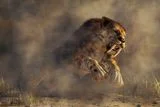
A spinal nerve tumor is rare enough that many doctors may go their entire careers without diagnosing one. It often causes pain first and, if left untreated, can slowly reduce function in the limb controlled by the affected nerve. In humans, it appears in an estimated 0.22 to 0.38 cases per 100,000 people and results from a genetic mutation, either inherited or spontaneous.
Now picture evidence of that same painful condition appearing in the fossilized spines of three separate predators that lived more than 10,000 years ago.
Researchers examining thousands of bones from the La Brea Tar Pits in California found signs of the tumor in three Smilodon fatalis, the saber-toothed cat. The tumors appeared within a pattern of skeletal abnormalities that may point to inbreeding as the species approached extinction. The findings appear in Frontiers in Veterinary Science.
“Smilodon enjoys the reputation of mighty hunter. But the discovery of the tumor shows that it was an animal with weaknesses and feelings, not just a predator,” Hugo Schmökel, lead study author, told Discover.
Read More: Everything You Need to Know About the Saber Tooth Tiger Extinction
La Brea Tar Pits May Have Trapped Saber-Toothed Cats in Pain
At La Brea, crude oil seeps up through the ground in ponds of sticky black tar, and animals that wander in get stuck. Their distress calls draw in predators looking for an easy meal, who then become trapped themselves. During the Pleistocene, that included Smilodon.
“A trapped prey animal is very attractive for a predator in pain,” Schmökel said in a press release. “A wounded or sick predator must rely on carcasses for surviving, so they’ll take bigger risks to get to them.”
What Thousands of Vertebrae Revealed
Schmökel and his colleagues examined 3,722 vertebrae from at least 849 adult saber-toothed cats held by the La Brea Tar Pits Museum. Signs of abnormal development turned up throughout the collection, including 32 vertebrae with incompletely formed arches, 48 fused together into solid blocks, and 226 transitional vertebrae that had taken on features belonging to a different part of the spine.
Three vertebrae each contained an enlarged opening with a smooth, remodeled surface where a nerve passed through the spine, evidence that a slow-growing tumor had pressed against and reshaped the bone. Because those three vertebrae came from three different pits, they had to belong to three separate animals.
For an ambush hunter that relied on leaping and wrestling prey to the ground, even partial loss of function in one limb could have made securing a kill difficult.
Within the La Brea sample, the estimated prevalence reached 353 cases per 100,000, more than 900 times the estimated human rate.
A Warning About What Comes Before Extinction
Researchers cannot confirm inbreeding without genetic testing, but the number and variety of skeletal abnormalities led them to suspect it. Scientists have documented similar spinal malformations in modern inbred gray wolf populations.
As Smilodon numbers declined and mates became scarce, harmful genetic variants may have become concentrated within the population. Schmökel emphasized that this genetic deterioration would have been a consequence of the decline, not its cause.
For today’s wild cats, he said, habitat loss, hunting, pollution, and climate change can set that decline in motion.
Bones can record changes in the spine, but diseases affecting soft tissues may leave no trace in the fossil record. That leaves Schmökel with questions the fossils may never answer.
“Scientifically, the question is what soft tissue diseases Smilodon suffered from, given the likely inbreeding. Personally, I would like to find more answers to the question of Smilodon's extinction, so that today's big cats like lions and tigers don't have to go the same way,” he told Discover.
Read More: Fossil Skull From a Museum Drawer Reveals Obscure Saber-Toothed Cat Species With Knife-like Teeth
Article Sources
Our writers at Discovermagazine.com use peer-reviewed studies and high-quality sources for our articles, and our editors review for scientific accuracy and editorial standards. Review the sources used below for this article:
- This article references information from a study published in Frontiers in Veterinary Science:Foraminal widening indicating a spinal nerve tumor in the saber-tooth cat Smilodon fatalis from Rancho La Brea