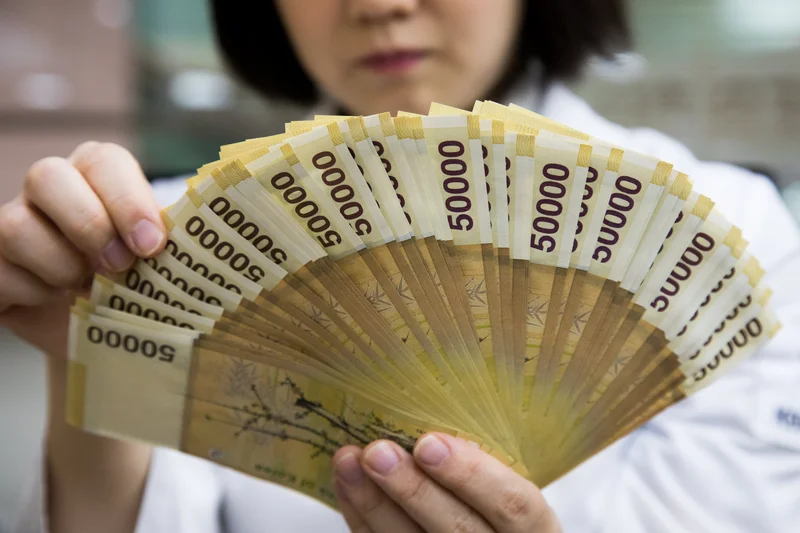
Asia's currency market is increasingly becoming a play on artificial intelligence, according to Goldman Sachs. Currencies tied to semiconductor exports and AI supply chains, notably the South Korean won , Taiwan dollar , Singapore dollar and Malaysian ringgit , have outperformed peers more exposed to rising energy costs such as the Thai baht , Philippine peso , Indonesian rupiah and the Indian rupee , the bank highlighted in a report published Saturday. While the U.S. dollar has broadly strengthened this year amid higher oil prices, a hawkish Federal Reserve, a stable yuan, and Middle East tensions, Goldman expects the divergence within Asia to persist as long as AI investment remains intact. The U.S. dollar index has climbed nearly 3% so far this year. "The two main drivers of Asian macro markets this year have been the energy supply shock and the AI-related investment boom," according to Goldman. South Korea is one of Goldman's strongest bullish calls. The bank said the country's AI-driven semiconductor exports have pushed the current account surplus to record levels, with economists forecasting it will nearly double to almost $300 billion this year, equivalent to 13.9% of its GDP. While heavy foreign equity selling earlier this year weighed on the won, Goldman said those outflows have slowed, allowing the currency's strong external fundamentals to reassert themselves. "Reduced foreign equity outflows has lessened offset to surging current account surplus, paving way for [the won's] rally," the note stated. Taiwan is another favored market. Goldman expects the Taiwan dollar to continue outperforming as booming semiconductor exports drive one of Asia's largest trade surpluses. The bank forecasts Taiwan's current account surplus to reach 25% of GDP this year, while exports have expanded at a record 40% to 70% pace for much of 2026. Although policymakers are expected to keep interest rates unchanged, Goldman said robust technology exports and large U.S. dollar deposits should continue supporting the currency. China also stands out. Despite broad dollar strength, the yuan has been Asia's only currency to appreciate against the greenback this year. "China's economy is being propelled by strong performance in high-tech manufacturing and related sectors, while activity across the broader economy remains subdued," Goldman analysts said. Goldman maintained its 12-month forecast for USD/CNY at 6.50, saying the currency remains undervalued while strong exports and policymakers' push to internationalize the yuan should underpin further gains. Not every technology-linked currency is expected to outperform equally. Goldman is neutral on the Singapore dollar, saying resilient AI-led growth and contained inflation support the economy, but leave limited room for further currency gains because the Monetary Authority of Singapore has kept its policy unchanged. In a surprise move, the MAS on Monday tightened its monetary policy. Goldman remains bearish on Thailand's baht and Indonesia's rupiah. The bank said Thailand is being weighed down by falling gold prices and lower real interest rates, while Indonesia continues to face concerns over policy uncertainty and governance despite measures aimed at attracting foreign capital. It also expects the Philippine peso to remain sensitive to elevated oil prices given the country's dependence on imported energy. Overall, Goldman maintains bullish three-month views on the Chinese yuan, South Korean won, Taiwan dollar, Indian rupee and Malaysian ringgit, while remaining bearish on the Thai baht and Indonesian rupiah. While rupee has remained under pressure this year and is not an AI play, Goldman said that recent measures by the Reserve Bank of India to attract foreign capital and relatively lower oil prices, should help support the currency. Goldman is also bullish on the Malaysian ringgit, saying resilient AI-driven growth, strong exports and continued foreign direct investment should underpin the currency.
Goldman Sachs lists Asian currencies riding the AI boom