Critica Limited has strengthened the case that its 100 per cent-owned Brothers rare earth project is evolving well beyond Jupiter into a district-scale rare earth system after a string of shallow, high-grade drill hits at the company’s Juno satellite prospect in Western Australia.
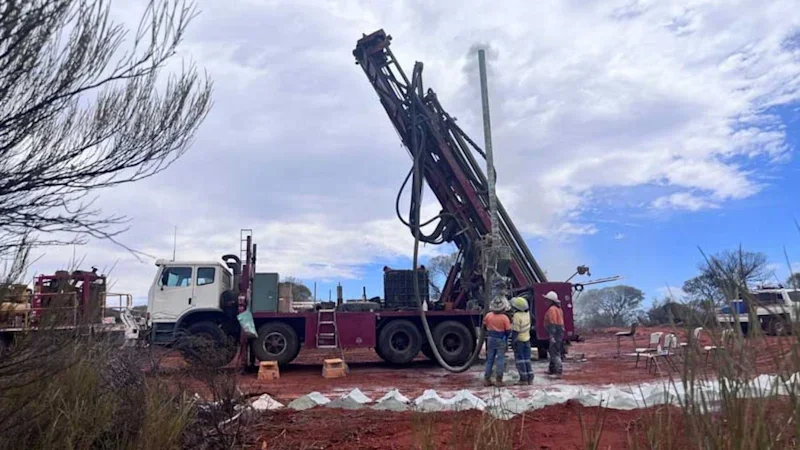
A 30-hole, 1249-metre air-core program designed to test extensions to previously identified clay-hosted rare earth mineralisation and the broader project potential confirmed shallow, high-grade rare earth mineralisation across an area of approximately 45 square kilometres.
Standout results include 14 metres grading 3053 parts per million total rare earth oxides, or “TREO”, from just 44m downhole. Other significant hits have included 20m at 2155ppm TREO from 40m, 24m at 2147ppm TREO from 24m, 16m at 2117ppm TREO from 20m and 17m at 1825ppm TREO from 24m.
Magnet rare earth oxides generally accounted for between 20 and 25 per cent of the total rare earth content, broadly matching the proportions seen at Jupiter.
‘The results demonstrate the significant potential of the Brothers Rare Earth Project beyond Jupiter’Critica Limited chief executive officer Jacob Deysel
Preliminary mineralogical analysis also indicates Juno hosts the same rare earth phosphate minerals within a shallow kaolinite-rich clay-hosted system which is generally suited to conventional surface mining with relatively low stripping ratios.
Initial mineralogical analysis also provides confidence Juno mineralisation will be amenable to the metallurgical flowsheet being developed for Jupiter, potentially allowing multiple satellite deposits to feed a common beneficiation and downstream processing circuit.
The shared processing pathway could give the company greater mine-planning flexibility, feed-blending opportunities and provide a pathway towards a larger, more optimised development.
Critica’s beneficiation-first strategy has already demonstrated the ability to reject about 95 per cent of the feed mass before the expensive hydrometallurgical stage, allowing a much smaller downstream plant to treat only higher-value concentrate. If Juno proves compatible with that same flowsheet, the economics of developing multiple deposits across Brothers could become considerably more compelling.
The latest results reinforce the company’s strategy of developing the Brothers rare earth project through multiple satellite deposits rather than relying on a single flagship project.
Critica Limited chief executive officer Jacob Deysel said: “The results highlight the opportunity to progressively develop a pipeline of satellite deposits capable of supporting future resource growth and enhancing development flexibility across the project.”
Juno lies 50 kilometres south-east of the Jupiter deposit, reinforcing the district-scale nature of the Brothers rare earth project. With Jupiter occupying less than 3 per cent of the project’s broader 1,500-square-kilometre footprint, substantial scope remains for additional satellite discoveries capable of supporting a future hub-and-spoke development.
Critica is already assessing Juno’s role in the future development of the Brothers project and will now undertake detailed geological interpretation, mineralogical and metallurgical studies alongside preliminary metallurgical testwork to confirm its processing characteristics. The work will also assess processing options, feed blending and how satellite deposits could contribute to the project’s future development.
Further drilling is planned at Juno, while assays from the recently completed drilling program at the nearby Aurora prospect, immediately to the north, are pending. Aurora forms part of the company’s regional exploration programme to identify additional rare earth centres across the Brothers rare earth project.
While Jupiter remains Critica’s immediate development priority, Juno has already progressed from a promising regional target into what appears to be the first serious satellite prospect positioned to complement Jupiter.
The company’s progress comes amid growing government support for Australia’s critical minerals sector, with Juno’s drilling program supported by the Western Australian Government’s Exploration Incentive Scheme, which covered approximately 50 per cent of approved drilling and mobilisation costs.
Rising demand for rare earths used in permanent magnets, advanced manufacturing, defence technologies and electrification continues to strengthen the long-term outlook for the sector.
With further drilling planned, Aurora assays still to come and the metallurgy pointing towards a common processing route, Critica is rapidly assembling the pieces to transform Brothers from a giant rare earth deposit into a genuine district-scale rare earth province.
Is your ASX-listed company doing something interesting? Contact: mattbirney@bullsnbears.com.au