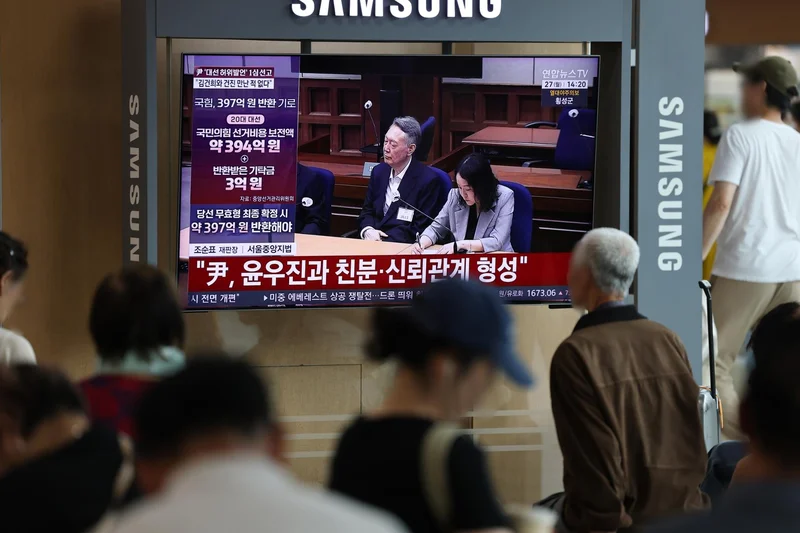
Ousted President Yoon Suk Yeol was sentenced Monday to one and a half years in prison, suspended for three years, for making false statements during the 2022 presidential campaign, a ruling that would require the main opposition People Power Party (PPP) to return 39.7 billion won ($27.05 million) in campaign reimbursements.
Yoon, the PPP's candidate in the March 2022 presidential election, was indicted in December 2025 on charges of violating the Public Official Election Act by allegedly making false statements during the campaign.
Under the Public Official Election Act, a candidate whose election is invalidated after receiving a disqualifying sentence for an election-related offense must return any campaign reimbursements paid by the National Election Commission (NEC).
The case drew particular attention because, if Yoon is ultimately sentenced to a fine of 1 million won ($720) or more, the PPP would be required to return 39.7 billion won in campaign expense reimbursements to the NEC.
Prosecutors said that during a Kwanhun Club forum on Dec. 14, 2021, Yoon falsely claimed he had never introduced a lawyer, identified only by his surname Lee, to a former chief of a district tax office.
He also faces charges over remarks made during an interview at the launch ceremony of the Buddhist Leaders Forum on Jan. 17, 2022.
He allegedly falsely stated that he had been introduced to shaman Jeon Seong-bae, better known as "Geonjin Beopsa," by a PPP official and that former first lady Kim Keon Hee had never met Jeon together with him.
According to the special counsel team, Yoon had in fact introduced the lawyer to the former district chief of a tax office and first met Jeon through Kim, maintaining ties with the shaman for more than a decade.
At the final hearing last month, special prosecutors argued that Yoon's false statements helped quell various controversies surrounding him and gave him an advantage in the presidential election.
They sought a two-year prison sentence.
Yoon's legal team has denied the allegations, arguing that he answered questions truthfully based on his recollection and understanding in order to satisfy the public's right to know, rather than intentionally spreading false information.
Under the Public Official Election Act, a candidate whose election is invalidated after receiving a disqualifying sentence for an election-related crime must return any campaign reimbursements paid by the NEC.