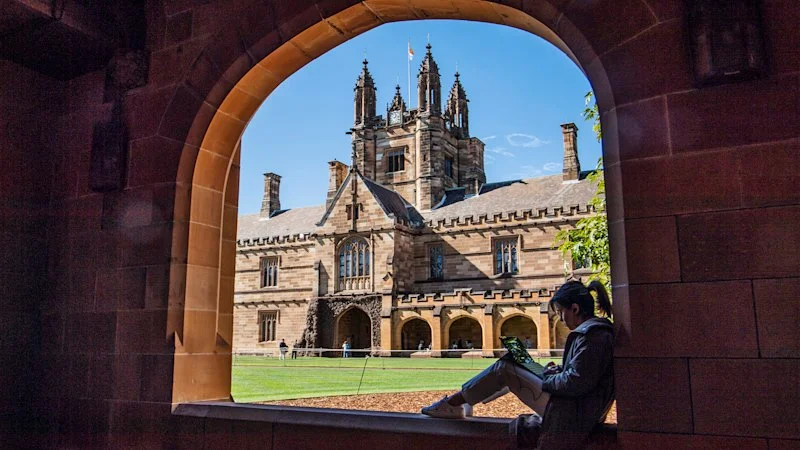
What will it take for the prime minister, who has an economics degree, the treasurer, who has a bachelor of arts, a bachelor of commerce and a doctorate in political science, and the education minister, who has arts and law degrees, to be fair to students wanting to study the arts and humanities (“Coalition left graduates with debts, not jobs”, July 27)? All others’ efforts to reduce the appallingly huge fees have failed. Have these decision-makers ever justified their stand and explained why Australia must treat its citizens, often young adults or those obliged to retrain because of job loss, so badly? I’d like the trio to front a televised community forum to explain, and try to convince everyone how and why they are so much better than the Coalition. The room would be packed. Jennifer Fergus, Croydon
Your editorial on HECS fees highlights the frustration that many Labor supporters have with the current government. Although the Coalition is nothing short of a shambles and the thought of One Nation governing Australia is abhorrent, it is so disappointing that this government has failed in significant areas where one would expect it to shine. Failure to reverse the Morrison HECS fee structure, the embarrassment of its gambling advertising reforms, its deafness to the calls for a gas tax and its continued ignoring of the need for the JobSeeker payment to be increased above the poverty line are just some of the areas where this Labor government is letting us down and ignoring the will of the majority of Australians. Phil Peak, Dubbo
Your editorial raises understandable concerns about student debt, so I realise I am likely to be swimming against the tide in defending the Job-ready Graduates scheme. However, those concerns overlook a basic reality: higher education requires a fair balance between taxpayer support and individual contribution. Annual fees of $18,025 for humanities, communications and business degrees are substantial. At the same time, a university degree remains a valuable private asset, typically delivering higher lifetime earnings. Taxpayers should not heavily subsidise degrees in fields where the supply of graduates exceeds labour market demand. Critics point to graduates with HECS debts exceeding $50,000. But Australia’s student loan system remains highly generous. HECS loans do not charge interest above inflation, repayments begin only when graduates earn a reasonable income and the government has recently reduced existing debts by 20 per cent. Encouraging enrolments in areas of national need while asking students in disciplines where there are no workforce shortages to contribute more is neither punitive nor unfair. It is a sensible use of limited public funds. John Kempler, Rose Bay
There is little doubt that for many students the decision to attend university has become a lot more vexed with the introduction of the Job-ready Graduates scheme and the enormous cost of arts degrees. A major issue with the JRG is that many students from low-income families may have the required ATAR necessary to enrol in a humanities or social sciences degree, but it does not give them access to many other courses. The minister has stated that he would like to see more low-income students attend university, but the policy clearly makes this less likely. The failure by the Labor Party to abolish the scheme is certainly perplexing. Alan Morris, Eastlakes
Boring spectacle
Just like the PM’s favourite ball game, rugby league, the ALP’s national conference comes together every so often to pretend a contest (“Why Albanese barely mentions Libs, but speaks his true enemy’s name,” July 27). League’s faux scrums now just send the ball straight through to the side in possession. Not how it used to be. The ALP conference, likewise, has outcomes arranged beforehand. Not how it used to be. Now, no player or member is allowed to challenge. That, seemingly, is how our PM likes things. Is it good for us bystanders? Well, league has become boringly predictable and repetitive. Whatever is being played now, it’s not rugby league. Could the same be said about the Labor Party? Indeed. Whatever happened in Adelaide was not how Labor was, nor how it should be. Peter O’Brien, Sydenham
Several questions remain after Sean Kelly’s analysis. On the heels of Labor’s tightly controlled national conference, is the price of unity the stifling of real debate? What is the danger when the government speaks with one voice? Is there no range of viewpoints within Labor on the purchase of phantom submarines, the situation in Palestine/Israel or gambling reform? What is our PM afraid of? Mark Paskal, Austinmer
I’m sure Labor made a strategic move to have potentially divisive issues and policies discussed behind closed doors prior to their recent conference. It is clear that the party is determined to portray unity and calm leadership as points of difference to the angry, divisive rhetoric of the right side of politics. John Anderson, MacMasters Beach
Pick your battles
Ed Husic is, of course, absolutely right about Israel and Gaza, but the party hardheads were right to prevent his views being adopted into the party’s platform at the ALP conference (“Bad blood lingers in Labor over conference’s Israel-Palestine policy”, July 27). Taking sides in this far-away, intractable conflict would not make an ounce of difference in Gaza, and would unleash a torrent of vitriol and divisiveness across Australia which Labor’s political rivals would exploit to the max, to the detriment of the whole country. It’s not a solution, and there would be no upside except the warm glow of standing on principle. The government has formally recognised the state of Palestine and adopted other positions through the appropriate forum, the UN. Elections in Israel in October and America in November will do a lot more to determine Israel and Gaza’s fates, including accountability, than any symbolic action in Australia. I urge Ed Husic not to do a Fatima Payman and deal himself into irrelevance, but to continue to fight the good fight in some of the many other avenues that are available. Chris Moon, Katoomba
Access for all
I am appalled by the “cash-for-access” culture that allows wealthy donors to purchase private access to our political leaders. Australia is meant to be an egalitarian society where every citizen’s voice carries equal weight. Instead, major parties have turned democracy into a commercial marketplace with tiered pricing. A single ticket to a political fundraising dinner costs between $2000 and $5000. Annual corporate memberships sit around $10,000 to $25,000, while exclusive boardroom lunches and private mansion events fetch $50,000 or more. Selling this level of power completely undermines our democratic principles. It is particularly disheartening to see a Labor government defend these practices, turning its back on the foundational values of fairness for working people. If this is how our political system operates, perhaps everyday Australians should set up a GoFundMe page to pool our money. If we raise $50,000, we could finally buy a seat at the table and force politicians to listen to ordinary citizens instead of billionaires. Access to our leaders must be based on the merit of ideas, not the size of a donor’s bank account. We must ban cash-for-access events immediately. Leanne Mullens, Faulconbridge
Ruinous legacy
Oh please spare me, Alan Joyce. Enough of the “I had to destroy the village to save it” rhetoric (“Alan Joyce tells his side of the Qantas story”, July 27). You took a world-renowned, innovative, iconic airline and turned it into just another brand. You ran down your premier product by channelling huge amounts of money away from it and making it a budget airline. You treated your whole tenure as though it was just an exercise in crunching numbers, ignoring the fact that the strength of Qantas has always been about its people, both customers and staff. There are far too many examples of your faulted management style, but your arrogance in assuming that it was the only way to manage the business is quite appalling. You changed Qantas forever. It will never be the same, and it will never be as good. John Mizon, Collaroy
We should not be surprised by former Qantas chief executive Alan Joyce’s apparent lack of contrition. Until recently, it was understood within a civil society that individuals should accept responsibility for their actions. Those who did not faced consequences. But that simple principle of accountability now seems to have diminished to the point where it can no longer be assumed to regulate a nation’s conduct, or curb personal excesses. Where accountability dies, everything becomes transactional. It begins from the moment a child realises their parents will make excuses for bad behaviour rather than apply corrective discipline. It ends with Donald Trump bragging he can do anything he likes without fear of retribution. Fraudsters walk away from bankruptcy. Corporations just apologise for their gross negligence and move on. Boatmen are murdered merely on suspicion of being “narco-terrorists”. Politicians knowingly mislead, yet suffer no real penalty. The media can expose and question these lapses but have no power to compel. This demise of the moral imperative of accountability is surely one of the most distressing failures of our troubled decade. David Salter, Hunter’s Hill
If Alan Joyce is so sorry he could ease some of his concern by dipping into his own funds and using that money to compensate the many workers still awaiting their much-deserved payouts. Gareth Turner, Louth Park
Polyester porkies
Finally, someone has twigged to the relationship between the Iran crisis and the production of synthetic fabric (“The next unlikely victim of the Iran crisis”, July 27). This can only be good news for the environment. The downside is the recourse to recycled synthetic fibres. This is the biggest lie from big oil and big textiles. Recycled polyester does more harm than virgin polyester. The very act of recycling releases microfibres into air and water, as does wearing and washing. The fibres in the recycled synthetic are 55 per cent shorter than the virgin product and are therefore more easily ingested and inhaled by humans and wildlife. Some 99 per cent of recycled polyester comes from plastic bottles. This has led to the disruption of a perfectly good plastic bottle recycling scheme. Plastic bottles recycled into polyester cannot be effectively recycled back into polyester owing to limitations in recycling technologies, and are more likely to end up in landfill. Ellen McEwen, Croydon
Penrith’s secrets
Callan Boys did Penrith a disservice in his review of Ross Dobson’s excellent latest restaurant Palermo (“‘Sydney’s best lasagne’ must henceforth include this”, July 25). He used the old cliché implying Penrith’s food scene was just Panthers and restaurant chains, when he should be very aware of the hatted restaurant Sinclair’s in the same postcode. Penrith has a huge diversity of ages and cultures and so there are plenty of cafes and restaurants to cater for that diversity. We therefore have quite a dynamic food scene. These venues are well patronised and so I, selfishly, won’t be letting him in on our secrets. With plentiful fresh local produce available, there are many restaurants and cafes that offer nuanced flavours without the hefty price tags of city locations. We don’t need to travel 50 kilometres to the city when we can stay out here and enjoy great food and even better company. **Carolyn Duval, Blaxland **
Science lags
It’s certainly exciting to see Australians winning races in the pool (“Clean sweep: McEvoy leads Aussies on 50m freestyle podium”, July 27). We could say that the high cost of training them to elite level was well spent. We also punch well above our weight in a wide range of scientific disciplines that include climate, environmental, agricultural, biomedical, physical and mathematical sciences. How sobering, then, to realise that we lie 40th out of 44 OECD nations per capita in our number of graduates in STEM (science, technology, engineering, and maths) subjects, so our scientific future is perhaps looking a bit less rosy. Further, our government funding of R&D is only 1.69 per cent of gross domestic products, way less than the OECD average of 2.72 per cent, while our industry R&D funding is proportionately even lower. I look forward to the day when Australia can be as proud of its support for science as it is for sport. Rob Baxter, Naremburn
Priceless parks
Something I’ve noticed since retiring is the mid-week popularity of our parks and reserves. Minibus loads of the aged and disabled mingle with many others of all ages in the sunshine and fresh air. Parks and reserves across NSW are a wonderful legacy we must preserve and ideally, expand. They are resources for relaxation, recreation, serenity, civility, exercise and social well-being. They are refuges too for birds and other wildlife. They are priceless. Tim Coen, Ashfield
Long shot
It is not the first time a letter-writer has suggested a central holding facility for guns (Letters, July 27). So when a farmer needs to put down a cow that is suffering or a neighbour needs to shoot a feral dog that is killing their sheep or feral cats or foxes eating chickens, they would need to drive hours to collect their guns while the carnage continues. Peter Egan suggests farmers would support having fewer guns around. Not the ones I know. Andrew Leuchars, Mosman
I agree with your correspondent Peter Egan, but a better place for storage of all guns would be the local police station. The question remains of why anyone other than a collector needs 10 guns. On top of which, I believe all guns within a collection should be registered – and also rendered unusable. Brian McDonald, Willoughby
Note perfect
What an incredible achievement for young Charlie Wu of Melbourne, winning the grand piano competition in Moscow (“Piano prodigy, a world beater, at age 13″, July 27). How lucky we are to have been able to share such a win on his return to Australia. Even more fortunate was his chance to find such a passionate teacher to guide him to this amazing result. I wonder what Pauline Hanson would say about it. Greg Vale, Kiama
- To submit a letter to the- Sydney Morning Herald, email letters@smh.com.au. Click here for tips on how to submit letters.
- The Opinion newsletter is a weekly wrap of views that will challenge, champion and inform. Sign up here.