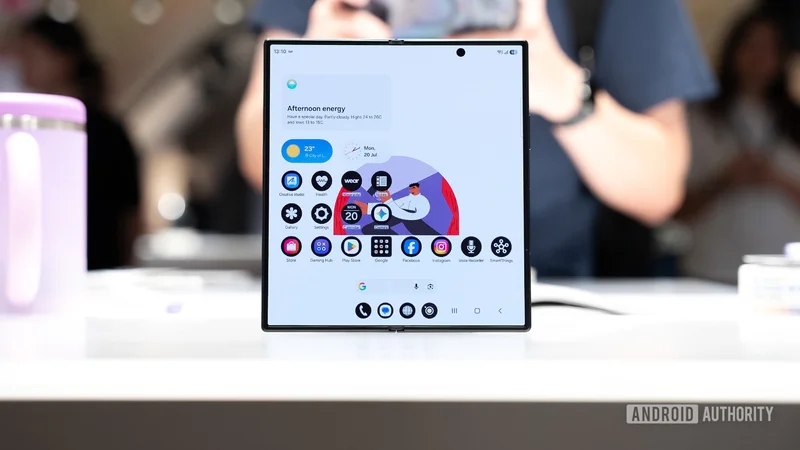
I hated using the Galaxy Z Fold 7 for one reason, and the Fold 8 Ultra quietly fixed it
Jul 27, 2026 — 5:00 AM ET
The Galaxy Z Fold 7 finally proved Samsung has the chops to make an ultra-thin foldable. I used both the Galaxy Z Fold 6 and the Galaxy Z Fold 7, and the 8.9mm thickness of the latter made it feel like using a traditional smartphone for the first time, even when folded. Compared to the Galaxy Z Fold 4, the Galaxy Z Fold 7’s slim profile is a clear leap in every way but one — the older models were easier to open.
Samsung’s new Galaxy Z Fold 8 Ultra is just as thin as the Fold 7, but it sports redesigned side rails with a subtle chamfer that makes them easier to open. The Galaxy Z Fold 7’s flat design worked when Samsung foldables were thicker. At their current sub-9mm thickness, a change was overdue.
After using the Galaxy Z Fold 7 for a year, I’m already convinced this subtle Galaxy Z Fold 8 Ultra tweak will be one of the foldable’s best upgrades.
Did you find the Samsung Galaxy Z Fold 7 hard to open?
The Galaxy Z Fold 7 is what happens when thin becomes too thin
There is such a thing as too thin. Back when I used the Galaxy Z Fold 6, the phone’s 12.1mm thickness felt like a non-starter. Samsung managed to shave three millimeters off the Galaxy Z Fold 7, bringing the thickness down to 8.9mm. Unfortunately, it didn’t change much about the design language. Both the Galaxy Z Fold 6 and Galaxy Z Fold 7 have mostly flat side rails and a rectangular shape.
The design made sense for the Galaxy Z Fold 6, as each side rail was about 5.6mm thick. There’s plenty of surface to grip on either side, making it easy to open and shut. With two hands, I barely have to apply any force to open the Galaxy Z Fold 6. I could even manage opening it with one hand in a pinch, although it’s admittedly an awkward maneuver.
More often than not, I try to wedge my fingernail in the opening to unfold it.
Opening the Galaxy Z Fold 7 is much trickier due to the foldable’s thinner profile. Each side rail is only about 4.2mm thick, giving you over a millimeter less of thickness to grip. It takes the right thumb placement and a considerable amount of grip for me to open the Galaxy Z Fold 7 comfortably, and that’s after a year of doing it. More often than not, I try to wedge my fingernail in the opening to unfold it.
It’s a bad habit, because only plastic covers the folding display. If my fingernail makes contact with the protective raised bezel around the inner screen, it’ll probably be fine. However, if my nail digs into the plastic display covering or screen — Samsung likes to call this “Ultra Thin Glass” — it could cause permanent damage. This wouldn’t be a concern if the Galaxy Z Fold 7 were easier to open, and it looks like Samsung considered that when designing the Galaxy Z Fold 8 Ultra.
The Galaxy Z Fold 8 Ultra solves the problem everyone missed
Comb the Galaxy Z Fold 8 Ultra spec sheet, and I wouldn’t blame you for thinking the foldable would be just as hard to open as the Galaxy Z Fold 7. The new model’s advertised thickness when unfolded is ever-so-slightly thinner at 4.1mm, so there’s a smidge less to work with. The opposite is true. Samsung reworked the side rails from the ground up to improve the opening experience, and the Galaxy Z Fold 8 Ultra shouldn’t be such a chore to unfold.
Specifically, Samsung says the Galaxy Z Fold 8 Ultra has an opening gap that’s 20% wider than the Galaxy Z Fold 7, and the hinge is optimized to make opening easier. It’s easy to spot in the photo below, which features the Galaxy Z Fold 8 Ultra on the left and the Galaxy Z Fold 7 on the right. There isn’t much of a gap between the folded display on the Galaxy Z Fold 7, whereas the Galaxy Z Fold 8 Ultra looks like it has just enough space to get a good grip.
There’s no need to worry about durability. The wider opening gap is the result of the aluminum chassis slightly shrinking and a more aggressive chamfer. The raised protective bezel still safeguards the folding display. This explains why the Galaxy Z Fold 8 Ultra’s unfolded thickness is 0.1mm thinner, but its folded thickness is the same as the Galaxy Z Fold 7. Samsung doesn’t count the bezel’s thickness in its official unfolded dimensions.
So, the aluminum side rails are a bit smaller, and the raised protective bezel is about the same size, making the Galaxy Z Fold 8 Ultra easier to open. The wider gap should give you enough room to pry open the Galaxy Z Fold 8 Ultra without using your fingernail. It solves a usability issue with the Galaxy Z Fold 7 and reduces the risk of your nail accidentally damaging the fragile folding display.
The Galaxy Z Fold 8 Ultra’s best upgrade isn’t on the spec sheet
The Galaxy Z Fold 7 didn’t have many flaws, but its difficulty to open was one of them. That said, it’s a drawback that you only realize when you live with the Galaxy Z Fold 7 over time. It’s also one that’s easy to miss. In my Galaxy Z Fold 8 Ultra wish list, I readily admitted that upgrades like battery and charging improvements were more important than design changes.
When you glance over the Galaxy Z Fold 8 Ultra’s spec sheets, you’ll see some of the things I asked for. The larger 5,000mAh silicon-carbon battery and upgraded 50MP ultrawide camera are both there. What you won’t find listed is the wider gap that makes the Galaxy Z Fold 8 Ultra easier to open, and it might be the biggest upgrade of them all.