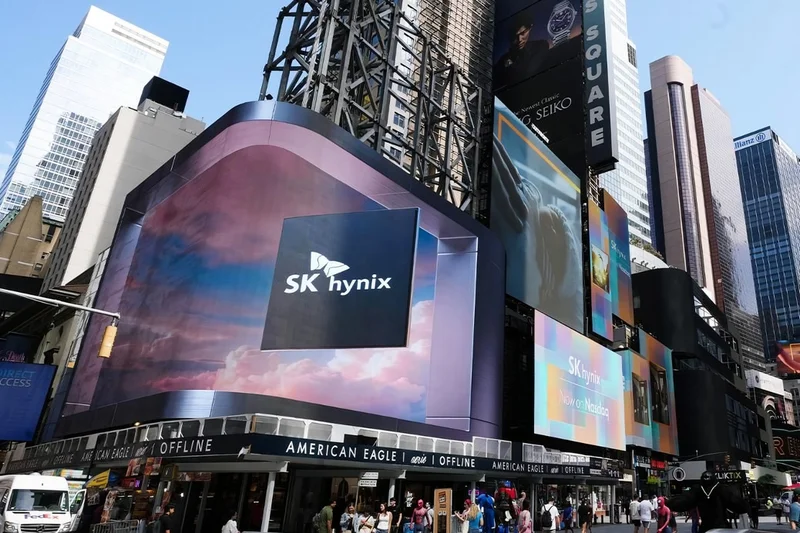
Korean investors are paying steep premiums for SK hynix's American depositary receipts (ADRs) in New York even though they can buy the chipmaker's shares more cheaply at home, analysts said Monday.
There is little economic rationale for Korean investors to buy the ADRs. Since the securities began trading on Nasdaq about two weeks ago, they have commanded a premium of 16 to 51 percent over SK hynix shares listed in Seoul.
The tax treatment is also less favorable. Capital gains on locally listed shares are largely tax-free for Korean retail investors, while profits from overseas stocks are subject to a 22 percent capital-gains tax after an annual deduction of 2.5 million won ($1,704).
For some individual investors, however, the attraction appears to lie less in valuation than in short-term trading patterns.
"When the underlying shares rise, the ADRs follow," one investor wrote in an online community. "They tend to fall less and rebound more strongly than the Seoul-listed shares, and they can be traded at night, when the domestic market is closed."
Korean investors bought a net $675.5 million of SK hynix ADRs, making them their second-biggest overseas purchase over the past month, according to SEIBro, a portal operated by the Korea Securities Depository.
The only security they bought more heavily was the Direxion Daily Semiconductor Bull 3X Shares, a leveraged exchange-traded fund designed to deliver three times the daily performance of the Philadelphia Semiconductor Index.
"The ADRs are soaring because of the premium attached to the U.S. market. The Korean shares might rise 5 percent at best, so stop dreaming and move to the U.S. market. Get the timing right, and you can make serious money," another investor wrote in an online community.
The widening performance gap has reinforced the perception that the ADRs offer greater short-term upside.
The receipts rose more than 10 percent above their $149 offer price on debut and even surged 27.3 percent to $193.92 on July 14, widening their premium over the Seoul-listed shares to as much as 51 percent. The Korean shares, meanwhile, have fallen from a June 25 record of 2,987,000 won to the 1,700,000-won range.
Since the ADR listing, volatility in the Korean shares has exceeded 100 percent, while volatility in the ADRs has topped 200 percent.
Analysts say SK hynix's ADRs and its Seoul-listed shares are essentially two versions of the same security, meaning their prices are likely to move in the same direction over the medium to long term, even if the ADRs continue to trade at a modest premium.
"I can at least understand the logic of a non-Korean investor buying the ADRs. What I cannot understand is a Korean investor buying the ADRs," said Owen A. Lamont, a senior vice president at Acadian Asset Management. "These nonsensical purchases are consistent with a pattern of baffling and self-destructive behavior, including obvious mistakes, by Korean retail investors."
Conversions between the ADRs and the Korean shares will be allowed from Wednesday. But with the volume eligible for conversion limited, analysts expect the impact on the premium to be modest.