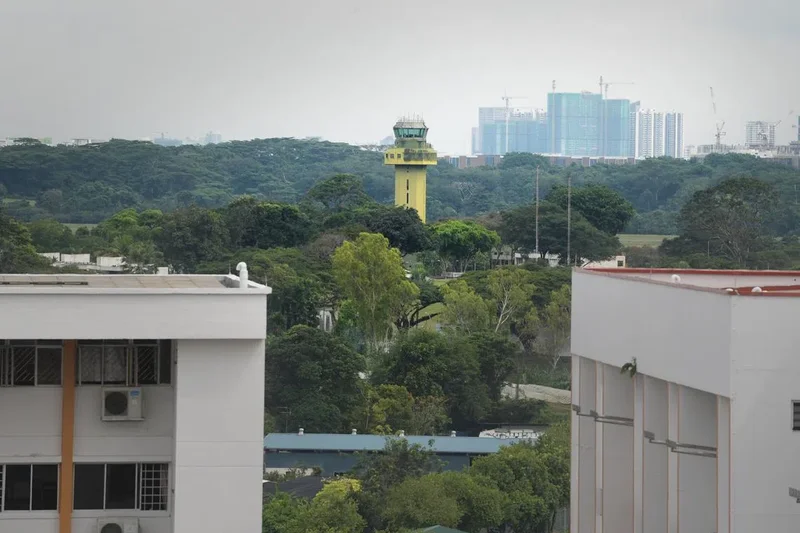
19-year-old arrested for plotting knife attacks on Sembawang Air Base soldiers, LGBTQ schoolmates
AI generated
SINGAPORE – He wanted to kill Singapore Armed Forces (SAF) personnel stationed outside Sembawang Air Base, LGBTQ students at the tertiary institution he attended and Muslim acquaintances who disagreed with his radical beliefs.
Those were among the violent plans harboured by 19-year-old Tan Jun Jie, the Internal Security Department (ISD) said in a statement on July 27.
Tan was one of three male teenagers detained under the Internal Security Act between April and June. The other two, aged 14 and 15, were not named because of their ages.
Although unrelated to one another, they had been self-radicalised online and planned to carry out attacks in Singapore.
Tan, who converted to Islam in early 2022 after learning about the religion on social media, was exposed to radical foreign preachers later that year.
By January 2025, he was consuming pro-ISIS material online and eventually concluded that "armed violence was permissible against kuffar (disbelievers)," ISD said.
Beyond non-Muslims, Tan also considered Shi’ite Muslims, Muslims whose religious views differed from his own, and those who served secular governments to be part of this group.
Before he devised physical plans for violence, Tan attempted cyber attacks in mid-2025, targeting the websites of several local and foreign Muslim organisations that he deemed to be deviant.
This included the Muhammadiyah Association (Singapore), Jaafari Muslim Association Singapore, and a foreign organisation associated with the Ahmadiyya sect.
Using malware that he downloaded online, he carried out distributed denial-of-service (DDoS) attacks on these websites, with the aim of flooding their servers with internet traffic to prevent users from accessing them.
ISD said Tan wanted to do so to “protect Muslims from what he believed to be misguided teachings”.
Although he recorded himself justifying his actions, he did not disseminate the oral declaration, as he was unsure if his attacks succeeded, given that the websites remained accessible.
The police are separately investigating Tan for potential offences under the Computer Misuse Act.
At the end of 2025, he devised plans to target both SAF personnel and LGBTQ students at the tertiary institution he attended, and was prepared to be killed in the process of carrying them out.
He regarded the SAF service members as “enemy combatants serving the ‘kuffar Government’ of Singapore”, and prioritised them as targets, believing that killing them would earn him greater divine rewards and increase his chances of dying a martyr.
He also targeted his LGBTQ peers because he viewed their behaviour as not conforming to the teachings of Islam.
To prepare for the attacks, he researched knife skills online and planned to buy a knife with a 10cm blade from a hardware store in a shopping mall.
ISD noted that Tan had no specific timeline for his domestic attacks. Instead, he intended to use them as a backup plan if he was unable to travel overseas to participate in armed jihad – a path he believed would guarantee his martyrdom if he died in battle.
He initially planned to enter Gaza, mulling the possibility of using humanitarian work as a guise to join Hamas and fight the Israel Defense Forces (IDF).
However, he scrapped those plans by January 2026, as it was not feasible to travel there, and set his sights on Somalia, where he believed the local ISIS affiliate was the only one actively fighting “disbelievers”.
He actively searched for flights from Singapore to the East African nation, as well as researched bomb-making techniques in preparation.
During that period, Tan had already viewed himself as an ISIS member, having taken the bai’ah, or pledge of allegiance.
In early 2026, violent thoughts would also extend to his Muslim acquaintances who disagreed with his ideologies.
“He had imagined, while preparing food at home, that his kitchen cleaver was a knife to slit his acquaintances’ throats, mimicking executions in ISIS’ propaganda videos,” said ISD.
His acquaintances reported him to the authorities.
15-year-old ISIS supporter who wanted to form a Malaya Caliphate
The 15-year-old student’s radicalisation began in the aftermath of Hamas’ October 7, 2023 attacks on Israel, when he was exposed to online content that showed the suffering of Palestinians.
During that period, he also joined several online groups to learn more about Islam, and found violent extremist content that “encouraged support for terrorist groups”, ISD said.
His consumption of extremist narratives led to him developing a hatred for Israelis, the IDF and Zionists, while supporting Hamas, Hezbollah and the Houthis, whom he viewed as fighting against Israeli oppression.
The teenager briefly considered travelling to Gaza to join Hamas in 2024, looking up potential travel routes.
As he lacked the resources to travel there, he ended up taking to social media to express his support for Hamas and his hatred for Israel.
One example the ISD cited was an online video he made, encouraging Muslims to take up armed violence in support of the Palestinian cause.
The online groups he was part of also inculcated in him an interest in Islamic caliphates and ISIS, with the teenager convinced that an Islamic caliphate was necessary to revive a golden era for Islam, while letting Muslims live in a society governed by sharia, or Islamic law.
As ISIS managed to establish a caliphate in Syria in 2014, he believed its use of violence was “the most effective way”.
By mid-2025, this belief had developed into a desire to establish a caliphate in South-east Asia through violent means. Termed the Malaya Caliphate, it would comprise Brunei, Indonesia and Malaysia, all of which are Muslim-majority countries.
He thought it would be easier to recruit like-minded individuals because the countries were near Singapore, with the Indonesian province of Aceh as a starting point, because it was already ruled by sharia.
While he researched ways to make homemade explosives online, he also recruited members for his caliphate through several chat groups set up on social media.
He shared pro-ISIS content in those groups, whose membership included his friends and family members, which he “indiscriminately added”, said ISD. Even though they were seemingly aware of his extremist views, none of them reported him to the authorities.
He designed a caliphate flag and tricked his mother into getting it printed via an e-commerce retailer by claiming it represented support for Palestine.
In late 2025, he publicly pledged allegiance to ISIS on social media and researched flights to Syria, as well as overseas shooting ranges, hoping to fight for the terror group abroad.
Although he did not have a specific timeline for this, he planned to use his time in National Service eventually to “equip himself with firearms training, physical fitness and the mental resilience to fight for ISIS”.
Believing that attacks on secular states that labelled ISIS a terrorist organisation were justified, the teenager planned to carry out an attack in Singapore through the use of pressure-cooker bombs.
He learnt about the improvised explosive devices after watching a video online about the 2013 Boston Marathon bombing, which killed three and left hundreds injured.
ISD said he was in the early stages of planning when he was arrested in March, and he had yet to devise a timeline, location or target for his attack.
He did, however, visualise that the attack would happen in an urban location, where there would be multiple civilian casualties.
Besides searching online about the cost of a pressure cooker and how to make a bomb with one, he also looked up how to buy potassium nitrate after he learnt it was used to make the rockets that Hamas deployed in its Oct 7, 2023 attacks.
14-year-old exposed to cocktail of extremist ideology
The youngest teenager detained was a Secondary 2 student self-radicalised by Composite Violent Extremism, or a mixture of extremist ideologies that may sometimes be conflicting.
His first taste of it was in 2024, when he was 12.
After playing first-person shooter games on Roblox, an online gaming platform, that recreated real-life school shootings, he went down a rabbit hole where he discovered how several mass shooters had been bullied, with their acts of violence carried out in retaliation.
He developed a sense of affinity with those killers, as he also claimed to be a bullying victim. Additionally, he consumed copious amounts of violent content, including mass shootings, as well as executions by Mexican drug cartels and ISIS.
ISD said he had downloaded thousands of such material on his personal devices.
That same year, the boy learnt of an ISIS supporter’s 2016 mass shooting on a gay nightclub in Florida, United States, via social media and began idolising him.
He related with the shooter’s experience being bullied, and came to believe it was justifiable to kill people who are gay, which he considered to be forbidden in Islam.
After consuming more ISIS content, he came to support the group’s killing of kuffar, whom he defined as non-Muslims.
Besides being willing to attack non-Muslims if ISIS instructed him to do so, he also planned to travel to Syria, but decided against it because of a lack of resources.
He shared ISIS-related videos with his friends, including several schoolmates, but they were not radicalised by him, noted ISD.
Beyond Islamic extremism, the teenager consumed neo-Nazi and anti-Semitic far-right propaganda.
This led to him supporting the Holocaust and supporting white supremacy, considering himself as being more “white” because he saw himself as having fairer skin.
The mixture of violent ideologies culminated in a plan to carry out an attack against non-Muslim teachers and schoolmates during the school holidays in June 2026.
He formulated this plan in late 2025, spurred by personal grievances over being bullied, as well as the academic pressure his teachers placed on him.
The school holidays were chosen because he thought there would be fewer teachers present to stop him, and he had singled out the specific days when he and his targets would be in school for co-curricular activities.
Initially, he planned to use a gun but changed his mind because of Singapore’s laws. While he wanted to make a homemade bomb, he realised he did not have enough money to buy the materials or a place to build and test them.
He eventually settled on a knife, identifying a kitchen knife and penknife at home as potential weapons.
He planned to livestream the attack and had searched for tactical apparel on an e-commerce platform.
ISD said: “The youth saw his attack as a form of jihad and intended to pledge allegiance to ISIS during his attack... and thereafter kill himself, to die a martyr.”
The teenager drafted a 21-page manifesto in January, months before the planned attack.
The manifesto, which would have been published on his social media accounts a day before the attack, outlined that he was targeting only Secondary 2 students as well as teachers.
However, someone in his school noticed signs of him being radicalised and alerted the authorities.