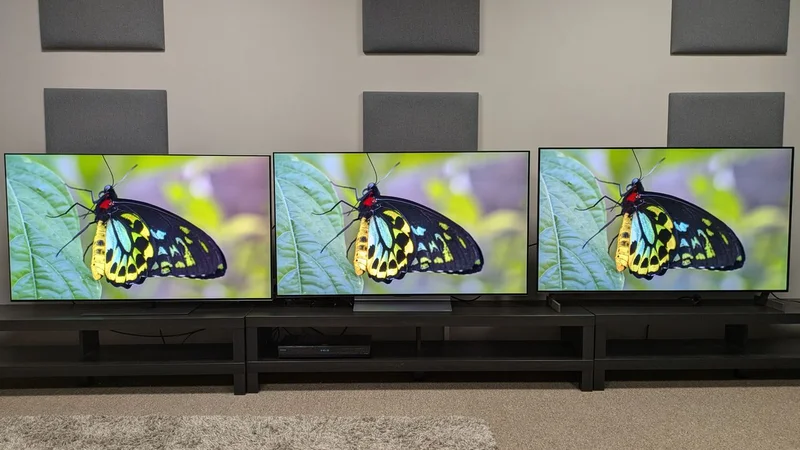
LG’s OLED TVs are often among the best TVs I test each year, and 2026 has been no different. Both the LG G6 and LG C6 earned full five-star ratings in my reviews, while the LG B6 also earned four-and-a-half, proving itself to be a fantastic affordable option.
On paper, all three of these TVs share a lot of the same features, especially for gaming, and they all scored highly for their picture quality, but how do they compare alongside one another in a real-world setting? I conducted this same test last year with the LG G5, C5 and B5 and in that instance, the LG C5 was my top pick, with the best balance of price and performance.
I’ve already compared the G6 and B6 this year, but now that I have access to all three TVs at the same time, I couldn’t wait to do a real world comparison between the three. The C6 has a new built-in processor (the same Alpha 11 AI Gen 3 the G6 uses), the B6 I tested hit new brightness heights and the G6 delivers even more impressive colors than its predecessor. All three still have big shoes to fill, so let’s see how they compare.
A quick note: I’m using the LG B6E here — a more affordable version of the LG B6 that I used for my review. While there is a price difference, LG has told me they are fundamentally the same TV; the B6E is missing some remaster features and has a plainer back panel, but still has important features such as Dolby Vision and the same gaming features.
Colors
The best OLED TVs often produce rich, vibrant colors that add real depth to a picture, and all three of these 2026 OLED TVs do the same across the board. Watching The Super Mario Galaxy Movie, the colors rendered on all three screens are stunning. The red and green of Mario and Luigi’s hats and overalls are both punchy and lifelike on each TV, and in this scenario, there’s not a lot to choose between them.
Any time the Lumas are on screen, there’s gorgeous visual pop with seriously bold colors on all three TVs, but this is where differences started to show. While there was a nice vibrancy on all three TVs, the G6 demonstrated the richest and brightest colors thanks to its higher peak brightness (more on that in the brightness section). I was surprised, however, at just how close to the G6’s colors were to those of the C6. The Lumas had the same color depth and luminosity (pun intended) on both.
Switching to another colorful movie in Speed Racer, all three TVs again accurately delivered super-saturated, vivid colors throughout the movie. The bright decor of the Racer home, with its orange and blue walls, really explodes on screen and again, the G6’s brightness gives its colors the most outright impact. Clothing, such as Speed’s blue shirt and Pops Racer’s red and orange shirts, are vibrant with plenty of visual punch.
Sign up for breaking news, reviews, opinion, top tech deals, and more.
One thing I did notice while watching Speed Racer is that on occasion, the G6’s color luminance could get ahead of itself. Colors would sometimes lose the richness I’d seen, bordering on too-bright. The C6 on the other hand, kept that nice depth. This was true particularly in the bright greens of grass and in the neon signage along the various racetracks. The B6E did a very good job demonstrating the same gaudy colors as its step-up siblings, but didn’t quite have the same wow-factor as the other two.
In terms of color accuracy, all three TVs did a good job, but I did notice that the G6 and B6E exhibited signs of a green tint that has been an issue for some LG OLEDs in the past. The C6 however, showed little to no sign of this green tint. The tint was particularly obvious in skin tones. Watching the opening scenes of Lawrence of Arabia, as a reporter interviews several outside Lawrence’s funeral, I could see people’s skin had a green/yellow complexion on the G6 and B6, which didn’t look right. The C6 showed a more natural skin tone. This was true in Speed Racer as well, shown most of all on several of the commentators.
Contrast and dark room viewing
All three TVs demonstrate impressive contrast, but the strength of the contrast depends on the scene. Watching The Batman in dark and ambient conditions, there’s a great balance between light and dark tones on all three screens. The scene where Bruce is in the Batcave early in the movie shows strong HDR highlights from the lamps, which contrast well with the dark surroundings. The G6’s higher brightness meant that light sources had more impact and created stronger perceived contrast than the other two models, but the C6 was a very close second.
All three TVs delivered deep blacks, and other dark tones looked authentic. In the subway scene, as Batman stands on the platform post-fight, I did notice that the green tint was prevalent on the G6 and B6E in darker room conditions. I found that dropping the G6’s contrast from 100 to 95 in the settings reduced the green tint significantly. On the B6, I couldn’t find a way to reduce it. On the C6, the picture looked accurate in its default settings, accurately portraying the gray color of the platform.
While all three TVs had great shadow detail as well as satisfying dark tones, I found on occasion that black crush could occur on the C6 and B6E. The G6 had better detail retention in dark areas such as creases in Gordon’s coat or the texture in Batman’s armor, showing better contrast balance and shadow detail overall. While there were some obvious differences between these three, it was clear all three demonstrated strong contrast overall, which is one of OLED’s main strengths.
Brightness and bright room viewing
Looking at these TVs together, the brightness differences are obvious. In terms of measurements, with all three TVs set to Filmmaker Mode, the G6 registered 3,004 nits peak HDR brightness — a staggering result for an OLED — while the C6 hit 1,427 nits, and the B6E clocked in at 808 nits. All of these numbers are increases over their predecessors (the G5 hit 2,268 nits, the C5 hit 1,180 nits, and the B5 hit 668 nits), resulting in more impactful pictures.
Fullscreen HDR brightness also jumped for all these TVs, with the G6 hitting 451 nits, the C6 hitting 248 nits, and the B6E hitting 148 nits. While the B6E’s boost over the B5 is minor, it’s a 50 nits jump for the C6 and a huge 120 nits boost for the G6. Fullscreen brightness is important for bright room viewing and for sports, as higher fullscreen brightness can be useful for displaying large areas of the same color on screen, say, a football field.
How did these numbers translate into real-world scenes though? Watching some footage of snow scenes from the Spears & Munsil UHD Benchmark 4K Blu-ray, the white of the snow has a lot more visual punch on the G6 than the other two TVs. But while the huge difference in brightness numbers may make this seem obvious, it’s not always been the case during my tests. It’s even clear on fullscreen brightness, as the opening shot of the demo footage shows the top of a snow-covered mountain, the G6 practically radiates brightness while showing the white sky, compared to the C6 and B6E.
Using brighter movie scenes, however, the perceived brightness becomes a lot closer. The white of the Mach 5 and Speed’s helmet in Speed Racer is still brightest on the G6, but the C6 still delivers plenty of vibrancy and brightness, and the perceived brightness gap isn’t as big.
The same is true when watching scenes from the desert in Lawrence of Arabia. The white sands surrounding the well dazzle on the G6, but the C6 still has plenty of impact, with bold HDR highlights. Even the B6E does a decent job rendering the brightness, although it lacks next to the G6 and C6.
With more colorful movies, such as The Super Mario Galaxy Movie, the brightness again is much closer. The Lumas I mentioned in the color section still have plenty of pop on all three screens, and despite the G6’s much higher brightness, these Lumas are only a bit brighter compared to the C6 and B6E. Fireworks also shine on all three screens, and while the color of the fireworks shines brightest on the G6, they’re close on the other two screens.
One thing that is undeniable, however, is which TV is best for bright room viewing. Most OLEDs struggle with bright conditions due to their glossy screens. While Samsung’s OLED Glare Free screen, most recently used on the Samsung S99H, is effective at eliminating reflections, none of these LG OLEDs use the same matte screen. This makes the G6’s anti-reflection so impressive, because not only does it do a great job reducing mirror-like reflections, but it maintains the crisp black levels OLED are known for. So impressive was the G6’s bright room performance, it became my choice of bright room OLED when I compared it to the Samsung S95/S99H.
This is one area where the C6 falls short. It has a very reflective screen, meaning trying to watch dark movies such as The Batman is impossible in Filmmaker Mode. The B6E seems to have some form of anti-reflection that does a better job reducing mirror-like reflections compared to the C6, but its lower brightness again affects bright room performance. For bright rooms, the G6 easily comes out on top.
Which to buy?
Which LG OLED is best for you will ultimately come down to how much you want to spend. Each TV delivers fantastic features, excellent picture quality and is superb for gaming. Even their processors operate at similar speeds. For my money though, the best value model and my top pick is the C6.
A 55-inch C6 (the size I tested) is available at the time of writing for $1,499 / £1,499 / AU$2,495, whereas a 55-inch G6 will cost you $2,199 / £2,099 / AU$3,995. The C6 not only carries the same processor, but shows a more accurate, out-of-the-box picture with no green tint, and it’s the model with the biggest improvements over its predecessor.
The B6E is a bit of a steal at $799 / £899 in the US and UK for the 55-inch, which is an excellent price for a brand new OLED. In Australia, the B6 is AU$2,495 for the 55-inch, the same as the C6. While the B6E is best for budget buyers, it doesn’t deliver the same performance as the C6, hence why the C6 is easily my top pick of LG three 2026 OLEDs.
Thinking of buying a new TV?
Try our TV size and model finder! You tell it how far you sit from your TV, we'll tell you what size to buy based on viewing angle advice from image quality experts, and we'll recommend our three top TVs at that size for different prices.
James is the TV Hardware Staff Writer at TechRadar. Before joining the team, he worked at a major UK based AV retailer selling TV and audio equipment, where he was either telling customers the difference between OLED and QLED or being wowed by watching a PS5 run on the LG 65G2. When not writing about the latest TV tech, James can be found gaming, reading, watching rugby or coming up with another idea for a novel.