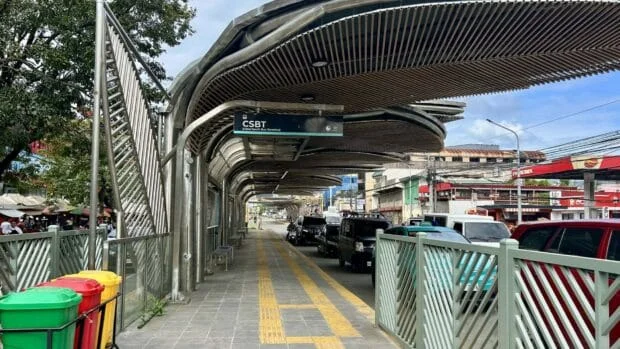
Sona: Marcos touts Arrow Act as Cebu BRT right-of-way woes persist
CEBU CITY, Philippines — President Ferdinand Marcos Jr. highlighted the government’s new law designed to accelerate right-of-way acquisition for major infrastructure projects during his fifth State of the Nation Address (Sona) on Monday, even as Cebu City officials identified unresolved land acquisition as the primary obstacle delaying the long-awaited Cebu Bus Rapid Transit (CBRT).
Marcos cited the CBRT among the administration’s ongoing transport projects that the first operational segment has already opened.
“Sa kabilang banda, ‘yung unang bahagi ng Cebu Bus Rapid Transit ay bukas na. At ‘yung nasa Ilocos Norte naman ay ating ipasisinaya sa susunod na taon,” he said.
(On the other hand, the first segment of the Cebu Bus Rapid Transit is now open. Meanwhile, the one in Ilocos Norte will be inaugurated next year.)
The President pointed to Republic Act No. 12289, or the Accelerated and Reformed Right-of-Way (ARROW) Act, as the government’s answer to one of the biggest causes of delays in flagship infrastructure projects.
Signed on Sept. 12, 2025, the ARROW Act amended Republic Act No. 10752 to streamline and speed up the acquisition of private properties needed for government infrastructure.
Marcos said the measure directly addresses what he described as one of the country’s biggest infrastructure bottlenecks—right-of-way acquisition.
Cebu: Right-of-way biggest hurdle
Just hours before the President’s SONA, Mayor Nestor Archival acknowledged that right-of-way acquisition dominated discussions during a meeting with the Regional Project Monitoring Team of the Regional Development Council in Central Visayas.
Archival said the national government has already allocated budget for the right-of-way acquisition, particularly along F. Vestil, one of the critical corridors needed for the CBRT.
According to the mayor, the national government has already downloaded half of the funds to Cebu City, allowing the city to compensate affected landowners.
However, the payment process slowed after the city discovered that several transaction documents still carried the name of the previous city administration.
“Medyo nahinay ni because during that time nga karong atong nang time nga makabayad na unta ta, ang mga dokumento are still in the name sa previous mayor,” Archival said. (The process slowed because when we were already supposed to start paying, several documents still carried the name of the previous mayor.)
He said city officials now continue updating the documents under the current administration before releasing payments to property owners.
Beyond documentation issues, Archival said some landowners have refused to sell their properties.
“Sa 55 kabuok owners, dili tanan musugot nga ilang ibaligya. So usa ni sa makadugay because atong man ing himoan og expropriation proceedings,” he said. (Out of the 55 property owners, not everyone has agreed to sell. That causes delays because we have to initiate expropriation proceedings.)
The city also continues processing documentation for additional properties in Talamban.
Archival urged both the Department of Transportation (DOTr) and the city’s technical teams to expedite the process.
He warned that failure to utilize at least 70 percent of the initial fund release could prevent the national government from releasing the remaining balance.
“Kung dili nato mabayran ang mga tag-iya sa 70 percent sa gi-download nga pondo, dili nila i-download ang nahibiling bahin,” he said. (If we fail to pay property owners using at least 70 percent of the downloaded funds, the government will not release the remaining amount.)
Asked what the city would do if negotiations ultimately fail, Archival gave a one-word answer: “Expropriation.”
DOTr cites same issue
The mayor’s remarks reinforce the explanation that the DOTr presented before the Cebu City Council last week when councilors debated the proposed South Road Properties (SRP) realignment of the CBRT.
DOTr Project Implementation Unit engineer Norvin Imbong said persistent right-of-way problems forced the agency to prioritize infrastructure in the SRP instead of immediately proceeding with the Bulacao corridor.
He explained that construction could move faster in the SRP because government-owned land eliminated the need for lengthy property acquisition.
“The reason why we have to go to SRP is that there is no right-of-way issue there,” Imbong told councilors.
He disclosed that the national government had already transferred P460 million to Cebu City for right-of-way acquisition in the F. Vestil area, but many affected properties remain unsettled.
“There are only 52 lots, and until now not even half have been settled or paid. How can we proceed with construction if the right-of-way has not been cleared?” he said.
Imbong also cited another constraint—the expiration of the project’s foreign loan in September 2026—which prompted the government to prioritize portions of the project that remain feasible within the funding period.
Council rejects SRP realignment
Despite the DOTr’s explanation, the Cebu City Council formally rejected the proposed SRP realignment of the CBRT.
The council adopted Vice Mayor Tomas Osmeña’s position that the city should prioritize the project’s original Bulacao-to-Talamban corridor instead of shifting initial construction toward the SRP.
DOTr officials maintained that the SRP component would not replace the original alignment.
Instead, they said the 2023 NEDA-approved configuration expanded the network from the original 22.96-kilometer corridor into a 35-kilometer system extending to Talisay City.
Imbong repeatedly assured councilors that the original alignment remains part of the project.
“The original alignment is there. It’s just a matter of implementation,” he said.
The agency also said the council’s rejection would only remove the proposed SRP component and would not halt the overall CBRT project, which already carries approval from the National Economic and Development Authority.
Following the expiration of the foreign loan later this year, the DOTr plans to pursue the remaining CBRT components through a public-private partnership.
READ: Marcos revives push for nuclear energy program – News
Disclaimer: The comments uploaded on this site do not necessarily represent or reflect the views of management and owner of Cebudailynews. We reserve the right to exclude comments that we deem to be inconsistent with our editorial standards.