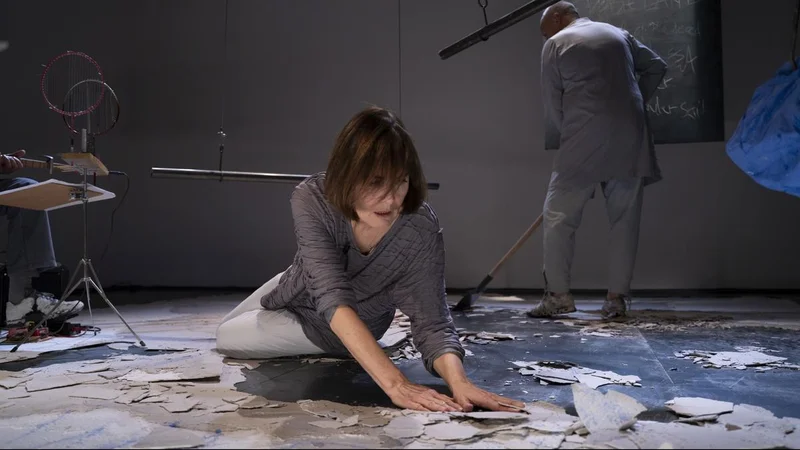
What happens when an architect‑turned‑director takes up T. S. Eliot’s The Waste Land? Eliot’s fractured poem is transformed on stage into a living canvas. That is exactly what Axel Tangerding, founder of META Theatre Munich, does. Known for bringing his architectural sensibilities to the theatre, he treats the stage not as backdrop but as environment: a stark white square, covered with plaster, “prepared anew for each performance,” then broken layer by layer to reveal what lies beneath. “It’s like looking beneath the surface,” he explains over a call from Germany. “In a time of fake news and fragmented realities, theatre must ask what is reliable, what comes down.”
The Waste Land, presented by Jagriti Theatre in collaboration with META Theatre, will be staged in Bengaluru from July 30 to August 2 at 7.30 p.m. Featuring actor Nicole Kleine, with live music composed and performed by Ardhi Engl, the production transforms Eliot’s verses into an immersive theatrical experience.
“Eliot’s text itself jumps across cultures — quoting Shakespeare, Wagner, and also the Upanishads in its closing lines with Shantih Shantih Shantih — weaving fragments across centuries, from antiquity to modernity”Axel Tangerding
Written in 1922, Eliot’s poem still haunts us. A century later, its verses continue to echo devastation, uncertainty, and disillusionment. To adapt this text, Axel began by using fragments of the poem for a libretto in musical theatre. In 2022, marking its centenary, he staged the full text as a reading with META Theatre and was astonished by the public response. “The reading was repeated, then expanded with music, later with song, until a structure slowly emerged. It was a gradual process,” he recalls. “I did not think of turning it into a play. But the audience was so enthusiastic we decided to do so. With this poem, Eliot broke with all traditions. It has no rhyme or fixed syllables. That’s why it’s called the first poem of modern literature. For my generation, it was a milestone. We too were revolting against old theatre traditions, opening the stage as a laboratory.”
Meta Theatre, says Axel, is influenced by La MaMa Theatre in New York and by Jerzy Grotowski in Poland. Both were pioneers of what we now call avant‑garde theatre, concentrating on the core of performance. “I felt The Waste Land works in a similar way,” he explains, “and I compare it with Jim Jarmusch’s Only Lovers Left Alive (2013), which zooms into situations and then leaps to the next. The impact is emotional rather than logical — not a linear continuation, but coherence that lies between the lines.”
“Eliot’s text itself jumps across cultures — quoting Shakespeare, Wagner, and also the Upanishads in its closing lines with Shantih Shantih Shantih — weaving fragments across centuries, from antiquity to modernity,” says Axel, who observes that it is the youth who feel at home with this disrupted narrative: “They live with overwhelming, often confusing information, and must form their own view of the world. Across centuries — from two thousand years ago to today — the poem’s fractured presence resonates.”
Fragments that connect
He sees their mood caught between depression and the hope of a better future. “That tension is in Eliot’s text as well — between despair after the First World War and the longing for renewal,” says Axel, who is an admirer of Peter Brook. For him, Brook’s radical experiments in theatre opened new ways of thinking about performance, and Eliot’s poem, with its broken voices and cultural leaps, continues that tradition of disruption.
The play in English will be staged at Jagriti Theatre in Whitefield, Bengaluru on from July 31 to August 2, 7.30 p.m. Tickets on BookMyShow.
Published - July 27, 2026 05:37 pm IST