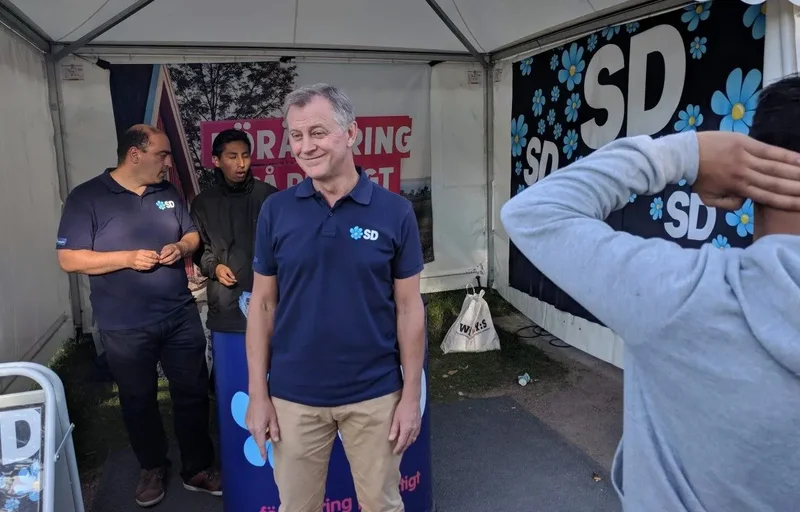
**The 2014 election: **
My abiding memory of the 2014 election was arriving at a press event in Malmö to find Sweden Democrat leader Jimmie Åkesson hemmed in by one of the biggest press packs I have ever seen, at least for a politician. It made sense to me when he took sick leave for burnout after the election.
The upstart far-right party was already the big story back in 2014 – especially for international journalists. But neither the party nor its main issue, immigration, played much of a role in the actual campaign. It functioned instead as a bogeyman that other parties contrasted their more humane positions against.
This was the last great hurrah for cordon sanitaire, the tacit agreement between the main parties of left and right to freeze the Sweden Democrats out of national politics, refusing any cooperation or dialogue with them and more or less refusing to debate their main issue, immigration.
Instead, it was about welfare issues. In the last four years, there had been a string of scandals at privately-run, state-funded care homes and kindergartens, the bankruptcy of one of Sweden’s largest free school chains, and the plummeting performance of Sweden’s students as ranked by the OECD’s Pisa study.
The Social Democrats won, but they had a lacklustre campaign. The party's then leader, the burly former union boss Stefan Löfven, barely increased the party's share of the vote from the 2010 election – and that had been its worst result since working men got the vote in 1909.
Looking back, it strikes me that the 2014 election introduced both of the two big underlying themes of the elections I've covered: the rise and gradual breakthrough of the Sweden Democrats, and the Social Democrats' enduring inability to find a leader or a set of policies capable of catching the public's imagination.
2018: 'Stir it up'
My preconceptions of the Sweden Democrats were shattered when I visited Hörby, an agricultural town in Skåne where the Sweden Democrats were hoping to take control of their first municipal council, and when I saw just how much interest the far-right party generated among voters with an immigrant background at an election event held in Rosengård (where around 90 percent of residents are first and second generation immigrants).
Rather than a working class local, the local leader in Hörby was Stefan Borg, a former fighter pilot who had spent an (I think suspiciously) long time in Russia and derived much of his income from translating Russian nationalist Christian philosophy. The deputy leader, Cecilia Bladh in Zito – who became mayor – had been a senior international energy executive.
In this campaign, the taboo on discussing restricing immigration had long gone.
For this, the Sweden Democrats could thank the 2015 refugee crisis, stories of migrant youth sexually abusing Swedish girls, a riot in the Stockholm suburb of Rinkeby, and a surge in fatal shootings.
But while the Sweden Democrats' issues topped the agenda, the other right-wing parties still refused to cooperate with them.
This disconnect sent the Sweden Democrats soaring, with some polls showing it was on course not only to overtake the Moderate Party, but even the Social Democrats. In the end, this didn't happen: it caught up with but ultimately failed to overtake the Moderates, remaining in third place.
The Social Democrats, meanwhile, did even worse than in 2010 and 2014, receiving their lowest share of the vote in over 100 years. But they managed to stay on in government by striking an agreement with the Centre and Liberal Parties
When I interviewed voters on the streets of Malmö afterwards, several told me that the result meant that the other parties could no longer continue to freeze the Sweden Democrats out.
2022: 'Paradigm shift'
My most vivid memory of the 2022 election comes from the Moderate Party's election vigil at a hotel in central Stockholm: the joke calls for "liquor" when the exit polls indicated a left-wing victory, and then the growing exultation as the numbers turned in their favour.
I interviewed Gunnar Strömmer, the party secretary who went on to become Justice Minister, and joined a huddle of journalists hovering around Maria Malmer Stenergard, who Swedish journalists whispered to me was destined for great things (she became Migration Minister and then Foreign Minister).
The Christian Democrats and Moderates had by now dropped their refusal to cooperate with the Sweden Democrats.
Magdalena Andersson, who had taken over as Prime Minister and Social Democrat party leader in 2021, ran a presidential-style campaign with few concrete policies, hoping to capitalise on the high level of public confidence in her following Russia's invasion of Ukraine.
The lack of policies probably didn't help, but she also suffered from extremely bad luck. In the wake of Russia's invasion, the price of electricity, petrol and diesel surged and at the same time the rebound from the Covid-19 pandemic led to soaring inflation.
The opposition ruthlessly exploited this, coining the phrase magdapriser (Magda prices), promising voters generous energy subsidies and cuts to the price of fuel, and blaming high power prices on the closure of nuclear power plants.
It probably won them the election.
**Lessons for 2026? **
I can now see how the Sweden Democrats took a big step forward in each of the three elections I've covered:
- In 2014, both the party itself and immigration were out bounds
- In 2018, the party remained a pariah, but the taboo on debating immigration had gone.
- In 2022, it was largely treated like a normal party, aside from a bar on ministerial positions
- In 2026, even the bar on Sweden Democrat ministers has gone.
As for the Social Democrats, the process of policy renewal they launched after losing power in 2022 has yielded little – apart perhaps from justifying a shift to the right on immigration in another sign of Sweden Democrat success. The party once again looks as if it's planning to campaign on the personality and (slightly waning) popularity of its leader.
So there are two biggest questions in 2026: whether voters want to have the Sweden Democrats as an ordinary party of government, and whether the Swedish Social Democrats – influenced by the success of their Danish sister party – can find a way to stop them.