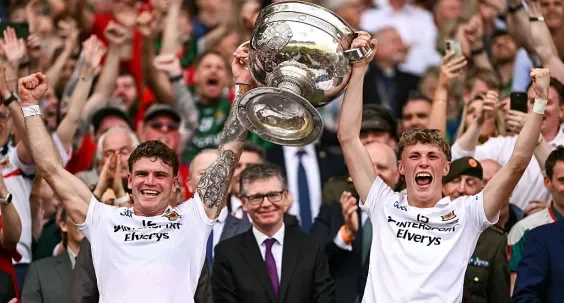
DUBLIN — Misery loves company, but ecstasy attracts it. And so it was that Irish football fans by the tens of thousands shed happy tears together inside Croke Park on Sunday during the All-Ireland Final, as historically downtrodden Mayo vanquished both mighty Kerry, 1-20 to 1-17, and oh-so-many demons. It’s impossible to make up for 75 years of pain and suffering caused by all the brutal championship-game losses in one afternoon, but the outpouring of joy among Mayo players and the green-and-red clad faithful that packed one of the biggest (capacity: 84,000) and holiest sporting grounds in the world was as close to an equal and opposite reaction as anybody could have conjured. I’d never experienced anything in sports nearly as emotional before. And, yeah, I was crying like a baby and smiling as wide as could be, as was everybody around me.
I’d fallen hard for all things Mayo, but mostly the football team, during a work trip there in 2023. I learned lots about the supposed "curse" that was placed on the county after the 1951 All-Ireland championship. The legend holds that while on their way home from their second Sam Maguire Cup in a row, Mayo players who were either riding on the back of a lorrie or in a bus (depending on the teller of the tale), were so caught up in their victory celebration that they paid no mind to a funeral taking place in the town of Foxford. A peeved local priest then decreed that Mayo would not get another Sam Maguire Cup until every member of the championship panel had died.
And Mayo, by coincidence or bad luck or divine intervention, started losing big games, and kept on losing them. Since the 1951 placement of the mythical or ecclesiastical hex, the team played in 13 All-Ireland Final games, including two replays, and went 0-fer.
The last living player from the 1951 panel, Dr. Mick Loftus, died in April 2023 at 93 years old. So this was the first final appearance for Mayo since his death.
The Irish are into mysticism, and nowhere moreso than in Mayo, and there were signs from above that this match could be different from every other match. Lots of folks looking for omens from above heading into the Kerry contest harped on how a GAA scheduling change meant that, for the first time ever, this year’s final would take place on Reek Sunday, the holiest day in Mayo. That’s when Catholic pilgrims flock to Croagh Patrick, a mountain in the county not far from the Atlantic Coast atop which, according to another tall tale that everybody in Mayo knows, St. Patrick of binge-drinking-incitement fame spent 40 days and 40 nights fasting and praying. (The god-fearingest football fans summited the mountain before sunrise so they could make it to Dublin by kickoff.) Another GAA ruling held that Mayo could not wear its traditional red and white jerseys because of a clash with Kerry’s colors. So they wore white; the last time a Mayo team played an All-Ireland Final game in a white kit? 1951.
To anybody ignoring the spooky stuff, Mayo surely looked ripe for a beating. On paper, this was David vs. Goliath stuff, with even the game’s greatest David (Clifford, the Kerry corner forward acclaimed as the Gaelic GOAT) on the big guy’s side. Kerry, historically the winningest football county in Ireland by a wide margin, was going for its 40th title. I’d been speaking all week to football know-it-alls and fans about the upcoming match, and nobody gave Mayo more than a puncher’s chance. Mayo’s first-year manager, Andy Moran, had been trying to use his team’s underdog status as a rallying point ever since qualifying for the final.
"I can’t see it," Pat Spillane, a Kerry football legend, TV talking head, and overall national treasure, told me at Croke Park before kickoff, when I asked if Mayo might win. BBC’s crack football radio play-by-play man, Thomas Niblock, said that a Mayo win was so unlikely that it would rank among the top Irish sports stories of the last 75 years, "up with beating Italy in the 1994 World Cup."
Yet whatever the head said, the heart had other ideas. Everybody not wearing Kerry’s green and gold was pulling for an upset for the ages. Nobody remembered ever seeing such one-sided rooting at Croker—I figured Mayo fans outnumbered Kerry by 80-20—or everybody staying through the presentation of the Sam Maguire Cup. There is no public sale of tickets for All-Ireland finals, the biggest day on the Irish sports calendar. They are instead distributed by GAA to every parish and club team in the country.
Jarlath Burns, the GAA president, told me ticket distribution wasn’t any different this year. I asked him about the amazingly pro-Mayo crowd and he admitted he’d never experienced anything like it, but said his group did what it always does in trying to ensure the All-Ireland finals crowd is representative of all of Ireland.
"Every neutral was for Mayo," said Burns.
Yet, at several points in Sunday’s match it appeared the skein was safe. Kerry, and especially David Clifford, came out of the gate on fire. After just 16 minutes, powered by a goal and several points from play from its all-timer, Kerry was up by seven and the rout seemed on. But Mayo played as if they hadn’t read their clippings of the last 75 years. Midfielder Jack Carney hit a two-pointer to stem the tide, and Mayo began relying on a frontline for the ages that flaunted both the teenage exuberance of Kobe McDonald and Darragh Beirne, and the veteran leadership of ascending superstar Ryan O’Donoghue. By halftime, they’d cut the deficit to a single point.
The Mayo train kept a-rollin’ after the break. Kobe hit a 45 straight and true at the 37-minute mark to give Mayo the lead. Two minutes later, O’Donoghue turned over Kerry and sprinted from midfield to set up a play that ended with Beirne powerblasting the ball into the net for a goal. Then Carney hit another clutch two-pointer. And O’Donoghue turned over Kerry once more to feed Kobe, who kicked the ball off Kerry goalie Shane Murphy’s face and over the bar for a point. At one point during the blitz, Kobe turned toward the stands and screamed while hitting the fans with an upward thrusting arms move, the international symbol for "Let’s Fuckin’ Go!" The crowd went ballistic; a stadium-wide "Mayo! Mayo! Mayo!" chant broke out. With seven minutes left, the underdogs were up five and everything looked in order. Right around this time, amid the mass delirium, I heard somebody sitting behind me in the upper deck shrieking, "Dream!" That was new to me as a sporting event cheer, but in context I totally got it.
But then Mayo’s Jordan Flynn, set up beautifully by O’Donoghue in front of the net unguarded for a tap-in that he’d convert into a game-clinching goal nine times out of 10, instead swatted the ball off the crossbar. This gave Kerry possession, and every Mayo fan’s uh-oh detector began buzzing.
"I saw that and I’m saying, ‘Oh, no. Not again! Not again!’" said Tom Fox, a GAA coach in Manchester who took a ferry over to root on Mayo, the county where his parents were born and reared.
Knickers twisted tighter when Clifford banged a two-pointer over the bar to cut the lead to three with five minutes left. For Mayo fans the clock all but stopped ticking. Then after a Mayo turnover and another Kerry point, it was a one-possession game. The Kingdom got the ball back with about one minute left.
But, for the first time in 75 years, ever since a lorrie or bus full of drunk Mayo men might or might not have torn through Foxford and peeved a priest, Mayo didn’t fold.
Instead, Kerry acted bizarrely. Clifford might spend the rest of his career, glorious as it’s been, answering questions about why he didn’t take the money shot that the whole stadium expected him to. Instead, with Sam hanging in the balance, Seanie O’ Shea, a Kerry mainstay who has come up large in clutch moments, attempted a game-tying two-point boot, and came up short. And no wiseacre from heaven or hell intervened. Mayo goalie Jack Livingstone punched the wayward shot out of harm’s way, and within seconds the ball was in the hands of his team's young frontliners. With the fans realizing that their impossible dream was not only possible but imminent, Kobe and Beirne streaked toward the goal and fed Tommy Conroy, who punched the ball over the bar for maybe the most thrilling superfluous score in Gaelic history. The decibel level in the closing moments was such that if Croker had a roof, it would no longer have had a roof. The journey from cursed to first was complete. Mayo for Sam was manifest. The strongest possible antonym of "agony" would apply to the mood that consumed the stadium.
Mayo captain Jack Coyne kept the chills coming while addressing the Croker crowd after accepting the Sam Maguire Cup from GAA boss Burns. Coyne, his voice hoarse and cracking with emotion, acknowledged the generations of players and common Mayo folk that lived and died having never felt what he was feeling. Coyne counseled everybody who shared his roots that their days of sporting shame were heretofore finished.
"To every young boy and girl across Mayo and to our diaspora across the world: Never stop dreaming!" Coyne bellowed from a perch in the stadium’s Hogan Stand, with Taoiseach Micheál Martin and the country’s new president Catherine Connolly standing a few feet behind him. "Stick your chest out and be proud to be from Mayo! One last thing: The wait is over. Sam is home! Mayo Abu!"
The players then went back down on the field and took Sam with them for a lap around the very same pitch where the original Bloody Sunday massacre took place. As the song "Beautiful Day" from an occasionally precious local band blasted over the stadium public address system, they took turns hoisting the old but new-to-them bauble skyward. Trust me here: It was another brilliant moment on an afternoon full of ‘em. I teared up again.
Paddy Andrews, a winner of seven All-Irelands as a member of the dynastic Dublin teams of the last 15 years, was among those who forecast that Mayo couldn’t win when I spoke with him on Friday. Andrews was more than OK with how things turned out.
"I was happily wrong," he said. "This was amazing. Maybe it takes 75 years of hurting. It’s one of the best scenes in Irish sports, and it’s a fitting fairy tale ending. If you love sports, then you love what you saw today."
During his post-game press conference, Moran did not mention the lifting of any curse. However, the Mayo manager, who played on six All-Ireland losing teams before taking a job on the sidelines, did bring up that over the last year he’s taken to wearing a Chicago Cubs cap. As Moran and most baseball fans know, after winning back-to-back championships in 1907 and 1908, the Cubs went a century and change without a World Series title. And the Cubs drought, which ended in 2016, was often blamed on a curse. Moran insisted the cap only served to remind him of great fan bases that have stuck by their teams despite the longest of losing streaks.
Irish sports are conceptually foreign to fans from anywhere but the island. The GAA requires that all athletes remain amateur and that they only play for their home county. That means every player for every Gaelic team grew up as a fan of the team they end up playing for. Mattie Ruane, a super sub forward, told me about being a lad in Mayo idolizing the players who’d visited his school, and got as emotional as anybody I’d seen tear up in the grandstands after the win.
"All I wanted was to be lucky enough to play for my county someday," he said.
Among his idols, Ruane said, was Aiden O’Shea, an 18-year veteran and longtime team leader who had lost all six All-Ireland Finals he’d played in coming into Sunday’s match. O’Shea accepted a reserve role this season to go for another shot at Sam, and also teared up while telling me that winning on his seventh try was every bit as "surreal" as living through such a big portion of the county’s bizarre and nearly interminable losing streak.
"Is there any sporting odyssey left?" he said.
Nobody with Mayo was in any hurry to leave Croke Park. I was walking in the bowels of the stadium more than two hours after the match, and saw that players had not yet loaded onto their bus to go back to the hotel to prepare for the traditional winners banquet. Through the cement walls of the locker room, I heard them singing "The Green and Red of Mayo." That’s a tune about emigration and homesickness that’s become the "Country Roads" of the west of Ireland and a stadium singalong for the Mayo fan base. It’s corny as hell. Yeah, I cried.
"The curse is dead. Seventy-five years," Fox told me a day after the game. "Everybody around me in the stadium was saying, ‘What do we do now?’ We don’t know how to act! We don’t know winning!"
In any case, this time around, there will be no funerals disrupted during the ride home. The Mayo team took a train back to Castlebar on Monday afternoon.