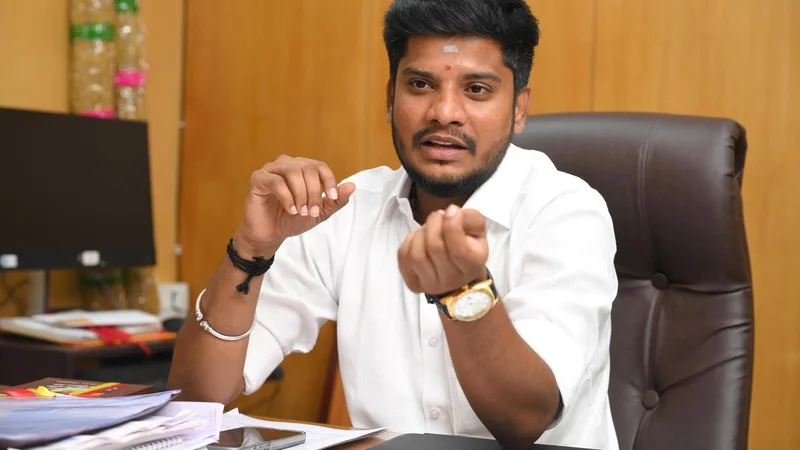
Strongly defending the Tamil Nadu government’s recent decision to lift the ban on registration of inam lands in the name of individuals, Hindu Religious and Charitable Endowments Minister S. Ramesh on Monday (July 27, 2026) said even the BJP and the AIADMK, which were opposing it now, had promised to do so in their respective election manifestos.
In an interview with The Hindu in Chennai, he said the title of these lands were never in the names of the temples.
Mr. Ramesh said the government had lifted transaction restrictions only on 471 specific survey numbers in Karur. “The legal position is clear. Individual titles were granted under the Inam Abolition Act, the names of the individuals appear in the UDR records, and the same names are reflected in the computerised chitta. At no stage were these lands recorded in the temple’s name in any of these three primary revenue records. Furthermore, no temple has filed a civil suit claiming ownership of these 471 survey numbers,” he said.
According to him, individual titles had been granted by the government 60 to 70 years ago under the prevailing legal framework. Over the decades, families had lived on the land, developed residential properties and transferred portions to others.
“These pattas enabled individuals to execute property transactions, obtain bank loans and buy or sell land without hindrance. Moreover, the government itself acquired portions of these lands for public infrastructure projects over the years and paid compensation to the titleholders. Had they not possessed legal title, the government could not have lawfully paid such compensation,” he explained.
On the issue of the fraudulent registration of land belonging to the Dhandayuthapaniswamy Mutt in Palani in the name of two individuals, the Minister said the case had served as an eye-opener. The pilot project launched to verify all properties belonging to the Palani temple would be extended to all major temples across the State.
The Minister had earlier announced that the special committee to verify temple lands would comprise officials from the HR&CE and Revenue Departments.
“This team has been constituted as a pilot initiative to undertake a comprehensive survey. Based on its findings, we plan to constitute similar dedicated teams in the first phase for all major temples with large landholdings,” he told The Hindu.
The Minister said attempts to sell the land in Palani had begun even before the TVK government came to power. He said the Joint Commissioner of the HR&CE Department had repeatedly written to the authorities stating that the land was under dispute, requesting that it should not be registered, and directing the Sub-Registrar not to process any registration.
“However, during that period, an official from another Sub-Registrar’s office was posted as temporary in-charge while the regular officer was on leave. That official proceeded to register the property in a single day,” he said.
Reiterating that his department had acted promptly, Mr. Ramesh said it had filed an appeal before the registration, issued formal warning letters, and taken all necessary legal steps. “As soon as we learnt that the registration had taken place—which came to wider public attention following the Chief Minister’s visit to Karur—we immediately lodged a police complaint,” he said.
“We requested that FIRs be registered on behalf of the HR&CE Department. I personally brought the matter to the Chief Minister’s attention and sought the transfer of the case to the CB-CID to ensure an impartial investigation. The Chief Minister immediately ordered the transfer,” he added.
On the issue of rent collection from temple properties, the Minister said the department faced two major challenges.
“The first is that some existing tenants simply default on rent payments. We have initiated proceedings under Section 78 by issuing statutory notices directing them to clear their arrears, failing which they will face eviction and the properties will be repossessed,” he said.
The second challenge, he said, involved properties that had been occupied by successive generations of the same family.
“Since no fresh lease agreement has been executed in the names of the current occupants, some contend that they are under no obligation to pay the accumulated arrears,” he said.
Mr. Ramesh said the department was determined to improve rent recovery and had fixed monthly collection targets for HR&CE zonal officials.
“Where lessees remain non-compliant or refuse to cooperate, we initiate legal proceedings under Section 78,” he added.
Published - July 27, 2026 09:30 pm IST