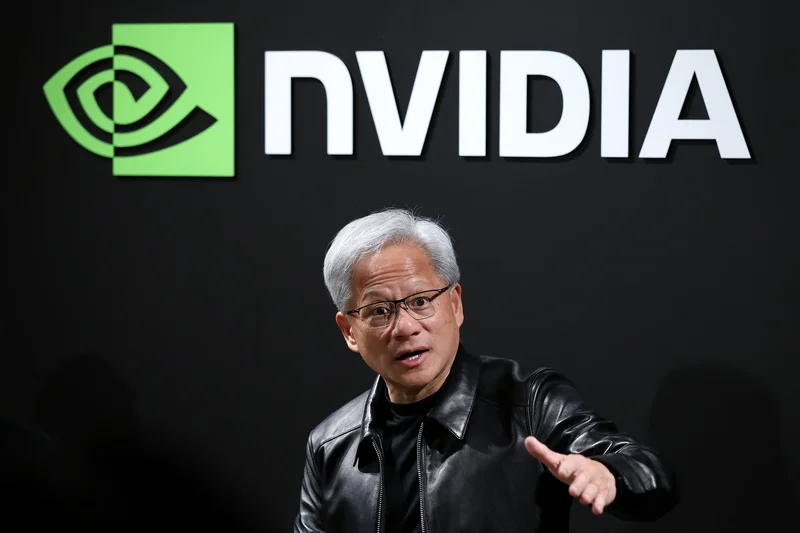
Nvidia may lend financial support to OpenAI to help the ChatGPT creator secure access to an enormous data center project being built in Ohio. The chipmaker's potential assistance shows exactly why our stock-picking approach has broadened out at this stage of the AI boom. Late Sunday, the Wall Street Journal reported that Nvidia is in discussions to offer a roughly $250 billion backstop for OpenAI as the Sam Altman-led startup looks to lease a proposed 10-gigawatt data center in southern Ohio. The massive compute facility is being developed by SB Energy , a subsidiary of Japanese conglomerate SoftBank. According to the Journal, Nvidia lending its backing to OpenAI would enable the developer to raise debt at more favorable terms because Nvidia's financial position is much better than that of unprofitable OpenAI. Nvidia shares fell more than 4% Monday, along with weakness across many semiconductor stocks and other artificial intelligence infrastructure winners. While additional forces could be impacting the group Monday, including AI advancements in China , the WSJ story is capturing a lot of attention. Why the cause for concern? Simply put, this is yet another example of circular deals within the AI buildout, as Nvidia has invested in a number of companies that buy its chips. That includes a $30 billion investment in OpenAI earlier this year. Nvidia also invested in Claude creator Anthropic last year, and it's backed multiple so-called neoclouds that rent out Nvidia chips to customers. Nvidia has said its investments are designed to support the development of the AI ecosystem and offer attractive potential returns so they're worthwhile uses of cash. To be sure, the potential $250 billion backstop for OpenAI would cover just the lease and debt to build the data center, not the AI server racks housed inside. However, the WSJ report also noted that Nvidia is in talks to finance OpenAI's chip purchase — in other words, something beyond the gigantic $250 billion figure. At this point, investors aren't really concerned about what the backing is for. They only care that the potential backing is massive and tied to a cash-burning company that isn't public and, with every commitment, will find it harder to raise money. No matter how you slice it, if Nvidia lends financial support to OpenAI on this SoftBank project, we will be left with two of the AI boom's most important companies tying themselves even closer together. This makes worries about a domino effect, should one party fail to meet its financial obligations, all the more understandable. On the positive side, this news can be considered another indicator of the insatiable demand for AI and the infrastructure needed to power it. OpenAI believes it needs more compute to serve its customers, and it's pursuing unconventional ways to get it. And if OpenAI is behaving that way, perhaps you can assume that the publicly traded hyperscalers — Meta , Alphabet , Amazon and Microsoft — will continue their own spending sprees, even if their stocks are being punished for it right now. This should, on paper, be considered good news for all the companies that supply the equipment and other components for AI data centers. Think Corning or Eaton , both Club names. Corning reports on Tuesday morning. Eaton's earnings are on Friday. The reality is that, in this current moment, seeing and chasing compute demand is no longer enough to satisfy the market, as Jim Cramer noted in his Sunday column . If the goal is a higher stock price, what investors want to hear and see from tech giants is that you are making more money. Period. End of story. Building to meet demand? Great. Now how much did that add to earnings this quarter? If you're a management team at a hyperscaler not addressing that question, while also talking about the need to spend more, expect to see your stock come under pressure. This was on display last week when Alphabet reported strong second-quarter results Wednesday night, but saw its stock fall on Thursday due to concerns about increased capital expenditures in 2026 and management's indication that there will be another big step up next year. Meta, Microsoft and Amazon report this week . Now layer in the market's negative action to Intel's superb results on Thursday night , and it's clear that the tech trade is in a new phase after powering the market higher to start 2026 and in recent years. The "easy money" in tech has been made, suggesting upside in certain stocks is limited in the near term. For that reason, as we look to the back half of 2026, investors are likely to be rewarded by looking outside the AI trade. To be sure, that's not to say give up on AI. When opportunities present themselves, we still want to take advantage, mindful that the longer-term setup remains highly attractive. That's why we added to our position in Intel this morning. However, the focus cannot only be on the AI trade anymore — precisely why we paired our Intel purchase with a buy of Honeywell Aerospace . The maker of engines, cockpit equipment and aircraft power systems benefits from growing air travel demand as the global middle class expands. It has next to nothing to do with data center buildout initiatives. Johnson & Johnson is another example of the "other kind of tech" to own in this market. While J & J remains a healthcare company at its core, it's driving growth via technology innovation with robotic surgery platforms like Monarch and the recently approved Ottava . Plus, on the pharmaceutical side of its business, J & J has a slew of innovative medicines on the market and in its pipeline. The upside isn't tied to building new data centers. Other stocks that can work in this current market are those that benefit from lower oil prices and lower interest rates — something Jim mentioned on Monday's Morning Meeting. Honeywell Aerospace and fellow Club name Boeing fall into this camp, as does Home Depot . The idea is that these stocks benefit from a calming of tensions in the Middle East, regardless of what happens with AI spending near term. We certainly like Honeywell Aerospace and Boeing more than we do Home Depot, which we mostly view as a way to play lower mortgage rates and a pickup in housing activity. That's proven to be more elusive than we thought, with plenty of false hope in recent years. So, if shares of Home Depot were to advance much further from here, we'd likely look to trim our position out of discipline. The bottom line? We're not giving up on Nvidia, or the AI trade more broadly. Nevertheless, the Nvidia-OpenAI story reinforces concerns about the AI capex levels that had already been building in recent weeks. Ultimately, all this AI spending needs to show a strong return to soothe investor concerns; we believe it eventually will. However, for now, there are plenty of money-making opportunities outside tech, and we're chasing them. (Jim Cramer's Charitable Trust is long NVDA, MSFT, META, AMZN, JNJ, HONA, HD, BA. See here for a full list of the stocks.) As a subscriber to the CNBC Investing Club with Jim Cramer, you will receive a trade alert before Jim makes a trade. Jim waits 45 minutes after sending a trade alert before buying or selling a stock in his charitable trust's portfolio. If Jim has talked about a stock on CNBC TV, he waits 72 hours after issuing the trade alert before executing the trade. THE ABOVE INVESTING CLUB INFORMATION IS SUBJECT TO OUR TERMS AND CONDITIONS AND PRIVACY POLICY , TOGETHER WITH OUR DISCLAIMER . NO FIDUCIARY OBLIGATION OR DUTY EXISTS, OR IS CREATED, BY VIRTUE OF YOUR RECEIPT OF ANY INFORMATION PROVIDED IN CONNECTION WITH THE INVESTING CLUB. NO SPECIFIC OUTCOME OR PROFIT IS GUARANTEED.
Nvidia's potential $250B backstop for OpenAI is another strike against the AI trade