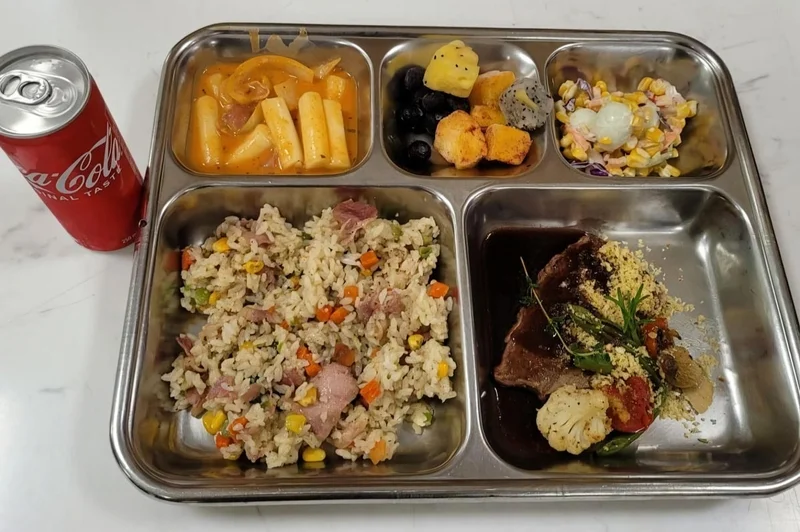
A military cook prepares meals in a Republic of Korea Army kitchen in this undated photo. Hankook Ilbo
For generations of conscripts entering Korea’s mandatory military service, the mess hall offered little room for compromise.
Meals were standardized, heavy on traditional staples and served without exception. But as dietary needs, ethical choices and personal convictions evolve among young Koreans, the nation’s top human rights agency is urging defense officials to overhaul what ends up on soldiers' trays.
The National Human Rights Commission of Korea said Wednesday that it issued formal recommendations to the Minister of National Defense, service branch chiefs, the Marine Corps commandant and the Military Manpower Administration to establish a systematic, legally grounded framework supporting service members with specialized dietary needs.
The guidelines, finalized in June following a comprehensive multiyear investigation into military dining environments, advocate for troops with specialized dietary requirements — including vegetarians, those adhering to religious diets, service members with food allergies and those requiring medical restrictions.
Because soldiers residing in barracks cannot freely select their daily meals or source food externally, military dining is not merely a matter of welfare or convenience, the commission noted. Instead, it constitutes a fundamental prerequisite for maintaining personal health and completing military service safely.
For troops with severe food allergies, exposure to specific ingredients or cross-contamination poses immediate physical dangers. Meanwhile, for vegetarians and religious adherents, the lack of suitable meal options forces an unfair compromise between military obligation and fundamental rights regarding freedom of conscience and religion. The rights watchdog emphasized that accommodating these soldiers must transition from discretionary, unit-level favors into an institutionalized guarantee of basic human rights.
To achieve this, the commission recommended amending the Military Service Act and related service regulations to explicitly define dietary minorities, establish state duties of protection, mandate rights-based training for military personnel and strictly enforce ingredient labeling for allergens across all mess halls, including outsourced catering operations.
The watchdog also highlighted structural flaws in how dietary data is managed.
Currently, information collected during draft physical examinations fails to reliably follow recruits into boot camp and their final active-duty units. The commission urged military leaders to unify data collection and privacy standards across all service branches while creating clear operational guidelines for alternative side dishes, substitute beverages, selective menus and dessert replacements, ensuring service members can declare their dietary needs without fear of stigma or disadvantage.
This article was published with the assistance of generative AI and edited by The Korea Times.