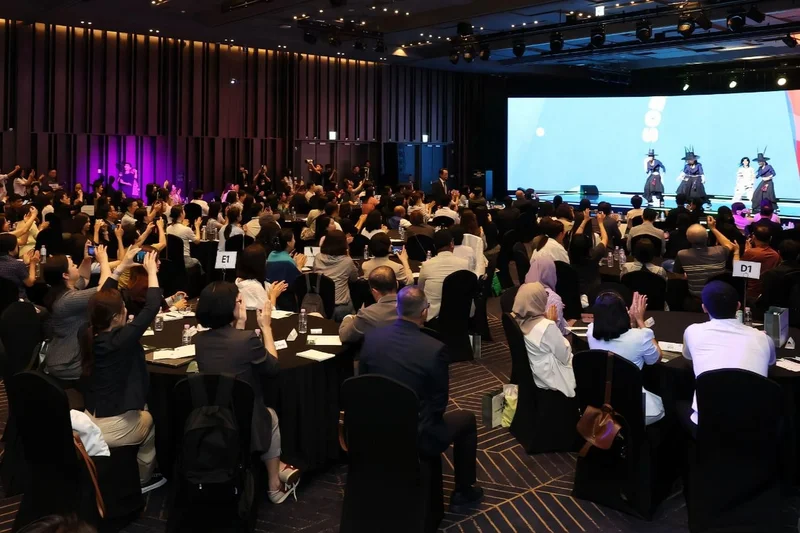
Overseas Korean language teachers and Korean school instructors attend the 2026 Global Korean Language Educators Training Program at Coex in Gangnam, Seoul, July 13. Yonhap
Inside hundreds of church basements, civic halls and rented classrooms across America, Saturday morning means one thing for young Korean Americans: learning to write their names in Hangeul, or the Korean alphabet, and tracing their family roots back across the Pacific.
Now, Korea’s Ministry of Education is stepping in to modernize those weekly lessons, dispatching thousands of newly tailored textbooks and digital learning tools to weekend language schools across the U.S.
Officials from the ministry and the International Korean Language Education Foundation announced the initiative ahead of the 44th annual National Association for Korean Schools conference in Teaneck, New Jersey. Under the new plan, the government will distribute 185,000 textbooks and instructional materials to U.S. weekend schools this year, up from 179,000 in 2025.
The strategic push targets longstanding resource gaps identified by educators on the ground, introducing customized language materials designed specifically for toddlers and preschoolers. Overseas curricula previously catered almost exclusively to elementary-aged students and older, leaving volunteer instructors to simplify complex materials for early learners. Out of 43,000 early-childhood textbooks produced globally by the ministry this year, roughly 21,000 copies will go directly to American classrooms.
"The root of Korean language education abroad lies in these overseas heritage schools," said Seol Se-hoon, head of planning and coordination at the education ministry. "We are committed to listening to educators in the field to actively support the next generation."
Beyond early childhood materials, the ministry is also updating its resources to keep pace with changing classroom technology.
Following direct feedback from teachers who are shifting from traditional blackboards to screen-based instruction, officials redeveloped standard reading texts into presentation-ready slide decks formatted for interactive multimedia displays. These digital assets will be demonstrated during the three-day gathering in New Jersey.
More than 600 weekend language schools currently operate across the United States through nonprofit and community networks, serving student bodies that vary wildly in size and resources. To manage logistical disparities and prevent waste, eight regional Korean Education Centers — located in major hubs such as New York, Los Angeles, Chicago and Atlanta — will help coordinate textbook supply lines. The centers will reallocate surplus books from larger institutions to smaller, newly established schools while sponsoring local teacher training programs.
The expanded support reflects Seoul’s broader foreign policy effort to deepen ties with its global diaspora and cultivate cultural literacy among second- and third-generation Korean Americans. By equipping weekend schools with modern pedagogical tools, officials hope to ensure that heritage education remains both accessible and engaging for young learners across North America.
This article was published with the assistance of generative AI and edited by The Korea Times.