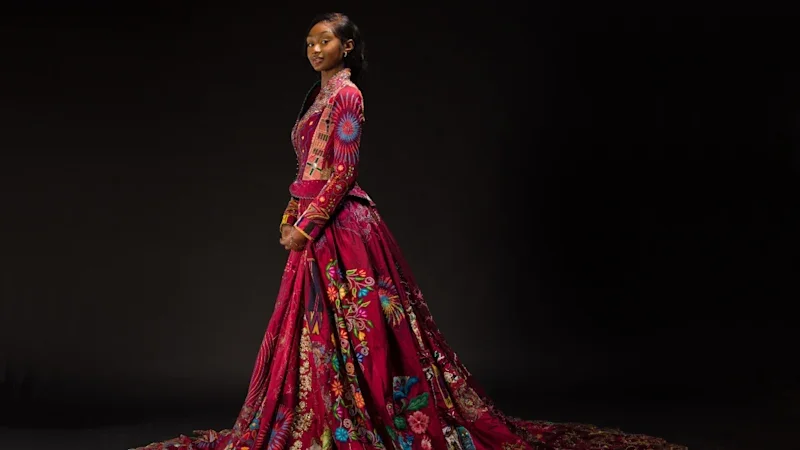
When Guinness World Records got in touch with Kirstie Macleod about her red dress, they presented her with a conundrum.
“They said, we absolutely love your project, and we can give you five different accolades. Which one would you like?” the British textile artist said.
Ultimately, The Red Dress appeared as a double-page spread in the 2026 edition as the world’s largest global collaborative embroidery project.
But the dress also involved the most countries for the manufacture of one garment – 51 – as well as the greatest participant age span (from six years old to one contributor in her late 80s).
The silk dupion dress, which weighs 6.8 kilograms, was 14 years in the making (2009-2023) and used an estimated 1 billion stitches.
The work of 380 different dressmakers – 367 women, 11 men and two non-binary – it’s on display at the Museum of Brisbane until September.
Macleod conceived the project as “a platform for vulnerable voices”.
“The dress is such a potent symbol of femininity and it depicts a being, a form. I found it a very useful way to communicate ideas of identity,” she said.
Macleod ran the project unfunded for the first 11 years, sending swatches to Africa, Asia, the Americas and across Europe, and paying the dressmakers herself.
On Tuesday morning, the dress was attracting a steady stream of admirers in the Museum of Brisbane’s Fairfax Gallery.
St Lucia resident Lyn Roberts was one of the Allthreads Embroidery Community, Norman Park, who contributed a design of Uluru, kangaroos, gum leaves and coral to the project in 2018.
“The panel was finished, it got sent off, and most of us didn’t think about it after that,” Roberts said.
“I feels amazing to see it, humbling when you see all the other work around it, of course, which is so magnificent, but there’s a sense of pride in being part of such a positive project.”
Close examination of the garment reveals confronting details. A panel by six women in Kigali, the capital of Rwanda, shows a man killing a child with a machete and black spiral turning into a rainbow sun.
Macleod said: “It’s depicting the horrors of the war and then their healing journey to fulfilled lives and the community that they now have with the other women.”
Two Palestinian women in a refugee camp in Lebanon contributed shoulder details in 2009. “They are still in the camp 17 years later,” Macleod said.
The Red Dress has been displayed at the United Nations in Geneva and at museums worldwide. But only 28 people have worn it.
“I get a huge amount of requests from people all over the world wanting to wear the dress for different performances, weddings, proms,” Macleod said.
“But I say sorry, no, it’s just for the embroiderers of the project.”
What is it like to wear? “They all say it makes them feel very empowered, and they love the feeling of connection to other women who have worked on the dress,” she said.
Exclusive to Queensland, the dress will continue its journey to Rwanda in November and the UK in 2027.
The Red Dress is on show at the Museum of Brisbane, City Hall until September 13. Entry is free.