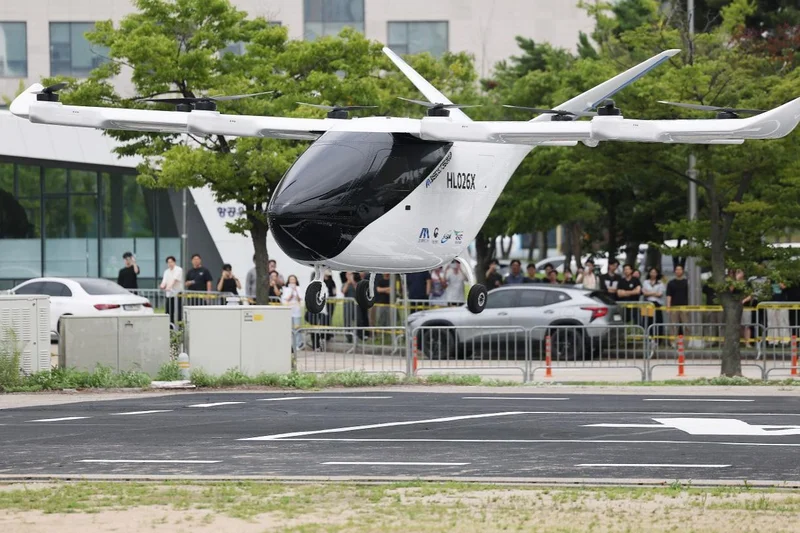
Against the volcanic backdrop of Jeju Island, the future of personal transit will take flight Wednesday as officials get set to offer the public its clearest look yet at the country's upcoming air taxi network.
At the "Jeju UAM Service Showcase" in Seogwipo, the Ministry of Land, Infrastructure and Transport will host a live flight demonstration featuring an electric vertical takeoff and landing (eVTOL) aircraft. The flight will operate off the coast of Seogwipo’s Seongsan Ilchulbong — a UNESCO World Heritage volcanic crater — and Seopjikoji, a scenic coastal promontory located on the eastern end of the resort island, a Volocopter 2X craft, developed by German aviation pioneer Volocopter. The flight will give onlookers a tangible preview of commercial urban air mobility in action.
The demonstration will not merely be a high-tech spectacle, but a functional trial run designed to model actual commercial operations.
Onboard high-definition cameras will stream real-time footage of the dramatic coastline directly to ground stations, allowing spectators to experience the passenger perspective of an aerial island tour. Beyond scenic travel, island planners intend to deploy the technology to reshape regional transport across isolated island areas and assist in emergency medical logistics.
Alongside the flight demonstration, local manufacturing efforts will be prominently on display. Domestic automotive supplier Sambo Motors will showcase a full-scale mockup of its B-33X aircraft, an 1,800-kilogram eVTOL designed to achieve cruising speeds of 150 kilometers per hour with a battery propulsion system engineered for whisper-quiet flight.
The showcase coincides with the ninth general meeting of "UAM Team Korea," a public-private alliance comprising more than 230 government bodies, academic institutions and corporate heavyweights, including Hyundai Motor, SK Telecom and Korean Air.
During the summit, officials will discuss regulatory blueprints for certifying Korea's first generation of air-taxi pilots and specialized maintenance engineers, laying the institutional foundation alongside hardware testing.
Korea has set an aggressive target to launch commercial urban air transit services nationwide by 2028. By focusing initial rollouts on regional tourist hubs like Jeju — where open coastal air corridors present fewer obstacle risks than dense metropolitan centers — authorities hope to build public trust, fine-tune flight management infrastructure and prove operational reliability ahead of larger urban deployments.
"Urban air mobility is no longer a story of the distant future," said Hong Jee-sun, vice minister of Land, Infrastructure and Transport. "While the government is accelerating preparations targeting initial commercialization in 2028, we will also thoroughly manage every aspect of safety so that the public can use these services with complete peace of mind."
This article was published with the assistance of generative AI and edited by The Korea Times.