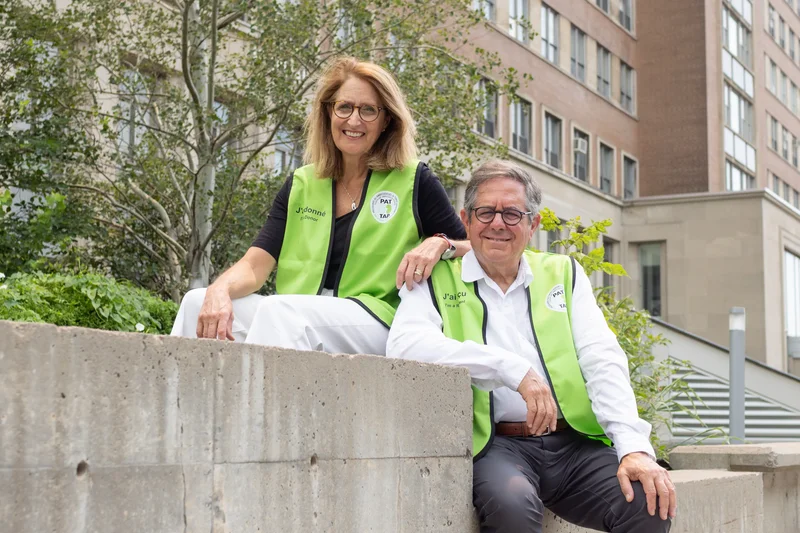
Twelve years ago, in the face of serious kidney disease, Serge Pisapia was in need of a transplant and had spent years on peritoneal dialysis. Still, he hesitated to accept a right kidney from his younger sister Christine even though she had gone through several tests and was medically cleared to do so.
“Serge was a very reluctant recipient,” Ms. Pisapia, 62, said in an interview. “He did not want my kidney.”
Much has changed since then, including Mr. Pisapia’s lease on life. In November, 2014, he accepted his sister’s kidney and felt an immediate boost of energy when he woke up in the recovery room. Now, at 70, he takes several daily medications and test results show he is doing well.
The two use this experience to inform their work as volunteers with the Transplant Ambassador Program in Montreal.
The program, run by a non-profit, was launched in Ontario in 2017 and expanded into Quebec last March. It connects patients with chronic kidney disease and their families with volunteers who themselves have gone through a transplant or donation.
The Transplant Ambassador Program is a first in Quebec – operating out of Montreal General Hospital – and draws lessons from long-standing efforts by its co-founder Susan McKenzie, who received a kidney from her sister-in-law in 2010 and became a transplant advocate.
The work of transplant ambassadors aims to address a care gap: They can offer valuable, first-hand knowledge about their experience, which health care providers do not have.
The siblings say most patients pause when they think about receiving a kidney from a family member. They often share how they fear a transplant could affect the health of someone they care about, contributing to feelings of guilt.
“I speak to a lot of potential recipients and I help to demystify and alleviate their fears and their anxieties,” Ms. Pisapia said, adding her brother could have benefited from speaking to someone like her.
“They get to see, in the flesh, somebody who has been through it and is doing quite well.”
A campaign is under way to enroll more volunteers. A new recruit in Quebec is 34-year-old Jonathan Vanderzon, a Canadian actor.
In March, 2024, Mr. Vanderzon had surgery to remove his left kidney to give it to his close childhood friend who was in renal failure. The operation followed a nine-month process for Mr. Vanderzon to be medically cleared to be a donor.
Mr. Vanderzon said the recovery process was fast; he was line-dancing a mere three weeks after his operation. His friend is doing well, too, and has been able to travel to New Zealand. “My kidney is better travelled than I am,” Mr. Vanderzon said with a laugh.
He said the surgery also left him with something lasting. “Most of all, becoming a living donor meant I got to keep my best friend around, so that’s the number one.”
Mr. Vanderzon looks forward to volunteering as an ambassador with the program.
“I just wanted to get the word out,” he said. “I wanted people to know that it was an option that it hasn’t impacted my life in a negative way whatsoever. It’s only been good.”
Mr. Pisapia has valued the chance to spread awareness through the ambassador program.
Additionally, he said volunteering affords him with something in return: New insight into the thought process of donors, which he has discovered is often quite emotional.
After hearing personal stories, he has a new appreciation for what they want to do and how it affects them.
“They have a mission and they’re driven to achieve that mission,” he said.
“If the recipients like me, the reluctant recipients, only knew that level of mission, maybe they would feel less guilty or responsible to have to put someone else through this.”
The ambassador program also buoys efforts of medical professionals.
Vicki Tan, an advanced practice nurse at the Montreal hospital, said while they can offer medical expertise, they do not have experience living with chronic kidney disease and how it affects day-to-day life.
“It’s something that we were missing before,” she said. “We can do the teaching, but we don’t fully understand what somebody goes through.”
Ms. Tan said in addition to the time required for patients to receive dialysis, it is draining on the body and affects quality of life.
Ms. Pisapia said her brother did not know that being on dialysis, which replicates the kidney’s function to remove harmful waste products, is designed to serve as a bridge for patients before a transplant.
While she said the procedure keeps patients alive, it is associated with considerable costs for the health care system.
The Kidney Alliance, a national non-profit made up of donors, patients and their loved ones, pegs this figure at $100,000 per patient per year.
By contrast, the cost of a transplant is approximately $100,000 in the first year but tapers in subsequent years to about $20,000 annually.
The alliance says more transplants would relieve burden on increasing health care costs in a system that is overstressed.
Despite making her pitch to her brother, Ms. Pisapia was not, in the end, the one to convince him to go ahead with receiving the transplant from her.
He only agreed after a surgeon advised that it is was medically preferable to accept his sister’s kidney rather than receive one from a deceased donor. The average length of time a patient can keep an organ from a live donor is longer than from someone who is dead.
On the morning of Nov. 6, 2014, the siblings went into adjacent surgery rooms at the Royal Victoria Hospital in Montreal. In one, Ms. Pisapia’s kidney was removed. In the other, it was transplanted into Mr. Pisapia.
Before she was wheeled into her OR, Mr. Pisapia said he remembers his sister, a trained pilot, giving him a thumbs up from the stretcher. He also recalls that she was smiling and looking confident.
“It also gave me confidence, of course, to see that she was in this kind of mood before going to the operating table,” he recalls.
Later, after the two procedures were complete and sedation medication had worn off, the two shared an emotional reunion in hospital gowns, amongst some family members in a hospital room.
There, they held hands, with needles in their hands for IVs, and shed what Ms. Pisapia describes as “tears of joy,” over a life-defining experience they went through together. Mr. Pisapia’s life was saved.