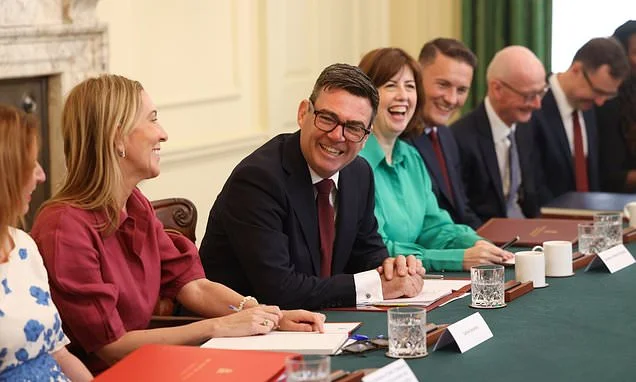
Andy Burnham was last night asked to explain how he will pay for his Left-wing spending spree.
In an early warning sign, the new Prime Minister's first cost-of-living pledge unravelled within hours yesterday as a sacked minister revealed it was unfunded.
And despite telling his first Cabinet meeting that his Government would always 'show how we are going to pay for it', Mr Burnham's spokesman was unable to say who would foot the bill for his many other proposals, which seem set to hit taxpayers for hundreds of billions of pounds.
Having already vowed to end rough sleeping in his maiden speech outside No 10, the PM has floated the prospect of raising the income tax threshold, looked at nationalising utilities, advocated for a national care service and promised to massively increase council housebuilding.
Tory leader Kemi Badenoch asked: 'Where's the money coming from? I am very concerned the Prime Minister is making a lot of promises without giving the country an explanation about how we can afford them.'
His agenda has raised fears that the Labour leader will hit the middle classes with fresh tax rises – with experts warning that bringing energy and water companies into public control would mean putting 2.4p on income tax – or risk spooking the City with more borrowing rather than cutting the ballooning welfare bill.
As a plan to cut VAT on energy bills over the winter descended into farce yesterday, Reform UK's Treasury spokesman Robert Jenrick said: 'Burnham's numbers don't add up.'
Andy Burnham was under pressure to explain how he intends to fund his cut to VAT on household energy bills
Darren Jones, an ally of Keir Starmer who was turfed out of the Cabinet by Mr Burnham, made life difficult for the new PM by pointing out his spending was unfunded
The PM began the day with a 6am announcement that the 5 per cent VAT charge would be removed from domestic electricity bills from October 1, saving households an estimated £45 when the price cap rises – a figure that was called into question by experts.
He vowed to fund it by scrapping Sir Keir Starmer's Digital ID scheme.
But less than two hours later, Sir Keir's former right-hand man, Darren Jones, threw the announcement into chaos by revealing the ID scheme was never funded in the first place.
On Mr Burnham's first full day in Downing Street:
- New Defence Secretary Wes Streeting hinted at more money for the Armed Forces as he claimed to have a 'firm friend' in Chancellor John Healey;
- Nigel Farage renewed his call for a general election, saying the recent turnover of PMs put Britain on a par with Italy;
- An opinion poll put Labour and Reform on level pegging in the first sign of a Burnham bounce;
- Boris Johnson blasted the appointment of Ed Miliband as Foreign Secretary, with the former Net Zero minister later jumping on a plane to fly 6,000 miles to the Philippines;
- The make-up of Mr Burnham's Cabinet raised eyebrows as it was decidedly more private-schooled and Oxbridge-educated than Keir Starmer's;
- It emerged the new Chancellor of the Duchy of Lancaster, convicted fraudster Louise Haigh, had been stripped of a fraud oversight role usually associated with the job.
Mr Burnham is keen to make a positive impact with voters during his first weeks in office after Sir Keir squandered his 2024 election landslide early with the disastrous cut to winter fuel payments for millions of pensioners.
At his first Cabinet meeting, the new PM suggested the change of leadership would give Labour 'a second chance to make a first impression'.
But he also hinted that ministers will have to find budget cuts to fund some of his priorities.
He told the meeting: 'If we're to deliver on the cost of living and reducing the pressure, then we've got to be prepared to re-prioritise.
'We've got to show fiscal discipline, we've got to show that our commitment to the fiscal rules is real and we're prepared to make difficult decisions in relation to that.'
Mr Burnham also pledged to end rough sleeping on his first day in office, which he said would be funded by 'unallocated' money from the housing department
The PM later told his colleagues around the Cabinet table his 'cost-of-living government' will 'always... show how we are going to pay for [measures]' – with his official spokesman insisting the energy bill plan was 'fully funded'.
Mr Burnham's spokesman also said the 'initial' phase of the pledge to end rough sleeping would cost £340million, paid for from 'unallocated' funds at the housing department.
But he was unable to say how much a string of other polices would cost – or how they would be paid for.
Asked about Mr Burnham's plan to build half a million council houses, the spokesman said the Government would 'set out plans in due course'.
He said the plan for a national care service was 'a significant priority'. But asked about the cost and funding, he again replied: 'We will set out plans in due course.'
The spokesman said the Government was 'prepared for all eventualities' on taking Thames Water under state control but declined to say how much it might cost the taxpayer.
On the idea of cutting student loan repayments, they said the new PM 'has been crystal-clear about his commitment to fiscal discipline'.
On the eve of his coronation, Mr Burnham had said he was looking at increasing the personal allowance for income tax, which has been frozen at £12,570 for the past five years.
The Institute for Fiscal Studies think-tank said a one-off unfreezing of the threshold would cost £2billion but if it continued permanently it would cost up to £9billion a year by the start of the next decade.
The Institute of Economic Affairs, meanwhile, put the cost of nationalising the water industry at £150billion, with another £50billion for energy.
But it added that there would also be £20billion a year running costs, which could mean a 2.4p increase to the basic rate of income tax to cover it.
Dr Valentin Boboc, senior economist at the IEA, said: 'There is no version of this where the public both takes back the utilities and avoids paying for them – the cost simply moves from the water bill to the tax bill.'
The TaxPayers' Alliance calculated that capping bus fares at £2 again, set to be announced by Mr Burnham today, would cost £240million while his ambition of boosting council housebuilding could cost £40billion.
Chief executive John O'Connell said: 'Andy Burnham is walking into No 10 with a shopping list that could cost taxpayers hundreds of billions of pounds. If he is serious about giving families breathing space, he should start cutting spending, not writing a blank cheque for every failed big-government idea on the shelf.'
Meanwhile, last night Mr Burnham made Dan Jarvis and James Murray – who stepped in as Defence Secretary and Health Secretary respectively after resignations from Keir Starmer's Cabinet – a security minister and Treasury minister.