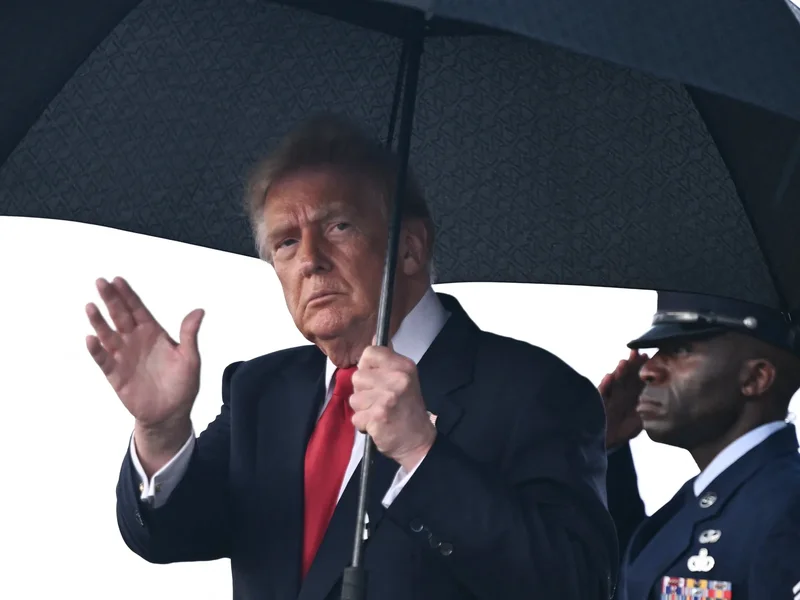
US President Donald Trump says Washington is engaged in “very friendly negotiations” with Iran after pausing military strikes last week, raising hopes that weeks of escalating attacks could give way to renewed diplomacy.
Speaking to supporters in Michigan on Monday, Trump said there was “a good chance” of progress in talks aimed at ending months of fighting, but reiterated his warning that military action could resume if negotiations fail.
Recommended Stories
list of 3 items- list 1 of 3Sixty Palestinians detained by Israel return to Gaza, describe abuses
- list 2 of 3France legend Zinedine Zidane confirmed as new national team manager
- list 3 of 3Moment 7.1-magnitude earthquake rocks southern Japan
Iran has publicly denied holding direct talks with Washington at all. The foreign ministry’s spokesman, Esmaeil Baghaei, said Tehran was not negotiating with the United States but added that “intermediaries may convey messages from the American side to us regarding ongoing developments in the region”.
According to news outlet Axios, Oman is leading the mediation effort, with Qatar, Pakistan and Egypt also involved alongside Trump’s envoys, Steve Witkoff and Jared Kushner.
The diplomatic push comes after fighting subsided again on Friday, after nearly two weeks of attacks by both sides had raised fears of a renewed, wider regional war.
Those strikes had threatened to upend a Memorandum of Understanding (MoU) signed in June which extended an April ceasefire and established a framework agenda for broader negotiations. However, disputes over its implementation and the wording of several clauses quickly emerged, particularly relating to control of the Strait of Hormuz, one of the world’s most strategically important shipping routes which connects Gulf oil producers to the open ocean for shipping exports.
On Tuesday, the third day of renewed talks continued, with the Strait of Hormuz at the centre of the discussions, as negotiators sought to salvage the agreement and prevent another round of fighting.
Questions remain, however, over whether this latest diplomatic push can succeed where previous efforts have failed.
The talks also come against the backdrop of a rapidly shifting strategic landscape. The Iran-aligned Houthis in Yemen have opened another front in the Red Sea where they are targeting ships; Ukraine has become increasingly drawn into the conflict; reports suggest US stockpiles of key munitions may be under pressure; Iran’s economy continues to face mounting strain; and oil markets remain volatile.
Trump’s potentially fraught meeting with Israeli Prime Minister Benjamin Netanyahu on Tuesday could also influence the direction of negotiations. So, what are the chances these talks lead to a more durable peace? Here’s what we know.
Why did strikes start up again following the June MoU?
Although the Pakistan-brokered ceasefire in April and the subsequent June MoU were intended to defuse tensions between Iran and the US to allow time for peace talks, strong disagreements over the Strait of Hormuz quickly became the biggest obstacle to lasting peace.
The MoU signed on June 17 committed Iran to facilitating commercial shipping freely through the strait for an initial 60-day period. Tehran said this meant it was in control and that vessels must use a route approved by Iran. Tehran also hinted that transit charges could be introduced after the initial 60-day period expired.
Meanwhile, however, Oman announced a new shipping corridor through the strait that it said had been coordinated with the International Maritime Organization and supported by the US, a position Iran claimed violated the MoU.
The map below shows the Iran-approved route, which brings ships much closer to the coast of Iran.
On June 25, a commercial vessel travelling along the Omani-approved route was struck off Oman’s coast, according to the British military. A day later, the US launched another round of strikes on Iran. Several more ships were struck following this.
The fighting escalated further in July, and Iran again announced the closure of the Strait of Hormuz, sending oil prices sharply higher and threatening one of the world’s most important energy chokepoints.
The US later announced a renewed, corresponding naval blockade on Iranian ports in what it described as an effort to increase economic pressure on Tehran.
Over the following two weeks, both sides expanded their attacks beyond military targets. Iranian officials said the US attacks hit railway stations, residential neighbourhoods, bridges, water facilities and food silos, while Iran later struck civilian infrastructure, including desalination plants and power facilities in Kuwait.
The conflict also spread beyond the Gulf. The Iran-aligned Houthis in Yemen announced a maritime blockade targeting Saudi ports, while Ukraine last week struck an Iranian vessel in the Caspian Sea, adding further pressure to an already widening regional confrontation.
The cycle of retaliation eased only after Trump announced a pause in US strikes on Friday. An Iranian military spokesperson later said Tehran had also halted its “retaliatory” attacks in response. According to the US, negotiations resumed.
What is happening in the talks?
At the centre of the latest talks is the issue of control over the Strait of Hormuz, the narrow waterway linking the Gulf to the Gulf of Oman through which about one-fifth of the world’s oil and liquefied natural gas (LNG) supplies are shipped during peacetime.
The strait did not become an issue between the two sides until after the US and Israel launched their first strikes on Tehran on February 28, after which Iran closed it down. About 130 ships passed through the strait each day before that.
Oman is understood to be leading the mediation effort, with Qatar, Pakistan and Egypt also involved, alongside Trump’s envoys Steve Witkoff and Jared Kushner.
Al Jazeera’s Tohid Asadi said that “while there are numerous points of contention in the talks, including the nuclear dossier, sanctions, war reparations … the strait may be the most contentious issue of all”.
“Iran is insisting on maintaining control and authority over it, saying any passage through the chokepoint must be coordinated with Iran and routed close to its coastline.”
Oman’s Foreign Minister Badr Albusaidi has held a series of calls with counterparts in Iran, Qatar, Saudi Arabia, Kuwait and Egypt in an effort to bridge the gap.
In a statement, he said the discussions had “focused on ways to enhance the prospects for reaching practical, fair and sustainable arrangements for maritime navigation … through the Strait of Hormuz”.
What could be agreed about the Strait of Hormuz?
According to reporting from the Wall Street Journal and Axios, mediators are exploring proposals that would give Iran and Oman a greater role in managing traffic through the strait while addressing US concerns over freedom of navigation.
One proposal is understood to be a regional consortium responsible for maritime security, search-and-rescue operations and other services. The arrangement would reportedly draw on the cooperative framework used by Malaysia, Singapore and Indonesia in the Straits of Malacca and Singapore.
Another proposal would allow countries bordering the Gulf to collect fees linked to maritime security and environmental protection. One option under discussion would place those payments into a jointly administered fund coordinated by the International Maritime Organization, while another would allow Iran to collect what one regional source described as “reasonable service fees”. These could be for services such as insurance or docking assistance.
Under international maritime law, tolls to pass through natural straits such as the Hormuz waterway are not allowed, even when they pass exclusively through countries’ territorial waters. However, ships can sometimes be charged for practical services rendered by those countries.
Iran has indicated it is willing to discuss these proposals but continues to insist that it should retain ultimate authority over the strait, including the right to collect transit fees.
Tehran is also likely to argue that its position is consistent with the MoU signed in June, which only requires it to facilitate passage for ships without charge for 60 days.
Article 5 states that “upon the signing of this MoU, the Islamic Republic of Iran will make arrangements using its best efforts for the safe passage of commercial vessels, with no charge for 60 days only, from the Persian Gulf to the Sea of Oman, and vice versa”.
The same article also commits Iran to holding discussions with Oman on the future administration of the strait.
“The Islamic Republic of Iran will conduct dialogue with the Sultanate of Oman, to define the future administration and maritime services in the Strait of Hormuz, in discussions with other Persian Gulf Littoral States, in line with applicable international law and the sovereign rights of coastal states of the Strait of Hormuz,” it reads.
That language has taken on renewed significance because the current negotiations closely mirror the process outlined in the MoU, potentially strengthening Tehran’s argument that discussions over the strait should now focus on its long-term administration of the strait rather than whether Iran should have any role at all, experts say.
Parliament Speaker and lead negotiator for Iran, Mohammad Bagher Ghalibaf, appeared to signal on Monday that total freedom of navigation through the strait will no longer be on the table. “The administration of the strait will never return to the way that it was before the war”, he said.
A ‘third way’: Could the US release frozen Iranian assets?
While control of the Strait of Hormuz remains the central dispute, negotiators are also trying to resolve another issue that has long divided Washington and Tehran: sanctions relief.
Iranian officials have repeatedly stated that easing economic pressure must form part of any lasting agreement. Access to its frozen assets has, therefore, emerged as one possible area for compromise.
According to Axios, US officials increasingly believe that economic pressure may ultimately prove more effective than continued military strikes when it comes to influencing Tehran’s position.
Iran is facing mounting economic difficulties, including fuel shortages despite being one of the world’s largest oil producers. During previous negotiations with US envoys Steve Witkoff and Jared Kushner, Iranian officials have also made clear that regaining access to these funds remains one of Tehran’s main priorities, Axios reported.
However, some analysts question how much pressure sanctions alone are placing on Iran. Brett Erickson, an analyst at Obsidian Risk Advisors, estimates that Iran generated about $23bn in oil revenue during the first half of the year, exceeding government budget forecasts.
“Economic warfare is a fundamentally broken approach to the Iran War,” Erickson wrote on X.
The June memorandum also referred to the release of frozen Iranian funds, although Washington and Tehran appear to have interpreted that commitment differently – again because of vague wording, analysts say.
Iran had expected assets to be released shortly after the agreement was signed. US officials, however, have indicated that any release would depend on Tehran continuing to keep the Strait of Hormuz open and complying with other parts of the deal.
This has raised the possibility that access to frozen assets could become part of a broader compromise. Under such a scenario, Iran could accept limits on how transit fees are collected through the Strait of Hormuz in exchange for sanctions relief and the gradual release of frozen funds, to replenish its economy.
Simon Mabon, professor of international politics at Lancaster University in the UK, told Al Jazeera that Tehran can be expected to “push hard for sanctions relief”.
However, Mabon added that deep mistrust between the two sides remains one of the biggest barriers to any breakthrough on this point.
“Iranians and Americans don’t trust each other. But particularly the Iranians who are of the view that Trump and the US have completely disregarded the MoU regarding sanctions relief.”
Iran has also pointed out on numerous occasions that the US has now launched strikes on Iran while peace talks have been ongoing at least three times.
Will the threat of more US strikes persuade Iran to compromise?
Probably not. Alex Vatanka, a senior fellow at the Middle East Institute in Washington, DC, questioned Trump’s suggestion that US military action had forced Iran back to negotiations. “I don’t think the Iranians were ready to throw in the towel just because of US military strikes,” Vatanka told Al Jazeera.
Furthermore, Trump’s halting of strikes late last week came amid reports that US officials have expressed serious concerns about dwindling supplies of air-defence interceptors while Iran continues to demonstrate that it retains a significant missile and drone capability, according to reporting by the Wall Street Journal.
Those military pressures, combined with concerns about rising oil prices and the economic consequences of a prolonged conflict, may have strengthened the case within Washington for returning to diplomacy.
Mabon said those changing dynamics will likely only strengthen Tehran’s negotiating position. “This time things are changing due to a shift in dynamics and apparent dwindling of US supplies and capacity, and its arsenal being massively depleted.
“That tells us the Americans are under pressure and the Iranians will capitalise on that and push harder. At the same time, Iranians thinking ‘we have withstood the worst the US can offer, so we are in a position of strength’.”
What else could derail a peace deal?
Despite the renewed diplomatic push of the past few days, analysts say several major obstacles to a lasting agreement remain.
Last week, Axios reported that Qatar, Egypt, Pakistan and other regional mediators had proposed a 10-day ceasefire to halt the fighting and create breathing space to revive the June MoU.
However, political analyst and executive vice president of the Quincy Institute, Trita Parsi, told Al Jazeera that Tehran is unlikely to accept such a short-term arrangement. He said Iran would probably see it as an “effort to push down oil prices”, allowing the US to resume military operations once markets have stabilised.
Analysts also warn that the conflict is no longer confined to Washington and Tehran, as the war has become increasingly intertwined with the Saudi-Houthi confrontation and the Russia-Ukraine war.
The Houthis in Yemen have declared a maritime blockade targeting Saudi ports, threatening another major shipping route in the Red Sea, with analysts suggesting this gives Iran more leverage to disrupt oil markets. Meanwhile, Ukraine has struck an Iranian vessel transporting military cargo across the Caspian Sea, which some analysts suggest gives the US more leverage to hurt the Iranian economy.
The situation in Lebanon could also complicate negotiations, with the first article of the June memorandum calling for the “immediate and permanent termination of military operations on all fronts, including in Lebanon”.
But Israeli attacks on southern Lebanon, where it has occupied about one-fifth of the country, have continued, raising further questions over how fully the agreement has been implemented.
Israeli Prime Minister Benjamin Netanyahu’s visit to Washington on Tuesday is expected to include discussions on Iran. Analysts say Netanyahu, who has long advocated military action against Tehran, is likely to argue against easing pressure.
Danny Citrinowicz, a senior researcher at the Institute for National Security Studies, wrote on X that “this leaves Trump facing a difficult strategic choice”.
“Prime Minister Netanyahu is likely to argue strongly for expanding the military campaign, but once the conflict widens, returning to diplomacy and negotiated arrangements will become far more difficult.”