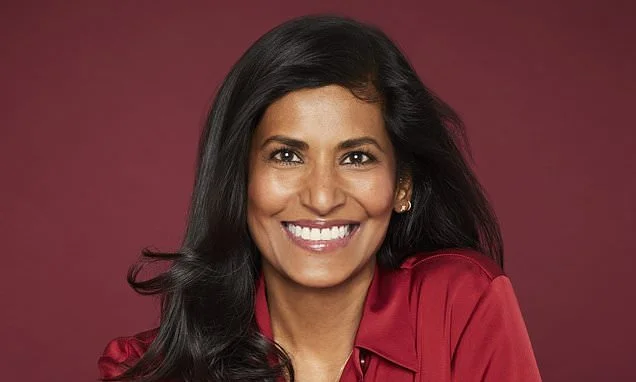
Struggling with symptoms of the menopause, makeup artist and MBE Ruby Hammer was initially in denial when she started to notice symptoms of auditory decline.
Soon, however, her hearing loss became impossible to ignore. ‘I work in noisy photographic studios, and I’d be called to go on set to tweak the model’s makeup and I wouldn’t hear my name,' she said.
'Someone would need to come and physically tap me on the shoulder to get my attention. Then I got the nickname "Ruby wrong sticks" because I was always getting the wrong end of the stick in conversations. I’d be talking about another topic entirely as I hadn’t caught the start of the discussion.
'In shops people thought I was being snooty because I wasn’t responding to them. Or that I was being rude if I asked them to repeat themselves again and again. I also realised I had also been struggling in business meetings.’
Ruby had been counteracting her worsening hearing by lip reading, putting subtitles on the TV and putting her phone on speaker for important conversations or interviews.
Makeup artist Ruby Hammer was initially in denial when she started to notice symptoms of auditory decline
It took her daughter’s intervention to make her realise how bad her hearing had got. One day she asked Ruby if she’d missed her son Max (Ruby’s first grandson) talking. Ruby realised she had. Her daughter was firm she needed to address the situation. She told Ruby she’d ‘end up with dementia’ if she didn’t. (Recent studies have linked unaddressed hearing loss with the disease).
Ruby said she really struggled to confront the issue. ‘I’ve been losing my hair, wearing Invisalign braces for my teeth and navigating my way through the menopause, but this took me to rock bottom. I felt really worn down by it – struggling with my hearing made me feel decrepit,’ she said.
But, she added: ‘I thought sod it. I had some misguided vanity about wearing hearing aids but I realised I didn’t want to miss any more of my grandson’s words. So my MD (Ruby has a namesake beauty business brand) said she’d help me find a solution and I took her up on the offer.’
It wasn’t the first time she’d tried to address her hearing problems. Pre-pandemic an optician offered her a hearing test, which she took up. She said: ‘The man that did it just stared at me and said, "Your low-pitch hearing is off-the-radar bad. You need to go to your GP." I did and the GP sent me for an MRI to check for infections or wax.
After seeing her hearing deteriorate, a test revealed that Ruby was struggling with an issue she'd had since birth
'The results came back and the specialist then told me it was a congenital thing. I worked in noisy studios all through the 1980s and 1990s, where the music was often very loud, so maybe some damage was done there. Plus, there is natural deterioration that comes with age, but the specialist said the main reason was something I’ve had since birth.
‘I was offered NHS hearing aids. They were so ugly and obvious. It was when social media and Instagram were really ramping up and I didn’t want to wear them. Plus, I was in denial. I did go to Hidden Hearing and got these very expensive hearing aids that I paid £6,000 for and didn’t wear them once.
'This time around I went to an audiologist called Mr Prince Philip Punnoose and he advised Oticon hearing aids. I’ve been wearing them for a good year and they’ve changed my life. I have small ears and they were optimised for me. They are very discreet and are linked to my phone and I can change the volume on the screen. They were a little startling at first because you can hear everything – all the street sounds too. But most importantly I can hear my grandson now. He’ll ask, "Have you got them in Nan?"'
As to why she's shared her story of hearing loss, Ruby is clear. 'I’ve always talked about the difficult things in my life, my divorce, my menopause and now this. I’d love to help take the stigma out of hearing loss,' she concluded.