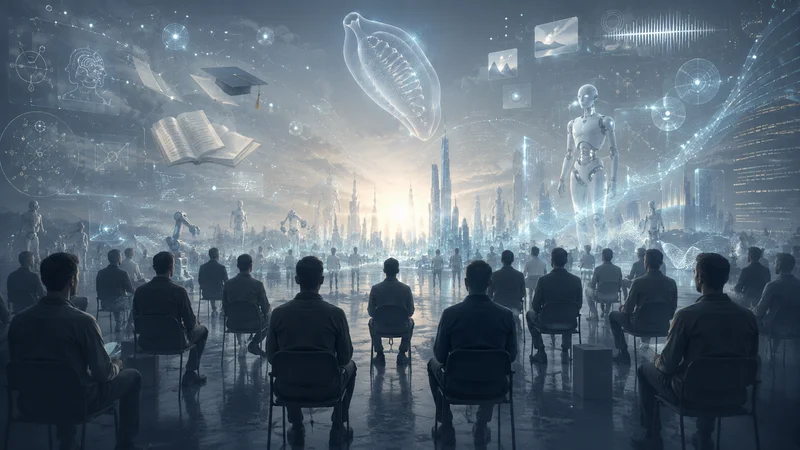
The explosive rise of ChatGPT at the beginning of 2023 marked, for the general public, the beginning of the generative artificial intelligence era. Within just two months of its launch, the system had reached an estimated 100 million monthly active users [1], despite still displaying obvious limitations. It fabricated information, made mistakes, and often sounded far more confident than it should have. Yet it was already clear that this was more than a technological curiosity. For the first time, millions of people could interact with a machine capable of writing, summarizing, translating, programming, and producing solutions within seconds. In the years that followed, these systems improved rapidly and began working with images, audio, and video as well. What initially looked like an impressive demonstration gradually entered everyday working life. And as machines became more capable, people became increasingly disoriented.
I first became fully aware of this during an activity with a group of secondary-school students. I had asked them to analyze a series of social media posts and understand why some users supported Donald Trump while others supported Kamala Harris during the 2024 US presidential election. I wanted them to identify recurring arguments and reconstruct the motivations behind people’s positions. After only a few minutes, one student had already finished. She had photographed the assignment and asked an artificial intelligence system to solve it. When I tried to explain that the purpose was not simply to obtain an answer, but to learn how to examine the data and develop an interpretation, she replied: “If the machine can do it, why should I?” I tried to motivate her, but I do not think I truly succeeded. Her question was not merely about one assignment. It concerned the very meaning of learning.
Soon afterwards, I recognized the same disorientation among friends whose work depends largely on interacting with other people: call-center operators, sales staff, and financial-product advisers. For a long time, such professions were considered difficult to automate because every customer is different, and the job requires listening, adapting one’s language, and responding to objections. Yet this is precisely what the new systems are beginning to do. They can handle different situations, retain the context of a conversation, and adjust the tone of their responses. They are not yet replacing people entirely, but they are performing an increasing number of tasks that, until recently, appeared to be reserved for human beings.
The most recent, and perhaps most surprising, signal comes from my colleagues in computer science. Until only a few years ago, many of them regarded generative artificial intelligence with a certain detachment. It was interesting, but it did not really work. It produced error-filled code and failed to understand complex systems. Today, that attitude is changing. These tools write programs, identify problems, explain existing code, and generate entire applications. Computer scientists have long inhabited a small, fortunate island: they built the automation that would transform other people’s work, without imagining that it would arrive so quickly in their own territory. Now some of them are beginning to worry and, for the first time, to consider possible alternative plans.
Artificial intelligence is not, of course, suddenly eliminating entire professions. More often, it changes their composition: it automates some tasks, accelerates others, and allows one person to produce what previously required the work of several. A new phase is also emerging: humanoid robots designed to enter everyday environments and perform some of the manual tasks currently carried out by people [2]. Jobs that have so far appeared more difficult to automate may therefore also be affected. The question then becomes broader: what happens when we delegate more and more aspects of what we know how to do to machines?
A provocative definition is commonly attributed to Linus Torvalds: “Intelligence is the ability to avoid doing work, yet getting the work done.”¹ In a sense, artificial intelligence appears to fulfil this aspiration. But the issue goes beyond efficiency. It concerns what remains of us when we stop exercising the faculties that allow us to understand, choose, and act. Like all animals, human beings evolved to orient themselves, seek resources, avoid danger, build tools, cooperate, and make decisions. In our case, however, movement is not merely physical. It is also the movement of thought: observing, remembering, comparing, imagining, and choosing.
An extreme example is provided by the sea squirt. During its larval stage, it swims freely and possesses a nervous system that allows it to orient itself and find a suitable place to settle. Once it attaches itself to a surface, its tail is reabsorbed and its larval nervous system regresses, together with the structures required for a mobile life [3]. It is often said, in simplified terms, that the sea squirt “eats its own brain.” This is not scientifically accurate, but the image remains powerful: once the animal no longer needs to explore its surroundings and decide where to go, part of its nervous system is no longer necessary. We are not sea squirts, of course. But what happens when we delegate to machines not only physical effort, but also memory, writing, information gathering, reasoning, and part of our decision-making?
A capacity that is not exercised tends to weaken. If we stop reading complex texts because we can instantly obtain a summary, will we still be able to follow their reasoning? If we stop writing because a machine can do it for us, will we still be able to organize our thoughts independently? If we accept a solution without understanding the process that produced it, how will we recognize when it is wrong? The risk is not only that we become less competent, but that we lose sight of why we should develop a competence at all. Technology advances through sudden leaps, while biological evolution operates over vastly longer periods. The world changes within a few years, but our bodies and many of the fundamental mechanisms of our minds remain the product of an ancient history.
The issue therefore concerns not only what we will still be able to do, but also the role that work plays in our lives. Work has never been merely a means of earning an income: it structures time, provides a social role, creates relationships, and contributes to our identity [4]. Even when it is tiring, it allows us to answer the question through which we often introduce ourselves to others: what do you do? If an increasing share of work is entrusted to machines, redistributing income will not be enough. We will also have to reconsider time, social recognition, and the possibility of feeling useful. We might work less and devote more time to care, culture, and relationships, but nothing guarantees that this will happen. The same technology could instead concentrate wealth and power in the hands of a few, while making a growing share of the population appear less economically necessary. It is therefore not enough to ask which professions will survive. We must understand who will control intelligent systems and how the benefits of automation will be distributed.
In 1977, the year of the Queen’s Silver Jubilee, Johnny Rotten sang with the Sex Pistols: “No future for me.” It was the provocative cry of a generation that could not recognize itself in the future it was being offered. Almost fifty years later, those words risk becoming relevant again in a different form. Not because the future does not exist, but because a growing number of people can no longer imagine what place they will occupy within it. The future of human work has not yet been written. But precisely for this reason, we cannot allow machines, the market, or a small number of large technology companies to write it for us.
References
[1] Reuters, “ChatGPT sets record for fastest-growing user base – analyst note,” February 2, 2023.
https://www.marketscreener.com/news/latest/ChatGPT-sets-record-for-fastest-growing-user-base-analyst-note-42873811/
[2] 1X, “Introducing NEO Gamma,” 2025.
https://www.1x.tech/discover/introducing-neo-gamma
[3] Hotta, K., Dauga, D., & Manni, L. (2020). “The ontology of the anatomy and development of the solitary ascidian Ciona: the swimming larva and its metamorphosis.” Scientific Reports, 10, 17916.
https://www.nature.com/articles/s41598-020-73544-9
[4] Paul, K. I., & Batinic, B. (2010). “The need for work: Jahoda’s latent functions of employment in a representative sample of the German population.” Journal of Organizational Behavior, 31(1), 45–64.
https://doi.org/10.1002/job.622
¹ Quotation commonly attributed to Linus Torvalds: “Intelligence is the ability to avoid doing work, yet getting the work done.” The original primary source has not been identified; the wording is reported by BrainyQuote.