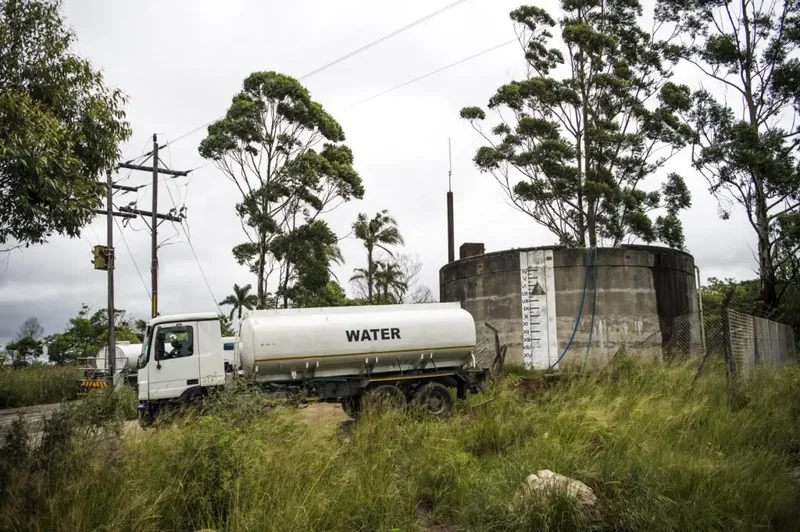
South Africa doesn’t lack water plans; it lacks implementation. That’s the challenge confronting the government’s new National Water Action Plan, which proposes the most significant overhaul of municipal water services in decades.
While the plan promises to reform how water services are funded, managed and regulated, water experts say its success will depend on whether the government can finally deliver on long-standing commitments to strengthen municipal finances, improve accountability and restore crumbling infrastructure.
Released by President Cyril Ramaphosa, the plan argues that the country’s water crisis is no longer primarily about water scarcity but about deteriorating municipal governance, fragmented accountability and decades of underinvestment in infrastructure maintenance.
“The real challenge lies not in the availability of water but in getting water to people's taps,” Ramaphosa said, announcing that implementation of the plan would be overseen by the National Water Crisis Committee, which he will chair.
At the heart of the strategy is the government’s contention that many municipalities have become trapped in a cycle of deteriorating service delivery. High levels of non-revenue water reduce municipal income, leaving less money to maintain infrastructure, repair leaks and employ skilled technical staff, resulting in even greater losses.
The plan identifies two structural weaknesses driving the crisis. Revenue generated from water services is frequently absorbed into municipalities’ general budgets instead of being reinvested in water infrastructure, while accountability is fragmented, with technical departments often responsible for delivering services but having little control over billing, revenue collection and financial management.
To address the shortcomings, the government wants municipalities to increasingly separate their oversight role from the day-to-day operation of water services by appointing licensed water service providers that meet minimum technical, managerial and financial standards.
Financial reform is equally central, with metropolitan municipalities expected to ring-fence revenue generated from water and sanitation services so that it is spent exclusively on maintaining and expanding water infrastructure.
The presidency estimates that about R156 billion will be invested in metropolitan water infrastructure over the next five years through a combination of public and private funding.
The urgency of the reforms is reflected in the condition of municipal water systems.
According to the plan, 74% of water services authorities scored poor or critical for drinking water o__r wastewater systems__, while 81% of municipal wastewater infrastructure is in poor or critical condition.
Nearly half (46%) of drinking water systems failed microbiological compliance testing in 2023, compared with just 5% in 2014, while municipalities lose an average of 47% of treated water before it reaches consumers through leaks, theft, faulty meters and other forms of non-revenue water.
The government also highlights Johannesburg as an example of the systemic problems it is trying to solve. Over the past decade, water main bursts have increased by 30%, sewer overflows by 35%, while 46.1% of treated water is lost before reaching consumers.
Similar interventions are planned elsewhere in the country, including bulk water projects in the Eastern Cape, pipe replacement in the Free State, wastewater upgrades in Gauteng and North West, expanded water supply schemes in KwaZulu-Natal and Limpopo and infrastructure improvements in Mpumalanga and the Western Cape.
For Anja du Plessis, an associate professor and water management expert at Unisa, the plan represents a more comprehensive roadmap than many previous strategies.
She said it builds on resolutions adopted at the 2024 Water and Sanitation Indaba and, importantly, identifies both short and long-term actions to address South Africa’s water challenges.
“It is a good starting point,” she said. “We need to start somewhere to ensure accountability.”
Du Plessis said the immediate test would be whether communities begin to see measurable improvements on the ground.
She will be looking for improved compliance at wastewater treatment works, reduced water losses, faster repair of leaks, properly ring-fenced municipal revenue and more reliable water supplies, particularly in vulnerable and rural communities.
She also welcomed greater private sector participation, provided it is accompanied by strong oversight and transparency to ensure investment reached communities most in need.
“By not addressing ongoing pollution, the degradation of environments will continue, we run the increased risk of water-related health issues as well as affecting economic growth,” she said.
“We’ve heard promises before about reducing water losses, fixing infrastructure, strengthening municipal finances and improving governance, yet we continue to experience dry taps, sewage spills and failing wastewater treatment works,” she said.
South Africa did not need another structure that repackaged old commitments, Adam said. “It needs a mechanism that can finally turn those commitments into visible, measurable improvements in people’s lives.”
While she welcomed the government’s recognition that municipal finances require reform, Adam questioned whether the plan contained sufficiently clear accountability mechanisms, timelines and dedicated funding to ensure implementation.
“The Action Plan outlines what should happen but is less clear about who will be held responsible if targets are missed. Without consequences for poor performance and corruption, we risk producing another plan that looks good on paper but fails in practice.”
She also questioned whether the proposed R156 billion investment for metropolitan municipalities would be sufficient, how it would be allocated and what support would be available for municipalities outside the metros.
Adam pointed to Johannesburg Water as an example of the financial pressures facing municipal utilities, noting that projects had been delayed after the city swept about R3 billion from the utility’s account, leaving insufficient funds to pay contractors. “If this is happening in Johannesburg, it is happening across the country,” she said.
“Municipalities cannot maintain infrastructure or address maintenance backlogs if water revenues continue to be diverted to cover other municipal expenses.
“Financial sustainability is … fundamental to delivering water services. The reality is that many of our municipalities are failing. I am not sure how this plan is going to help them at all.”
Adam also called for far greater transparency, arguing that the government should publish regular progress reports against every commitment in the plan, disclose how municipal water revenues were spent and make information on water quality, wastewater compliance and infrastructure performance publicly available.
She said civil society also needed a stronger role in implementation because communities were often the first to identify leaks, pollution and service failures.
Adam and Du Plessis agree that the plan’s success will ultimately be measured not by its ambitions but by tangible improvements in water services.
Du Plessis said “the proof will be in the pudding”, while Adam said success would be measured in “fewer water outages, safer drinking water, repaired infrastructure, reduced water losses and institutions that are held accountable”.