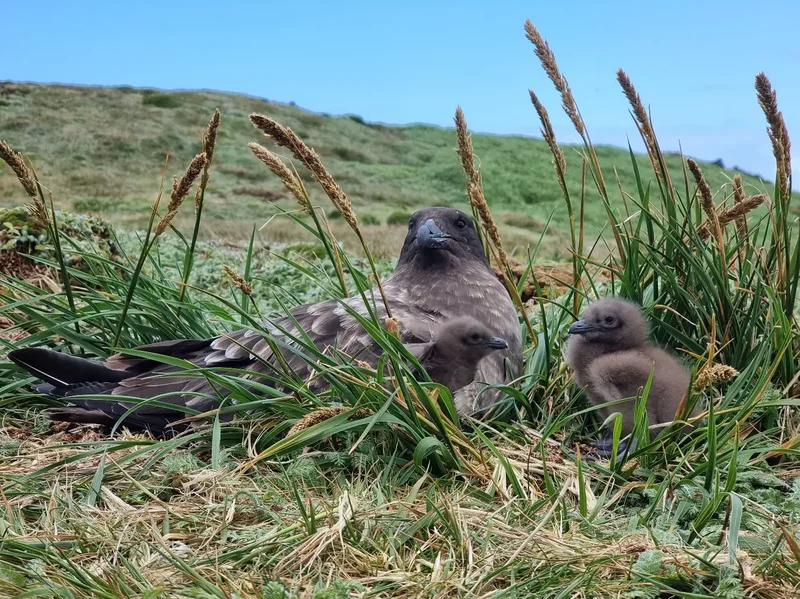
More than 30 years after South Africa eradicated feral cats from Marion Island in a landmark conservation success, scientists have discovered that one of the island's top predators has responded in a way nobody expected.
Instead of moving inland as native burrowing petrels slowly recovered, brown skuas are increasingly breeding along the coastline, despite relying on prey populations that are themselves declining.
The findings, published in Polar Biology by researchers from the University of Cape Town and Nelson Mandela University, suggest ecological recovery after the removal of invasive species is often far more complex than conservationists anticipate.
“Our findings show that even after one of the world's most successful invasive species eradication programmes, an ecosystem does not necessarily return quickly or predictably to its former state,” said lead author Michelle Risi, a PhD candidate at UCT's FitzPatrick Institute of African Ornithology. “Predators can respond in surprising and sometimes counter-intuitive ways.”
Marion Island, one of South Africa’s remote sub-Antarctic territories, became a global conservation success story after the last of about 2 000 feral cats was eradicated in 1991.
Introduced in 1948 to control mice around the research station, the cats went on to kill an estimated 450 000 burrowing petrels every year.
Scientists expected recovering petrel populations to lure more brown skuas inland, where the seabirds historically hunted them. Instead, the opposite has happened.
An island-wide survey in 2023 recorded 983 brown skua breeding territories, up from 878 during the past comprehensive survey in 1987-1988. But while the breeding population has grown slightly, its distribution has changed dramatically.
Breeding territories along the coast have increased by 39% over the past three decades, while inland territories have declined by 31%. More than 90% of breeding pairs are now found in coastal lowlands near penguin colonies.
“The shift towards the coast is unexpected because the skuas appear to be concentrating around prey populations that are themselves declining,” Risi said.
Researchers believe the birds may still favour penguins over burrowing petrels because they are easier to catch, while loyalty to established breeding sites and the uneven recovery of different petrel species could also be influencing their behaviour.
Despite the shift, the brown skua population appears stable, with breeding success remaining broadly similar to levels recorded in the late 1980s.
The study comes as Marion Island enters another period of ecological change, the researchers said. Climate change is altering Southern Ocean ecosystems, highly pathogenic H5N1 avian influenza has killed dozens of skuas on the island and South Africa is preparing a major programme to eradicate invasive house mice, which continue to prey on burrowing seabirds.