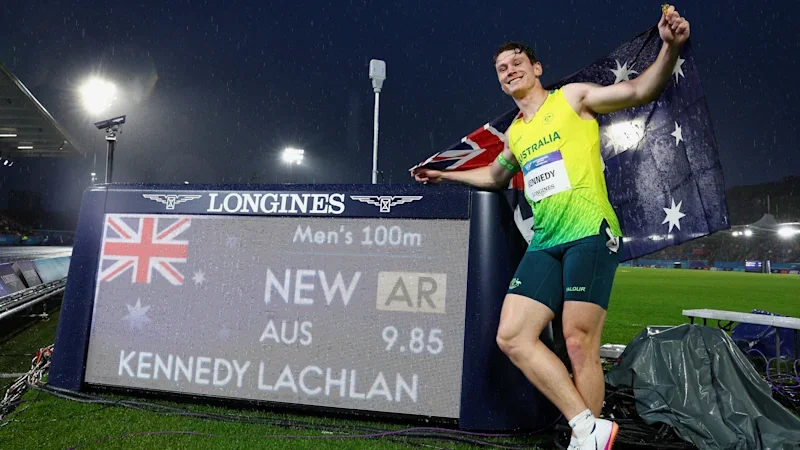
Glasgow: Australia has spoken of its new golden age of athletics. This was its golden night.
Sport is vulnerable to hyperbole, but it is not hyperbolic to say Tuesday night at the Commonwealth Games in Glasgow was possibly the greatest Australia has ever had in track and field.
Certainly it was in sprinting. And it was certainly the best night of athletics you probably slept through.
Lachlan Kennedy broke not only 10 seconds in the men’s 100 metres, but 9.9s. He broke the national record, won Commonwealth silver and was annoyed it wasn’t gold. Torrie Lewis broke 11 seconds in the women’s 100m and won bronze.
Ky Robinson matched Rose Davies’ effort from the night before and won 10,000m gold.
Eleanor Patterson and Nicola Olyslagers won gold and silver, respectively, in the high jump. While that no longer counts as a news story because they always share a podium and the question is only who takes the higher step, Patterson crowned herself a Glasgow queen. Her victory matched the Commonwealth gold she won in Scotland 12 years ago as a 17-year-old schoolgirl. Head-to-head, Patterson and Olyslagers have won 29 times each and tied one other time. It is a rivalry.
And from nowhere, Lara Roberts won a hammer throw bronze medal. The hammer! When does Australia ever win a hammer medal?
Six medals in one night is unprecedented. These were not school sports efforts, beating up on under-strength fields. The times these athletes ran in the sprints, and the runners they went stride for stride with, are world standard.
Sub-10 and -11 times put any sprinter in the mix at the line in any level of event. Kayinsola Ajayi, whom Kennedy edged out for silver in a photo finish, ran 9.84s only a week ago and an illegal 9.72 a week before that.
Gold medallist in the 10,000m, Robinson, was fourth at the world championships in the 5000m last year. He is the reigning NCAA champion over five and 10km in the US college system.
And this was without teen sprint sensation Gout Gout. At the risk of making this a Gout story when he is not here in Scotland, the point is that he isn’t here, and his compatriots did this anyway. Australia’s greatest night of sprinting happened without the biggest name in the sport for the last year competing here. But then, Kennedy and Lewis are reframing the idea of the big names in athletics.
The last time Australia won a men’s sprint medal, it was called the 100-yard dash and the British Empire and Commonwealth Games. Mickey Cleary won bronze that day in 1962. Sixty-four years later, Kennedy beat the man considered the fastest in the world this year, Nigeria’s Ajayi.
Kennedy becoming a 9.8s runner puts him in the frame in any meet, anywhere. At the Olympics inLA in two years’ time, he can win a medal with that sort of form, but beyond that with that sort of trend. His 9.85s in Glasgow was the fifth fastest in the world this year.
“I mean, I came in here wanting to win, but second place with a big, fresh PB, it’s a pretty good consolation prize, you know,” Kennedy said.
It should never have been like this. Nothing said it was a night to run fast. Hosing rain and cold, a small boutique track, thunder rumbling over the houses ringing the track.
“To be able to come out here in those conditions against a field like that … I mean, it’s pride, I guess. Very proud for my country to be able to get a medal in the Comm Games,” he said.
“It’s all about rising to the occasion. I’m a big believer in you have got to bring your best when it matters most.
“I mean, my goal is always to win in everything I do, be that Olympics, Comm Games, you know, Shield meets, I don’t really care who’s out there. At the end of the day, I can only control how I run. I can’t control how the others run. So I’m gonna go out there, do my best, and aim to win everything, including Olympics.”
Kennedy broke 10 seconds twice in the night – 9.94s in the semi-final then his 9.85 in the final. He is now a regular sub-10 runner, having broken through to single figures five times now. But more than that, breaking 9.9 is leaping ahead into new territory as a runner, especially to do it in unfavourable conditions.
Both he and Lewis will back up for the 200m and relays at these Games. In the form they are in, more medals beckon.
Lewis thought she’d broken 11 seconds in her semi-final; she crossed the line and the clock had stopped at 10.98s. Moments later it was revised to 11 seconds. They have a sense of drama, the Scots. She came to the final and smashed through the 11 anyway.
“I was hoping I got a medal, but I didn’t want to like, celebrate too early, just in case I got fourth or something else. But yeah, when I saw my name on the screen, I was super happy. And then to see the 10.99, I was really happy,” she said.
“I’ve just had Commonwealth in my sights ever since I didn’t make the Tokyo final [at the world championships] last year. You know, at first it was to make a final, but then through the year I’ve just been like, you know, I just want to go for a medal as well.
“It’s also just relief that I’ve been able to finish in one piece, and you know, it is confidence. Like you can just run through the pain and yeah, win a medal at Commonwealth.”
Seven’s Bruce McAvaney, calling from a seat behind this columnist, knew what we were seeing was special.
“Australian sprinting has never had a night like this,” he said. Indeed. It was special.
Get around our Commonwealth Games coverage
- King of Scotland: Idi Amin’s grandson vows to go for boxing gold in Glasgow
- As it happened: A record night at the track and huge haul in the pool
- Dethroned: Kyle Chalmers’ grip on 100m freestyle broken by youngster
Follow our coverage of the Commonwealth Games with live blogs covering every moment of the action from 6pm AEST daily.** **