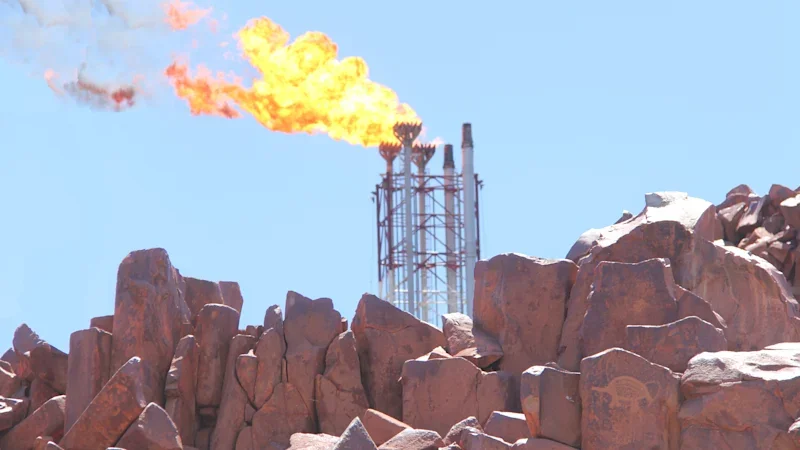
Australia’s largest oil and gas producer, Woodside Energy, has emerged as one of the nation’s biggest corporate beneficiaries of the Iran war, reporting nearly a 30 per cent revenue jump to $6 billion over the past three months.
As the conflict in the Middle East pushes the world deeper into an energy crisis, Woodside’s quarterly sales update on Wednesday offers one of the clearest signs yet of how surging fossil fuel prices are delivering major earnings boosts to exporters that operate outside the Persian Gulf, whose cargoes have become increasingly valuable as buyers seek reliable alternative supplies.
Demand and prices for shipments of super-chilled liquefied natural gas (LNG) – one of Australia’s most lucrative exporters – have surged since Iran launched missile strikes on a key Qatari LNG hub and disrupted tanker movements through the Strait of Hormuz, the vital trade corridor that normally carries about one-fifth of global LNG supplies.
Countries across Asia that usually rely on Qatari LNG to power their homes, factories and electric grids are desperate to find replacement cargoes to head off shortfalls. Customers have been increasingly turning to Australia – the world’s third-largest supplier of LNG, behind Qatar – to make up for the drop-off.
Woodside chief executive Liz Westcott said the LNG crunch had driven up prices and lifted the company’s sales revenue despite modestly lower production volumes across the quarter.
“Revenue is up, prices are up,” she said.
“The LNG market very much relies on the Middle East – Qatari volumes are 20 per cent of the global supply, and that’s been constrained completely.”
However, higher prices have also begun to erode demand. Some price-sensitive buyers in Asia had sought to shield themselves from soaring energy costs and had moved to lower their LNG consumption this year, including by switching back to dirtier sources of energy, such as coal-fired power stations, Westcott said.
“You’ve seen fuel switching in Asia to reduce demand as prices increase,” she said.
Some analysts have warned that this year’s upheaval in the LNG market may have lasting consequences for demand for the fuel. For the second time in four years, Asian nations have been reminded of the risks of their heavy exposure to LNG, including price shocks and shortages amid geopolitical turmoil. In 2022, LNG prices hit unprecedented highs following Russia’s invasion of Ukraine.
However, Woodside did not expect a long-term LNG demand reduction, Westcott said. Instead, Australian LNG suppliers could stand to benefit further in the future if Asian LNG buyers reconsidered their heavy reliance on Middle Eastern suppliers and pivoted toward trade partners perceived as more geopolitically stable, she said.
“We are seeing customers are recognising the benefits of diversification of supply,” she said. “Our proximity to Asia puts us in a really good place.”
This year’s LNG prices and sales revenue could also strengthen Australia’s budget outlook. Before the outbreak of the war on February 28, the federal government had anticipated a sharp decline in LNG export income from producers in Queensland, Western Australia and the Northern Territory. Official forecasters had projected revenue to slip from more than $50 billion to $47 billion in the 2027 financial year, dragged down by an impending wave of new LNG projects in the US and Qatar that had threatened to drive the market into oversupply.
Instead, the latest government projections, released earlier this month, reveal LNG revenue is now expected to climb from $59 billion in the 2026 financial year to $65 billion in 2027 – an increase of $18 billion compared to prior forecasts.
“A cessation of LNG output from Qatar due to military conflict has pushed LNG prices up sharply and raised price forecasts,” the report from the federal Industry Department said.
The revised forecast lands as the prospect of mega-profits in the gas industry has fuelled a political debate in Canberra. Climate groups, crossbench MPs and unions are pushing for higher taxes on multinational energy giants, arguing that the current federal offshore oil and gas tax – the Petroleum Resource Rent Tax (PRRT) – fails to deliver a fair public return.
The Albanese government has previously rejected independent senator David Pocock’s popular campaign to impose a 25 per cent tax on gas export revenue.
The Business Briefing newsletter delivers major stories, exclusive coverage and expert opinion. Sign up to get it every weekday morning.