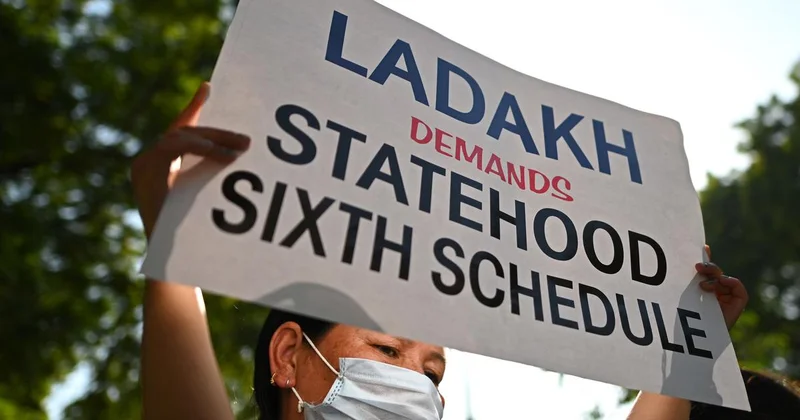
While public attention was justifiably focused on Ladakhi activist Sonam Wangchuk’s fast in Delhi, in support of the demands of the Cockroach Janta Party relating to education, there was quiet movement on the Union Territory of Ladakh’s long-standing demand for Constitutional safeguards.
At a meeting in late May between officials of the Central government and representatives of the Ladakh movement, whose minutes were confirmed in early July, there appears to have been a tentative breakthrough.
The movement has been demanding statehood and Sixth Schedule status – which would give Ladakhis considerable control over key decisions – for the moment, the agreement is more limited.
According to the official minutes: “It was unanimously decided that while statehood would remain the long-term aspiration of Ladakh, in the present situation, as a first step, an appropriate customized model of governance by establishing a UT level elected body with executive, financial and legislative powers would be established.”
As part of this, the elected body would have control and supervision of civil servants, including issuing their Annual Performance Appraisal Reports, documents that are crucial for the reputation and promotion chances of bureaucrats.
From the minutes, the precise nature of the elected body that will be established is not yet clear. There has been discussion about using Article 371 of the Constitution, under which some states have varying degrees of independent administrative, political and legal powers.
Nagaland, for instance, has the power to reject national laws and frame their own, as long as these are Constitutionally valid. Article 371A gives considerable powers to village councils. The minutes state that Ladakh could adopt a “customized sui generis model” and a draft containing details including executive, financial and legislative powers would be prepared.
Since the minutes do not specify who is to prepare such a draft, this is an opportunity for the Apex Body Leh and the Kargil Democratic Alliance to prepare their own. These organisations have been spearheading the movement for democratic powers since 2019, when the Central government’s action to downgrade Jammu and Kashmir’s Constitutional status had also carved out Ladakh as a Union Territory.
They have several years of experience weighing the pros and cons of possible pathways that could help fulfil the most important objectives of the movement.
These objectives include local collective rights to and control over land and resources, protection of the area’s unique ecological heritage and values, enhancement of livelihood opportunities including in governmental positions, and safeguarding the region’s ancient cultural identity, which is a mix of Buddhism and Islam, as also older faiths and customs, and a diversity of languages.
All of these are urgent, given that in the last few years of control by New Delhi through a lieutenant governor and a Union Territory administration mostly run by non-Ladakhis, several controversial processes and projects have been promoted.
The Autonomous Hill Council, which was recognised after considerable agitation for autonomy when Ladakh was part of the former state of Jammu and Kashmir, has been weakened, and currently non-existent since no elections have been held. Decisions regarding land-use have been dominated by the Union Territory administration.
The exploration for critical and other minerals continues and the exploitation of these resources could be ecologically damaging. Mega-projects are being actively pursued and contracts for infrastructure are going to outside bidders.
Tailor-made provisions
The Apex Body Leh and the Kargil Democratic Alliance have before them the possibility of cherry-picking the best of provisions from Article 371 and the Sixth Schedule, and even beyond as long as they are not constitutionally invalid. They can tailor-make legal, financial and administrative powers that would enable meeting the above objectives.
For instance, they could pick the power of Nagaland (and former Jammu and Kashmir) to accept (in original or modified form) or reject national laws. This is crucial in a situation in which the Central government has been systematically weakening provisions in environmental, labour and employment related laws.
They could choose provisions that significantly empower village and town level institutions to be able to take decisions on matters of land, environment, water, and so on. This includes recognising the long-standing and still robust yulpa (village assembly) and goba (village headperson) governance institutions of Ladakh, and clarifying their roles vis-à-vis panchayats. They could even consider these traditional institutions as equivalent to panchayats as is the case of the dzomsa system in north Sikkim.
Certain reforms in these could be mandated to remove discriminatory practices against women and marginalised castes. They could also enhance the legislative and financial powers of these local-level institutions, beyond the rather weak provisions available to panchayats in national laws.
Clear lines of power will need to be put into place with the principle of subsidiarity, with decision-making primarily at village- and town assembly-level, and only those decisions that cannot be taken at such levels, going to district- and Union Territory-level institutions.
Special provisions could be made for the ecological and livelihood security of unique regions such as Changthang, which has an ancient system of nomadic pastoralism, including the famous Pashmina goat rearing, and some of the world’s most valuable and beautiful high-altitude lake landscapes.
Local communities and the Union Territory elected body could be given powers to regulate tourism, which is a major source of livelihood for the people, but also causes problems such as garbage, pollution, excessive water use, drugs and certain cultural influences.
It is not clear if the Central government will insist on retaining the position of a lieutenant governor or governor, which comes with the status of a Union Territory. If so, provisions are needed to ensure that they cannot override the decisions of the elected body – with exceptions such as matters of security.
Another complicating factor is the heavy presence of the armed forces given Ladakh’s long international borders with Pakistan and China-occupied Tibet. This, like tourism, has had impacts that are both positive – jobs, investment – and negative, like the take-over of land, blocks to mobility.
On their part, Ladakh’s people have been mostly very cooperative, including with help in defending the borders. A clear understanding will be needed between the elected body and the army, to enhance cooperation and minimise harm.
There is, of course, no guarantee that even with full democratic power, Ladakh will be able to safeguard its cultural, economic and ecological well-being. A lot will depend on its own leaders and population.
After all, many of these objectives were also the foundation of the struggles that created Chhattisgarh, Uttarakhand and Jharkhand states, but subsequently their own leaders have often abrogated their responsibility towards social and ecological justice.
In a bid to generate financial resources, these state governments have mostly pursued the conventional model of development with mining, mass tourism and industrialisation, to the detriment of their own ecological and livelihood security.
If Ladakh has to blaze a different pathway, it will need to work out a political and economic model that is truly sensitive to its uniqueness, building on its own significant resources, and retaining all the revenues generated there. It could also consider establishing an independent environmental and community rights watchdog consisting of people with a proven track record.
Whatever legal status is decided on, at the outset some core principles should be enshrined, such as full democratic participation by people, ecological integrity at the heart of all development decisions, sustaining cultural diversity, gender and other forms of equality, collective control and governance of the commons, and priority to local people for livelihoods and jobs while not excluding migrants in need.
Given the awareness that the Apex Body Leh, the Kargil Democratic Alliance and activists like Sonam Wangchuk have shown over the last few years, there is hope that such a pathway can be set, once an appropriate Constitutional status for Ladakh is put into place.
Ashish Kothari is an environmental researcher.
We welcome your comments at letters@scroll.in.