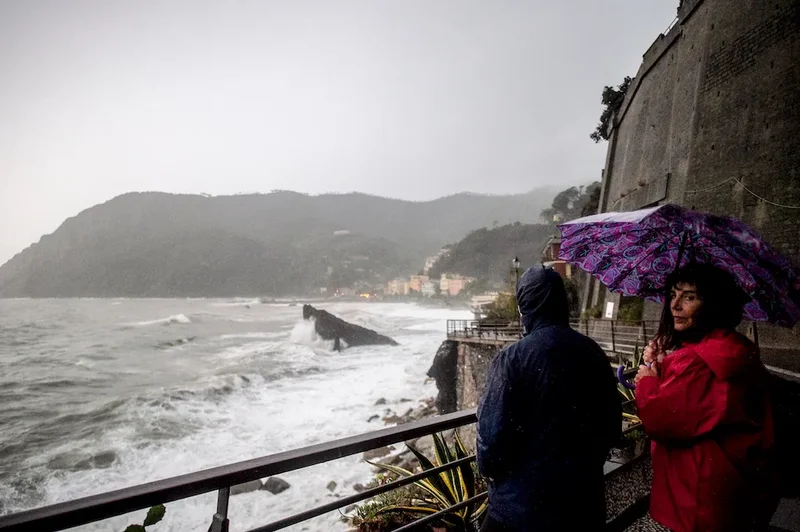
More storms were forecast in the north as cooler air was set to sweep across the country from Tuesday, ending the sweltering heatwave.
Italy’s weeks-long heatwave was set to break from Tuesday, but 17 cities stayed under the health ministry’s red heat alert on Monday as the extreme temperatures continued.
The red warning is the top of the ministry’s three-level scale. It marks conditions that are dangerous to everyone.
READ ALSO: What are Italian cities doing about intensifying heat?
Three elderly people died on Monday in the province of Lecce, in Puglia, two on beaches and one in a swimming pool, with heat suspected as a factor in all three deaths, Sky TG24 reported.
Long-awaited relief was in sight on Tuesday, when a new weather front was forecast to push back the African anticyclone that has gripped the country.
Cooler air from the north-east was set to bring scattered storms and strong winds to the north and centre of the country first, according to reports from weather website ilMeteo.it.
Its meteorologist Mattia Gussoni warned of a risk of hail in the north as the front arrived. “Given the sheer amount of energy present, we cannot rule out hailstorms of considerable intensity,” he said.
READ ALSO: Violent hail batters northern Italy as severe storms grow more frequent
The south and the islands were forecast to hold on to the heat until Tuesday, with highs of 40 to 42C and peaks of 44 to 45C continuing in Sicily, before cooler air reached them from Wednesday.
By Thursday northern and Adriatic highs could fall to around 24 to 25C, at or below the seasonal average, reports said.
Unstable conditions were then forecast to spread from Thursday, reaching the centre and south.
The south and the central Tyrrhenian coast would stay sunny for much of Tuesday, with temperatures still above 40C on Sicily and Sardinia.
The same heatwave has gripped much of western Europe, with wildfires burning across southern France. More than 1,300 excess deaths across the continent have been linked to extreme heat since June 21st, the World Health Organization said last month.
Europe is the world’s fastest-warming continent, heating at roughly twice the global average since the 1980s, according to the EU’s Copernicus Climate Change Service.
The continent now runs about 2.4C hotter than the preindustrial era, against 1.4C for the planet as a whole, a gap that is making prolonged heat of the kind Italy saw this month more frequent and more intense.