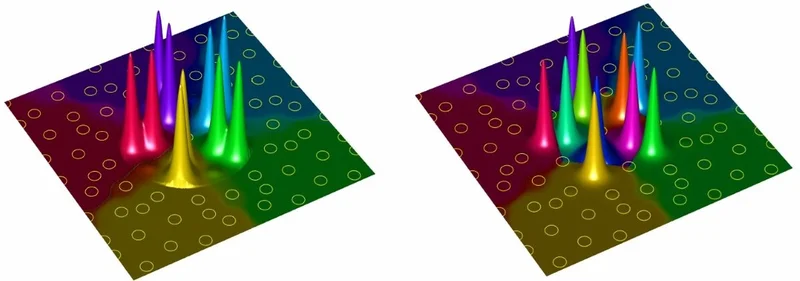
By reshaping quasicrystals with carefully designed defects, researchers can create and control stable twisting beams of light in new ways.
Quasicrystals are unusual yet relatively common materials. They show up in lots of different places from alloys to colloids and even in meteorites. They have some ordered structure, but unlike ordinary crystals their patterns never repeat.
This mix of order and irregularity leads to interesting behaviour when waves move through them. In optical versions of these materials, light can become trapped or guided in ways that doesn’t happen in regular structures.
In a new study published recently, a team of researchers investigated what happens when light beams with a twist, called vortex beams, travel through quasicrystals that have been deliberately altered. They began with a classic pattern known as the Penrose tiling and then introduce large scale defects by removing or adding wedge shaped sections. This let the researchers tune the rotational symmetry of the structure and compare how light behaves in each case.
Using a standard model for how light travels through the material, the researchers showed that these modified quasicrystals can support new vortex states. These include two distinct types of vortex solitons, which are twisted beams of light that keep their shape as they travel rather than spreading out.
Usually, these light states require carefully tuned input power and are easily disrupted. What’s different in this case though is they form even with weak input and remain stable under small disturbances. This makes them far more applicable to real-world conditions.
These vortex beams can carry information in the amount of twist they have, providing an extra way to encode data alongside commonly used properties such as intensity or colour. If they remain stable as they travel, they would allow more information to be sent through the same optical system. This could be very useful in optical communication systems, where fast and efficient data transmission is essential.
Read the full article
Hua Zhong et al 2026 Rep. Prog. Phys. 89 067903