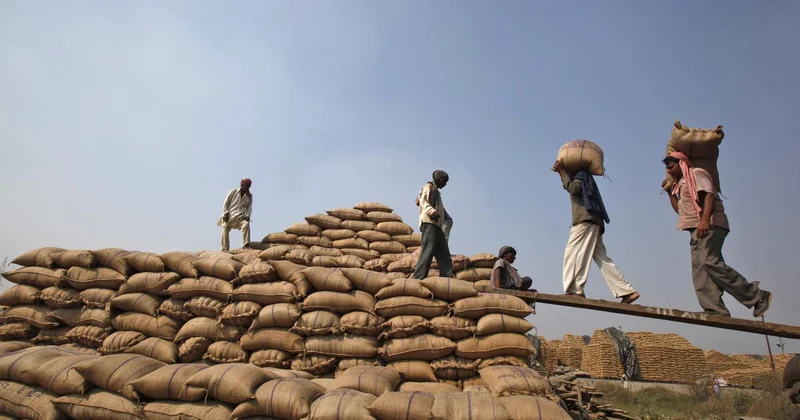
The Food Corporation of India sold rice to ethanol distilleries at about 40% below its average acquisition cost between June 2025 and June 2026, the Union government told Parliament on Tuesday.
The rice was sold at a price of Rs 2,250 per quintal to Rs 2,320 per quintal. The average acquisition cost was Rs 3,720 per quintal in the financial year 2024-’25 and Rs 3,889 per quintal in 2025-’26 based on data available so far, the Ministry of Food and Public Distribution told the Rajya Sabha.
Between November 2026 and June 2027, rice will be sold to ethanol distilleries for Rs 2,390 per quintal, it added.
The public sector organisation dispatched 6.3 million tonnes of rice worth Rs 14,596 crore to ethanol producers during the 12-month period.
At 844,141 tonnes, Haryana received the largest allocation of rice during the period. It was followed by Uttar Pradesh at 838,645 tonnes, Punjab and Himachal Pradesh combined at 658,952 tonnes, West Bengal at 584,672 tonnes, and Madhya Pradesh at 432,485 tonnes.
The government said that there is no subsidy granted to ethanol manufacturers for procuring rice for producing ethyl alcohol.
The ministry said that during the one-year period, the authorities found two cases of Food Corporation of India’s rice meant for ethanol production being diverted and action was initiated.
“Following detection of irregularities in the movement of rice consignments by the two distilleries, state food departments have taken necessary action,” the ministry said. “FCI has also discontinued further allocation of rice to these distilleries.”
India’s ethanol production has risen amid the Union government’s Ethanol Blended Petrol programme. It currently mandates the sale of petrol blended with 20% ethanol. India hit its target of reaching a 20% ethanol mix in petrol in July 2025, five years ahead of schedule.
The blending of ethanol with petrol is part of India’s broader energy transition strategy aimed at reducing dependency on fossil fuels, cutting greenhouse gas emissions and boosting income for sugarcane farmers.
However, consumers have complained that the new fuel mix damages engines and reduces their mileage.
An opinion poll by LocalCircles published on July 5 showed that 53% of the surveyed petrol vehicle owners said that they believe that the government’s handling of the E20 rollout was “disastrous” or “ineffective”.
Written by Nachiket Deuskar. Edited by Tanya Shrivastava.
We welcome your comments at letters@scroll.in.