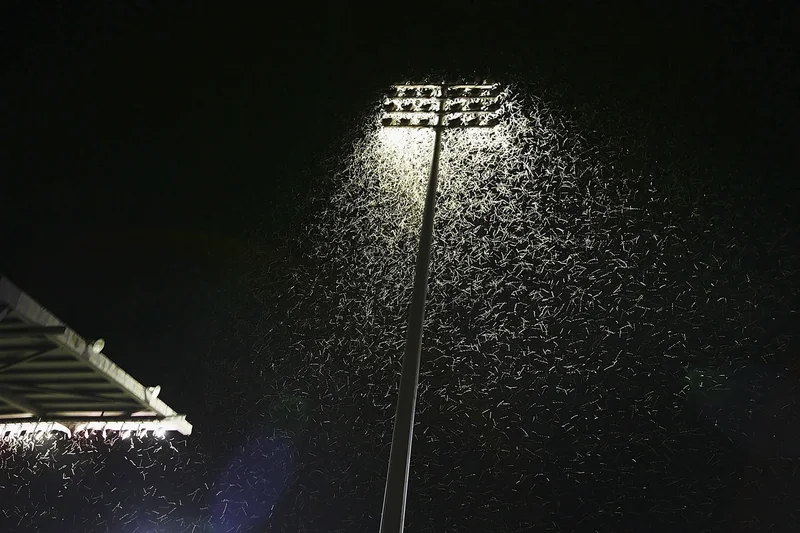
A small change to LED lamps in cities could potentially save the lives of millions of insects from artificial light pollution at night, without compromising human needs, scientists find in a new study.
Artificial lights have transformed human life, allowing people to travel, work and move around safely after dark.
But a growing body of studies finds they can be deadly for insects, which may get trapped in endless circles around lamps until they die from exhaustion.
Artificial night lighting is suspected to be one of the main pressures causing global insect population declines.
“The global increase in light pollution and the brightening of the night sky in recent decades therefore pose major threats to insect diversity and are of growing importance for national and international nature conservation,” write scientists from Leibniz Institute for the Analysis of Biodiversity Change in Germany.
Now, researchers have tested along a stretch of railway lines whether changing to a different set of artificial lights could save insect lives.
They found that specially designed 1800 Kelvin “amber LED” lights, which emit almost no blue light, attract far fewer insects than the conventional white LEDs (light-emitting diode) and high-pressure sodium lamps.
These special lights were chosen as insects are sensitive to ultraviolet, blue and green wavelengths.
The findings, published in the journal Biological Conservation, could lead to a practical way to make essential urban infrastructure wildlife-friendly.
In the study, scientists monitored insects flying near alternative light sources using semi-automatic air filter traps and artificial intelligence-based image analysis.
The analysis was conducted at six railway stations inside the Westhavelland Nature Park in Brandenburg, Germany.
Researchers replaced the lights on selected railway platforms with different lamp types while leaving others unchanged.
They also left some areas completely unlit to act as control sites.
Between 2023 and 2025, the study collected nearly 71,000 bugs, mostly beetles, flies, moths and butterflies, bees, wasps and ants.
While all the illuminated sections attracted many more insects than the unlit controls, amber LEDs consistently attracted far fewer bugs than the other lighting systems, researchers found.
“This reduced attraction is primarily driven by the narrow spectral composition and the absence of short-wavelength blue light in the 1800 K LED,” scientists wrote.
Amber LEDs reduced insect abundance by about 40 per cent in 2023, and by 44 per cent in 2024.
About 48 of the identified species in both years were listed as critically endangered, endangered or vulnerable, while 38 species receive legal protection, scientists noted.
“Our results underscore the substantial potential of 1800 K LED lighting under real-world conditions to mitigate ecological impacts on nocturnal flying arthropods, including threatened and legally protected species,” they concluded.