Delta Electronics is a Business Reporter client
Why charging infrastructure will define the next phase of industrial electrification.
The hidden constraint behind industrial electrification
Industrial electrification is accelerating at pace. Autonomous mobile robots, automated guided vehicles and electric material handling fleets are rapidly becoming standard in modern production and logistics environments. They promise greater flexibility, lower emissions and data-driven operations. Yet as these systems scale, a less visible constraint is beginning to emerge. The limiting factor is no longer the vehicle or the software controlling it. It is the infrastructure that keeps it running.
For years, discussions around Industry 4.0 have focused on connectivity, data and automation. Energy, by contrast, has largely been treated as a given – a background utility rather than a strategic variable. In highly automated environments, this assumption no longer holds. Energy is not just a prerequisite for operations; it is embedded in the process architecture itself. Autonomous systems respond in real time to production demands, are tightly integrated into warehouse and fleet management systems, and directly influence throughput and cycle times. In this context, any disruption to energy availability becomes a systemic risk.
Scaling fleets means scaling energy systems
As fleets grow, the challenge shifts from individual vehicle performance to infrastructure scalability. What works for a handful of vehicles quickly breaks down at scale. Charging must happen more frequently, often in short windows, and without interrupting operations. At the same time, systems must handle high power loads, maintain reliability in continuous operation and integrate seamlessly into automated workflows. Energy delivery becomes a coordination challenge rather than a standalone technical task.
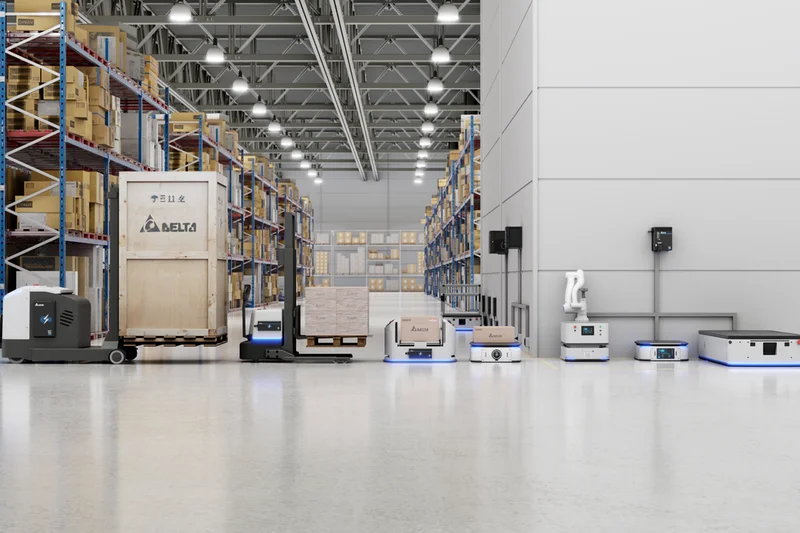
This shift is already visible in industrial practice. Charging solutions developed by Delta, brought together in its MOOV portfolio, have supported more than one million industrial electric vehicles worldwide, including AGVs, AMRs and forklifts operating in demanding 24/7 environments. This milestone is less about scale alone and more about technological maturity. It demonstrates that both conductive and inductive charging systems are no longer experimental technologies, but proven infrastructure operating reliably under real-world industrial conditions. Just as importantly, it highlights a broader shift in industrial priorities: the question is no longer whether electrified fleets can be deployed, but how reliably they can be sustained and integrated into continuous operations over time.
From charging events to continuous energy flow
Traditional charging models based on long idle periods are being replaced by opportunity charging, where vehicles charge in short, frequent intervals embedded directly into operational processes. This approach increases fleet availability but also places significantly higher demands on infrastructure. Systems must withstand extremely high cycle rates while delivering consistent performance and integrating seamlessly into automated decision-making systems.
Within its MOOV portfolio, Delta addresses these requirements through both conductive high-performance charging solutions and wireless systems. Contact-based platforms are designed to deliver high power within short time windows while handling billions of charging cycles in continuous operation. The real value, however, lies not in the individual charging unit itself, but in how these systems integrate into higher-level control and process logic. Once charging becomes predictable and aligned with operational workflows, energy shifts from being a constraint to a controllable operational parameter.
This has direct implications for how facilities are planned and operated. Energy availability increasingly influences throughput, process stability and overall system efficiency. In highly automated environments, charging infrastructure is no longer separate from production logic – it becomes part of it.
When environments push infrastructure to its limits
Not all environments can be addressed with conventional approaches. In settings characterised by dust, moisture, hygiene requirements or mechanical wear, physical contacts quickly become a point of failure. This is where the second dimension of Delta’s MOOV portfolio becomes increasingly relevant. The MOOVair Wireless Charging Systems enable fully contactless energy transfer, significantly reducing maintenance requirements and potential downtime while supporting continuous automated operation.
What makes these applications particularly notable is the breadth of environments in which the technology is already being deployed – ranging from agriculture and food production to highly automated intralogistics and demanding outdoor industrial operations. In agriculture, for example, Dutch company Lely, one of the world’s leading providers of automated systems for dairy farming, integrates Delta’s inductive MOOVair technology into autonomous barn cleaning robots to ensure reliable continuous operation in environments characterised by dirt, moisture and biological exposure. Similarly, Neumaier Industry GmbH & Co. KG, a specialist in automated intralogistics and driverless transport systems, uses Delta’s wireless charging solutions for autonomous outdoor tugger trains and forklifts operating without manual intervention and under changing weather conditions.
In both cases, charging infrastructure does not merely support automation – it increasingly determines whether automation can be implemented reliably under real-world industrial conditions in the first place.
Infrastructure as an enabler, not a constraint
These examples point to a broader shift. Charging infrastructure is no longer simply supporting existing processes; it is enabling entirely new operating models. The question is no longer how to charge a vehicle, but how to design energy systems that align with the dynamics of automated operations.
This has important implications for how companies approach electrification strategies. Energy can no longer be treated as a downstream consideration. It must be designed as an integral part of the system from the outset. This includes not only hardware, but also integration into control systems, data flows and operational planning. Decisions about fleet size, process design and system availability are becoming increasingly tied to how energy is delivered, managed and orchestrated across the operation.
The next bottleneck is already visible
As industrial systems continue to evolve, the next bottleneck is already becoming visible. It is not a lack of automation technology or digital capability, but the ability to deliver energy in a way that matches the speed, flexibility and scale of modern operations. Companies that recognise this shift early will be better positioned to scale their automation strategies and enhance their competitiveness.
In the end, the future of industrial electrification will not be defined solely by smarter machines or better software. It will be defined by how effectively energy is integrated into the system as a whole.