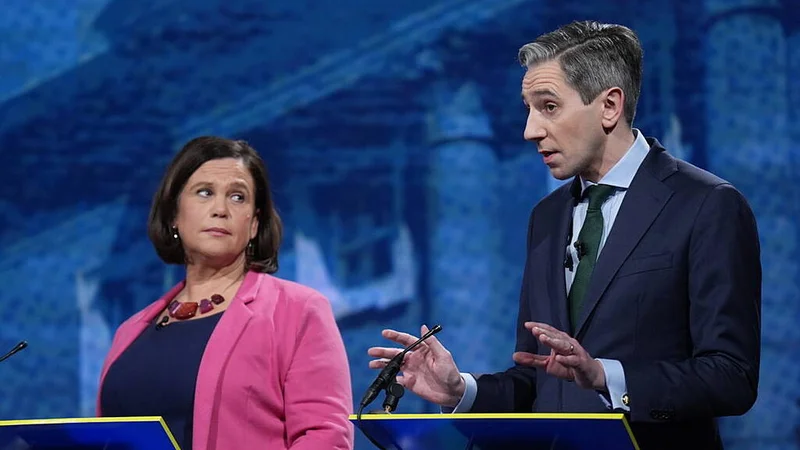
Since emerging as Ireland's largest party in the 2020 general election, Sinn Féin's fortunes have been on a downward trajectory.
Mary Lou McDonald's party couldn't come to any agreement with left-wing parties to even come close to a viable alternative government, and despite a united front in campaigning for President Catherine Connolly, this looks no closer six years on.
They slipped further back in the 2024 general election, with differences between the party and its potential coalition partners more evident that ever.
McDonald frequently engages in bitter Dáil confrontations with Taoiseach Micheál Martin. However, her relationship with Tánaiste and Fine Gael leader Simon Harris seems to have thawed somewhat.
They rarely have a good word to say about each other, which is why some eyebrows were raised after it was revealed McDonald and Harris had held "extremely constructive" talks on Irish unity.
It followed an earlier debate on Irish unification, after which Sinn Féin enterprise spokeswoman Rose Conway-Walsh told the Tánaiste “Michael Collins would be pleased with you".
McDonald called Harris' presentation “refreshing” and “exactly where we need to be”.
After the recent meeting between the party leaders, McDonald said: "I think there is a recognition now that we need to work together collaboratively, that the preparation needs to be made . . . There’s an awful lot of work to be done.
“There is a lot of talking to be done and a lot of listening to be done and the planning needs to go ahead. So another step, another constructive conversation on our pathway to referendums and an orderly, democratic and peaceful transition from partition to a unified Ireland.”
A spokesman for Harris said he “gave a commitment in the Dáil earlier this month to continue working across the House with party leaders from all parties to advance the ongoing conversation about Irish unity”.
“On that basis and following a request from the leader of Sinn Féin, the Tánaiste met Deputy McDonald earlier today to discuss these matters.
“The Fine Gael leader looks forward to his continued work with Government colleagues and engagement with other party leaders on these issues in the future.”
Again, this marks a significant leap in relations between the two parties. While Sinn Féin subsequently reverted to its usual attacks on the Government, it suggest a willingness to work together on certain issues.
No issue is more important, or existential, to Sinn Féin than Irish unity, so if common ground can be found here, could it be found on a potential future coalition?
One thing is certain, Fianna Fáil will never work with Sinn Féin while Micheál Martin is in charge.
After Fine Gael and Fianna Fáil put their Civil War history behind them to form a coalition in 2020, both stated they would never work with Sinn Féin.
However, six years is a long time in politics. Many TDs have softened their stance on the issue, after all being in power is what drives most politicians.
Then-taoiseach Leo Varadkar famously described Sinn Féin as "not a normal party". However, some in his party, including Harris, may hold a different view.
After six years in power together, Fianna Fáil and Fine Gael have a strained relationship, so working with Sinn Féin may not be as alien a prospect as it once was for many TDs.
As previously stated, this will never be a possibility for Fianna Fáil under Martin.
With Fine Gael at least hinting at moves in such a direction, pressure may now mount on the Taoiseach. He has insisted he will lead Fianna Fáil into the next general election.
However, sources within the party have suggested January 2027 is a more likely ending point for his leadership, after Ireland's EU Presidency ends on December 31st, 2026.
Potential successors to Martin as party leader include Minister for Justice Jim O'Callaghan, Minister for Social Protection Dara Calleary, Minister for Transport Darragh O'Brien and Minister for Public Expenditure Jack Chambers.
Whoever it is, it would give them about 10 months as taoiseach before the rotation with Fine Gael in November 2027.
They may want to hold their own 'constructive talks' with Sinn Féin to keep coalition options open.