S’pore’s first specialised gym for stroke patients opens, bridging gap between rehab and fitness
AI generated
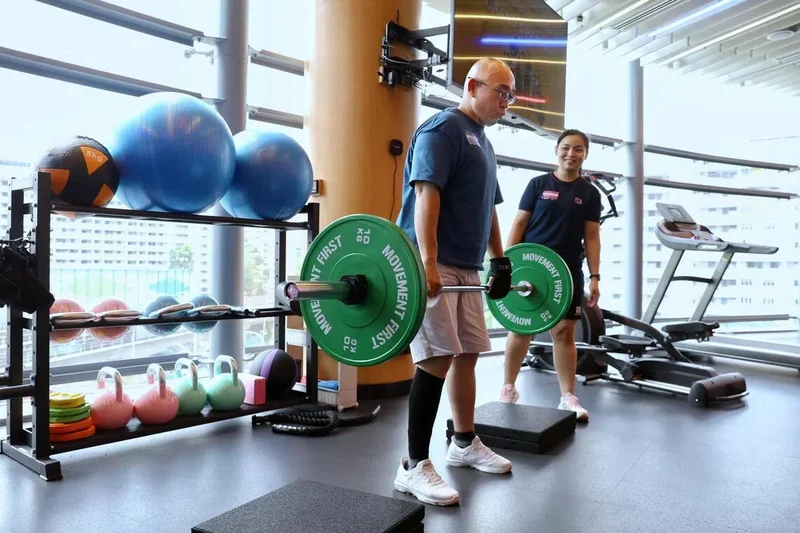
SINGAPORE - Watching Edmond Poh, 47, vigorously lifting weights, one would not think he suffered a stroke two years ago.
“I was in the office when I felt strange, as if my body was slowly shutting down,” the senior manager for operations training told The Straits Times.
At Tan Tock Seng Hospital’s emergency department, he was told that he had suffered a haemorhagic stroke and lost strength in the right side of his body.
“My twins were only seven when I had the stroke so I needed to recover for their sake. Once I was done with rehabilitation, I wanted to look for a gym to continue building up my fitness. That was when I read in the Straits Times that a new gym to help rehabilitate stroke patients will be open in 2026,” Poh said.
Stroke is the leading cause of adult disability and the fourth cause of death in Singapore. It occurs when there is a disruption of blood flow to the brain.
Age and chronic diseases like high blood pressure and diabetes are major risk factors for stroke, and the incidence of stroke among younger adults below 50 years of age has also significantly increased.
Almost one in five (18 per cent) of stroke survivors are readmitted to hospital following a recurrent stroke, within five years of their first stroke.
While rehabilitation helps stroke survivors regain essential function, continued physical activity is vital to sustaining long-term recovery.
That is where the new adaptive gym by Stroke Support Station (S3) - called S3 Summit - comes in.
Located on the fourth floor of AMK Hub in Ang Mo Kio, it was officially opened by Heng Swee Keat, Chairman of the National Research Foundation and Chancellor of the Singapore Institute of Technology on July 29.
Heng, a stroke survivor himself, said the the months during his recovery taught him an important lesson - that recovery does not end when one leaves the hospital.
“It is a lifelong journey, one that depends not only on medical care, but also on the support of family, friends, and the wider community,” he said.
To regain their health and reduce the likelihood of returning to hospital, stroke survivors need access to stroke-focussed information and programmes, such as specialised rehabilitation and community support initiatives designed exclusively for them and their caregivers.
“This gym breaches a critical gap between clinical rehabilitation and long-term recovery ... (and) empowering them to stay active,” Heng added.
Chief Executive Officer of S3 Ng Rei Na said: “Some survivors may feel uncertain about how to exercise safely, worry about getting injured or find that existing fitness programmes and conventional gyms do not adequately support their recovery needs.
“S3 Summit provides a dedicated space where exercise is adapted to them and not the other way around.”
This includes a combination of rehabilitation and fitness based equipment specially selected and adapted to stroke survivors, designed to support improvements in mobility, strength, coordination, balance and endurance.
An example is the SkiErg machine which combines upper-body strength and endurance with cardiovascular training, providing a full-body workout. Mounted on the wall with specialised wide floor stands and handle hook accessories, it is suitable for stroke survivors and wheelchair users, who are able to roll up and train directly from their chairs.
Ng said there are five stroke-trained exercise trainers and a senior physiotherapist at the gym, which can accommodate up to 40 stroke survivors at one time.
“Fashioned after the rehabilitation gyms in the United States that we visited, we wanted S3 Summit to be bright and cheerful and have the exercise trainers push the survivors to their limits in a friendly and encouraging manner,” she said.
Over the next five years, S3 Summit aims to support up to 1,200 stroke survivors with the knowledge, skills and confidence to exercise safely and transition to independent gyms.
It is supported by a $1.5m investment from Lien Foundation, as part of its $6.59m initiative which aims to strengthen recovery for stroke survivors through an integrated continuum of care which includes progressive rehabilitation and community-based support through long-term recovery.
Its spokesperson said: “We definitely see the potential for this to be beyond one location but for now, we will focus on strengthening the model and improving it to ensure it continues to address the evolving needs of stroke survivors.”