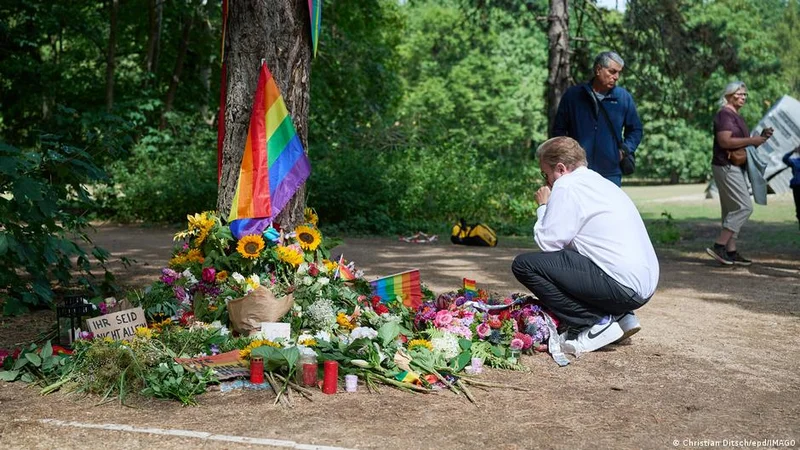
Following Saturday's deadly attack by suspected Islamist assailant Abdul B. against Berlin's Pride event, a debate has erupted in Germany over what lessons the country should draw from the incident. The 21-year-old, who was later shot and killed by police while he was on the run, had had two intake interviews in June and July as part of a deradicalization program in Berlin.
However, according to Thomas Mücke, executive director of the Violence Prevention Network, it did not appear that Abdul B. genuinely wanted to turn his back on the Islamist scene — and it is unlikely that he would have been accepted into the program.
Similar cases have also occurred periodically in the Islamism Exit Program (API).
"We then have to conclude that assistance in exiting is not possible at that point because we have no reason to believe the individual actually wants to distance themselves." API exit program counselor and social worker Stefanie Adler* tells DW.
The Islamism Exit Program API is based in Germany's most populous state of North Rhine-Westphalia, was established in 2014 to support people who want to break away from Islamist circles, including many who are considered potential threats by security services.
"What we've seen over the past two years is that we're dealing with younger and younger individuals. In the past, we saw people traveling to Syria, and it was more or less clear that they went there and joined the Islamic State, became radicalized in the real world," Adler explains.
Today, she says, they are younger, and they are often radicalized through digital media. "Social media acts as an amplifier for radicalization — and it happens much faster," Adler adds.
Deradicalization is a 'long and arduous process'
Some individuals do not approach the API on their own initiative, while other potential candidates are reported to the police or youth court services by contact persons in correctional facilities.
"We then take a closer look at the person," said API deradicalization counselor and psychologist Viola Geiger*, "gather information, and begin the counseling process — initially on a weekly basis, and toward the end, sometimes every few months. It's definitely a lengthy process."
Once an individual has credibly distanced themself from violence as a legitimate course of action and learned to cope with crisis situations on their own, they are considered successfully deradicalized and their cases are closed. But achieving this requires patience and persistence.
In one case, API exit program counselors worked with one individual for as long as seven years. In spite of these challenges, says Stefanie Adler, deradicalization programs are absolutely essential.
"What would be the alternative if these programs didn't exist? Many people who are released from prison after serving a sentence need such programs to reintegrate into society," said Adler. And the public is largely unaware of the many success stories. "People forget that those who have successfully left the movement then fly under the radar and no longer appear in public because they simply want to live their lives."
The effect of global political instability
Forty organizations and initiatives working on prevention, disengagement or deradicalization in the area of religiously motivated extremism are organized under the umbrella association the Federal Working Group on Religiously Motivated Extremism, or BAG RelEx for short. Its executive director, Jamuna Oehlmann, was just as shocked as many others after the attack in Berlin.
However, she told DW that the problem of radical Islamism in Germany remains significant.
"There are also more and more young women who are becoming radicalized. But still, it is above all young men in Germany who are becoming radicalized, who commit acts of violence and who act out their violent fantasies," Oehlmann says.
Radicalization is a process with many contributing factors, she explains, where various elements converge and, in the worst-case scenario, lead to radicalization. "Society and external factors play an important role in this, but so does the responsibility of each individual who becomes radicalized."
Oehlmann identified specific crisis situations, or "push factors," that can cause people to become alienated from society. These include the loss of a beloved parent, failing an exam, a housing crisis, job loss, experiences of discrimination, exclusion and bullying. Additionally, the global increase in political instability is also driving people to despair.
"Then there are Islamist groups who know how to take advantage of these life crises and target young people by giving them the feeling: 'You will be heard with us, you belong with us, you can be someone with us.' And in addition, they simplify the complexity of the world by breaking it down into good and evil, black and white."
Deradicalization programs threatened by budget cuts
That's why it's all the more important that funding for organizations working to prevent or deradicalize Islamists not be cut. However, Federal Minister of Education Karin Prien has announced exactly that.
Minister Prien plans to restructure the Live Democracy! funding program. Funding for approximately 200 projects is set to expire at the end of the year. Twenty-three of the 40 member organizations of the Federal Working Group on Religiously Motivated Extremism are affected by this.
Jamuna Oehlmann is critical of this decision. "The problem is that even projects that are doing good work are affected by this. And so now they're having to focus on fundraising — that is, finding new sources of funding — instead of concentrating on the actual work of preventing Islamism. We need reliability and a long-term approach."
*Name has been changed to protect privacy
This article was translated from German.