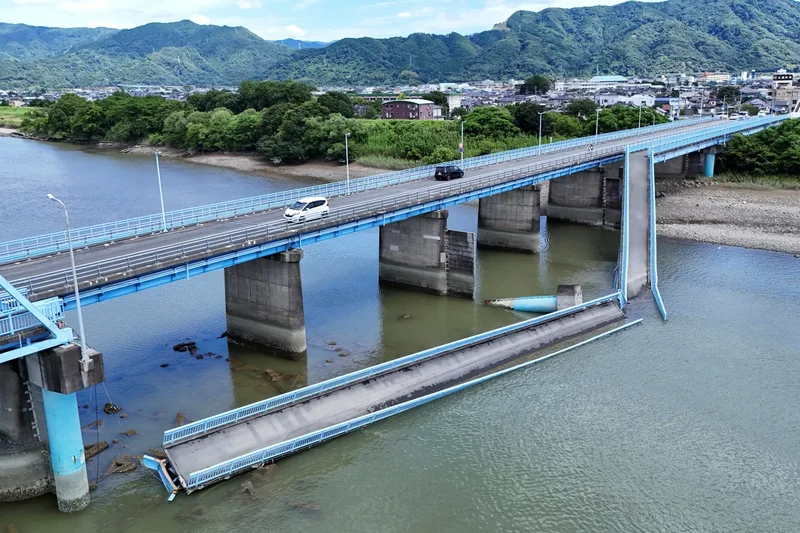
Rescuers in Japan raced to find more people still trapped inside collapsed buildings on Wednesday after a powerful 6.8-magnitude earthquake struck southwestern Kumamoto prefecture a day earlier, killing at least 18 people and leaving many missing.
The death toll rose to 18 by Wednesday evening with at least 62 people injured, including six suffering serious injuries, the prefectural government said.
More than 170 aftershocks have jolted Kyushu, Japan’s southernmost main island, since Tuesday’s earthquake, while nearly 10,000 people have been displaced from their homes and taken to evacuation centres.
One of the largest rescue operations remained focused on the Aeon shopping mall in Kumamoto, where an explosion tore through the building about an hour after the earthquake.
As of Wednesday afternoon the company operating the mall said three people had died in the incident, while another three remained missing. Another eight people had been pulled from the heavily damaged mall in overnight operations.
The mall had only reopened last month after years-long renovations following damage from another major earthquake in 2016, which had including measures to strengthen the building against seismic activity.
The president of the Aeon Mall in Kumamoto, Akio Yoshida, told a press conference search was ongoing to find the remaining people missing. "We take it seriously that an explosion happened and precious lives were lost," Mr Yoshida told the news conference, where he bowed deeply alongside two other executives.
Some 3,000 customers were inside the mall at the time of the earthquake, and between 1,300 and 1,500 employees, according to Mr Yoshida.
Rescue operations continued in nearby Yatsushino, where a chimney collapsed in the intense shaking at a Nippon Paper Industries factory, killing five workers. Seven others were rescued.
Four people were still believed to be trapped there, said the Kumamoto prefectural government disaster team.
“Arduous rescue operations are still underway,” governor Takashi Kimura of Kumamoto said during a meeting about the disaster. “As the situation remains unpredictable, we intend to take all possible measures right now.”
Prime minister Sanae Takaichi offered condolences to the families of those dead and expressed gratitude to rescue teams “working tirelessly through the night.”
“There are still people waiting to be rescued, and every minute counts. We will continue to devote every available resource on the ground to saving as many lives as possible,” she said.
Ms Takaichi said the federal government was preparing to deliver food and other necessities to hard-hit areas for thousands of people who had been moved to around 450 evacuation centres.
She said efforts were being made to provide evacuation centres with food, water, air-conditioning and power generators amid scorching heat in parts of the country, with temperatures hitting around 34C (93F) on Wednesday.
More than 35,000 households remained without electricity on Wednesday morning, according to Kyushu Electric Power, while about 84,000 households across five prefectures were without running water.
Some hospitals have reported being overwhelmed in the aftermath of the disaster, as power outages exacerbated the strain on emergency services.
One hospital in Uki City, near the epicentre, said a power outage caused by the earthquake left it unable to function.
"It's become like a field hospital," the head of the hospital's administrative department told NHK.
Another hospital in the city said it had suspended admissions because it could no longer handle additional emergency cases after treating 86 people injured in the quake, including three in serious condition.
Residents recounted terrifying experiences as they experienced multiple aftershocks. Many said the quake stirred up memories of 2016 disaster that killed more than 270 people and injured thousands of others in the same prefecture.
Riko Furuta, 23, said she spent the night at her office after the earthquake struck and experienced aftershocks the entire night.
"I couldn't sleep because the earthquakes continued throughout the night. It was more frightening than 10 years ago," she told Kyodo.
Kiyoshi Matsunaga, 74, who lives near the shopping mall, said he feared for his life when the powerful earthquake struck.
He was shopping at a nearby supermarket when the ground began shaking as he pushed his trolley towards the checkout. Goods flew from the shelves and he found himself unable to move.
"I thought I was going to die," he said. "I was frightened."
Workers near the Aeon mall described being thrown to the floor and being enveloped in a cloud of dust by the impact of the blast.
"I thought a bomb had gone off," Takateru Sonoda, 41, who runs a combined hair salon and cafe near the mall, told news agency Jiji Press.
"There were people calling on others to evacuate and sirens were ringing out. Nearby roads were gridlocked, it was a state of panic," Mr Sonoda said.
One worker manning one of the mall's 200 stores told the Yomiuri newspaper that Tuesday's earthquake shook the building for 10 seconds and brought him to his knees.
The Aeon shopping mall, the prefecture's largest shopping and entertainment complex, had been rebuilt with seismically reinforced ceilings and other safety upgrades after suffering heavy damage a decade ago.
But video footage shot by a police officer after the disaster struck showed large sections of the ceiling had collapsed, store fronts had been blown open, and furniture was strewn across the floor.
While the cause of the explosion remains unknown, investigators have focused their probe around a possible gas leak following the earthquake.
Rescuers reported smelling gas inside the building, and a TV correspondent reporting from the site said an emergency vehicle repeatedly urged people not to go near the mall due to a possible gas leak.
The cause of the incident was still under investigation, said Japan's top government spokesperson, Minoru Kihara.
Mr Kihara said the mall used LPG (liquefied petroleum gas), which is transported in large canisters rather than via a pipeline.
According to experts in Japan's gas industry, both piped gas and LPG systems are designed to automatically shut off during strong earthquakes or if leaks are detected. Aeon has not commented on the shopping mall's gas supplier or the safety measures in place.