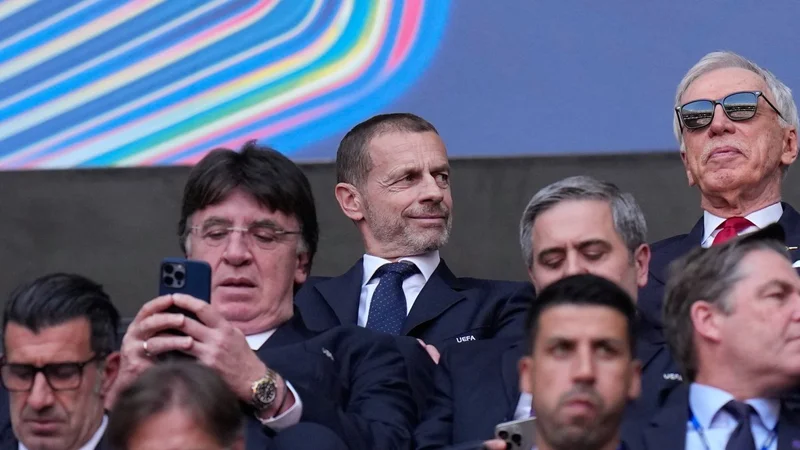
UEFA will convene an emergency meeting of its 55 member associations on Wednesday as European football moves to mount a coordinated response to FIFA's controversial plan to open the commercial rights of the World Cup and other major tournaments to outside investors.
French Sports Minister Marina Ferrari confirmed the meeting in a social media post, calling for European football to unite against a proposal she said could fundamentally reshape the game's future.
"I acknowledge the emergency meeting to be held Wednesday among European football authorities," Ferrari wrote. "Faced with a project that could profoundly transform the balance of our sport, it is essential that European stakeholders speak with a single voice."
The emergency talks come just a day after FIFA unveiled plans to establish the FIFA Forward Enterprise (FFE), a wholly owned commercial subsidiary that would manage the governing body's most valuable assets, including media rights, sponsorships, ticketing, licensing and event operations for the men's and women's World Cups, the Club World Cup and other flagship competitions.
FIFA has valued the new entity at approximately $20 billion and intends to sell minority, non-controlling stakes of up to about 21% to long-term investors, potentially raising as much as $4.2 billion this year. FIFA insists it will retain majority ownership and exclusive authority over governance and sporting decisions while reinvesting all net proceeds into football development across its 211 member associations.
The governing body projects the initiative could generate more than $10 billion in development funding over the next four-year cycle through increased annual distributions and one-time payments to national federations.
The proposal, however, has triggered one of the fiercest disputes between FIFA and UEFA in recent years.
In an unusually blunt statement, UEFA accused FIFA of crossing a fundamental line by attempting to commercialize football's governing structure.
"The proposal crosses a line that football's governing institutions should never cross," UEFA said. "The soul and governance of football are not assets to trade. None of us are the owners of football. It is not FIFA's to sell."
European football's governing body is expected to use Wednesday's meeting to coordinate a unified strategy, with options reportedly ranging from legal challenges to demands for greater transparency. A potential boycott of future FIFA competitions, including the World Cup, has also emerged as a possible bargaining tool if negotiations deteriorate.
The English Football Association said it had received no prior briefing on FIFA's proposal and described itself as "deeply concerned" after learning of the plans.
Political leaders have also entered the debate. UK Prime Minister Andy Burnham backed UEFA's position, arguing that football belongs to supporters rather than investors and warning against treating the World Cup as a commercial asset available for sale.
Former English Football Association chief executive Mark Palios believes UEFA possesses significant leverage if it chooses to escalate the confrontation.
"UEFA have a real card to play," Palios told Sky Sports. "If they don't turn up at the next World Cup, that's going to be an absolute financial disaster for FIFA. You're not going to get the sponsorships, the eyeballs and so forth."
He argued that the absence of Europe's leading nations would dramatically diminish the tournament's global appeal.
"If you don't have Spain, France, England, Germany there, then it's not going to be anything like the spectacle that it normally is," he said. "That's the major card they have to play and I hope they do play that."
Palios acknowledged that commercial growth has helped finance football's global expansion but warned FIFA's proposal risks prioritizing business interests over the sport itself.
"There's a real danger that this crosses the line," he said. "The ideal of sport is being suffocated by the raison d'etre of business."
He also noted that FIFA's voting structure could complicate UEFA's opposition, with each of the governing body's 211 member associations holding a single vote regardless of size.
"There are a lot of small FAs within FIFA," Palios said. "They all have one vote, which was part of the strength that Sepp Blatter had for so many years. These smaller FAs do benefit from this in terms of some fairly large amounts of cash."
FIFA's commercialization plan has drawn attention not only because of its scale but also because of the high-profile figures involved. Investment bank JPMorgan and former Liberty Media executive Greg Maffei are advising on the project, while potential investors reportedly include Thrive Eternal, an investment vehicle founded by Joshua Kushner. Former Walt Disney CEO Bob Iger has also been linked to the initiative as an adviser.
FIFA maintains that the structure mirrors models already adopted in other global sports organizations and argues the additional investment will strengthen football by significantly increasing development funding while preserving the organization's full control over sporting matters.
Critics remain unconvinced, warning that even minority private ownership could create long-term pressure to maximize financial returns, reduce transparency and pave the way for the gradual privatization of football's most valuable competitions.
The dispute marks the latest chapter in an increasingly strained relationship between FIFA and UEFA under president Gianni Infantino, following previous clashes over tournament expansion, governance, commercial strategy and the future direction of the international game.
Wednesday's emergency meeting is expected to determine Europe's collective response and could shape one of the most consequential governance battles football has faced in decades.