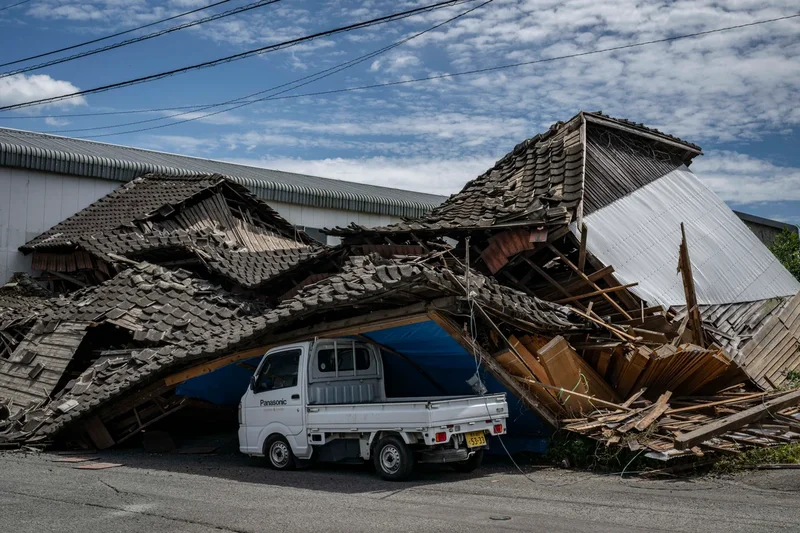
A magnitude 6.8 earthquake struck south-western Japan on Tuesday, collapsing part of a shopping mall, bringing down a historic shrine, and killing at least 18 people.
The toll is expected to rise as rescuers continue to dig through the rubble.
The deaths from a shallow, land-based quake of that size is a tragedy. But it is also, compared to the grim numbers of many other earthquakes, a strikingly low figure. A quake of similar strength has killed thousands of people in other parts of the world in recent years.
Then why are casualty numbers in Japan, a country that’s particularly more prone to quakes, usually so low? The biggest difference, experts believe, is in decades of preparation in making buildings earthquake proof.
A magnitude 7.8 quake, stronger than Tuesday's but not by an order of magnitude, killed more than 50,000 people and destroyed or badly damaged an estimated 185,000 buildings in Turkey and Syria. A 7.6 quake in Pakistan in 2005 killed at least 86,000. Japan's own great disaster of 2011 was a magnitude 9.0, releasing hundreds of times more energy than Tuesday's quake, yet most of its roughly 18,000 deaths were caused by the tsunami that followed, not by collapsing buildings.
Buildings are the key, because in almost every earthquake it is falling structures, not the shaking itself, that kill people. Japan has spent more than half a century engineering its buildings in a way that they can withstand earthquakes.
Daniel Aldrich, a professor at Northeastern University who studies disaster recovery in Japan, has compared earthquake death tolls with how much governments spend on safety measures and social protection, and found the two closely linked: the more a country invests, the fewer of its people die when the ground moves.
"There's a very, very, very high correlation," he told PreventionWeb, a website run by the United Nations Office for Disaster Risk Reduction, in 2024.
"Countries like Japan spend a lot more of their money on keeping people safe, and are typically better prepared."
New buildings in Japan are required to be designed to sway with the ground rather than resist it rigidly. Older buildings that snap off their foundations because they cannot flex are usually the ones that fall on people, which is why much of the damage in Japanese quakes is concentrated in ageing concrete and timber structures.
The foundation of the Japanese system is the building code, which has been tightened after every disaster.
A major change came in 1981, when Japan introduced a new standard requiring larger buildings to remain intact in moderate quakes and to bend and absorb energy without collapsing in severe ones.
In the 1995 Kobe earthquake, which killed more than 6,000 people, 5.8 per cent of buildings constructed after the 1981 revision suffered medium-to-large damage or collapsed, against 12.5 per cent of those built earlier, more than double, according to a 2019 study in the journal Engineering by Jiro Takagi of Tokyo Metropolitan University and Akira Wada of the Tokyo Institute of Technology.
The buildings that fail tend to be the old ones. Connection failures in ageing, non-engineered wooden houses caused more than 90 per cent of the deaths in the Kobe quake, the same study found, and similar failures were still bringing down houses in the 2016 Kumamoto earthquake two decades later.
"Older buildings, unfortunately, tend to snap off their foundations because they're so rigid," Professor Aldrich said. He described being on the 17th floor of a Tokyo building during a major quake. "The whole building swayed back and forth, but not a single pane of glass broke. None of the plaster broke. The whole building was built to flex."
For larger and more important buildings, engineers go further and try to separate the structure from the shaking ground altogether. In base isolation, the building sits on flexible bearings, often layers of rubber and steel, that absorb much of the motion so the structure above stays relatively still. More than 4,000 such buildings had been constructed in Japan by 2016, mostly hospitals, large warehouses and high-rise housing, according to the Takagi and Wada study. A second method, passive control, fits devices between floors that soak up the energy of a tremor, and these are now used in most new high-rise buildings.
Technology, however, is still just one part of the solution.
Japan also prepares its population regularly for earthquake safety drills. Schoolchildren practise earthquake evacuations and residents are trained in first aid and the use of firefighting equipment. The country operates an early-warning system that can alert people through phones, television and radio up to tens of seconds before the shaking reaches them, enough time to stop a train, halt a production line or take cover.
None of this makes, however, makes Japan totally immune, as Tuesday showed.
Base isolation and damping are expensive and largely confined to hospitals, offices and other important buildings, not ordinary homes. Not every structure has been upgraded, and the buildings that fail tend to be older ones. The elderly, who make up a growing share of Japan's population and are less able to evacuate quickly, remain especially vulnerable. Some of those hurt on Tuesday were in a care home.
Professor Aldrich warned the goal of eliminating earthquake deaths altogether is probably unreachable. "You can't retrofit every building," he said. But the distance between 13 deaths and 50,000 is a measure of how much can be done.