Study points to Sasanian military control reaching Indian Ocean
TEHRAN - A comprehensive geochemical study of ancient transport containers from the Fulayj fort in Oman has provided compelling new evidence of extensive maritime trade networks linking the Iranian heartlands with the Arabian coast during the Late Sasanian and Early Islamic periods.
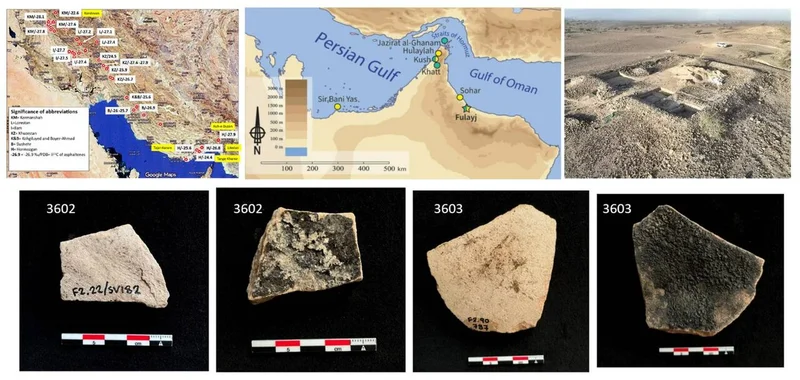
The research, published in the international journal Molecules, focused on fifteen sherds of distinctive "torpedo jars" – large, handless vessels with pointed bases and waterproof bitumen coatings that were widely distributed across the Mesopotamian plain, the Persian Gulf, and the western Indian Ocean littoral. Through advanced isotopic and biomarker analysis, an international team of researchers successfully traced the bitumen used to line these jars to two distinct geographical regions within southwest Iran, confirming the existence of multiple production centers for this crucial vessel class.
The key to unlocking these trade routes lay in the geochemical fingerprinting of the bituminous residues. By analyzing carbon and hydrogen isotopes alongside sterane and terpane biomarkers, the team identified two clearly defined compositional groups. The first group, characterized by the presence of 18α(H)-oleanane, a molecular marker entirely absent from oil seeps in Iraq, Turkey, Syria, Kuwait, Bahrain, and Oman, was matched to sources in the provinces of Khuzestan, Bushehr, and Fars.
These bitumens are believed to originate from the Eocene-Oligocene Pabdeh Formation, deposited in a marine environment with significant vegetal organic matter. The second group, lacking this oleanane biomarker, correlates with oil seeps in the provinces of Kermanshah, Ilam, and Lorestan, and is associated with the Albian-Aptian Khazdumi Formation, which formed under highly anoxic, hypersaline conditions. This distinction strongly suggests that jar manufacturing was not centralized but rather drew upon multiple bitumen extraction sites across Iran, pointing to a decentralized but highly organized system of production.
Beyond tracing the source of the jar linings, the study made a significant breakthrough in identifying the nature of the cargo once held within these vessels. Utilizing a newly developed liquid chromatography-tandem mass spectrometry assay, the researchers targeted specific molecular biomarkers, including malvidin derivatives and Vitisin B, which are stable compounds associated with processed grape derivatives. Positive readings were recorded in five of the samples, spread across both bitumen composition groups and spanning different occupational phases of the fort. These results provide the first published scientific identification of the organic contents of these widely traded jars, confirming their long-suspected role in transporting valuable agricultural commodities from the core urbanized zones of the Sasanian and early Islamic empires towards the Persian Gulf and Indian Ocean maritime sphere.
The archaeological context of the samples adds further historical weight to the findings. Fulayj, a small, heavily defended square fortification located approximately thirty kilometers southwest of the major Indian Ocean emporium of Sohar, is recognized as the first securely identified site of a Sasanian military presence directly facing the Indian Ocean. Radiocarbon dating indicates the fort was constructed between the early fifth and mid-sixth centuries CE and continued to be occupied, with modifications, into the first century following the Islamic conquest.
The analyzed sherds were recovered from securely dated stratigraphic layers, including the pre-Islamic foundation horizon and the seventh-century reoccupation phase. The presence of the grape-derived biomarkers in samples from both periods suggests that the supply of such commodities to the frontier garrison persisted across the historical transition, indicating continuity in trade and consumption patterns even as regional political control shifted.
The results point to a consistent usage pattern for this vessel class throughout the site's occupation, with the enduring acquisition of bitumen from multiple Iranian sources, plausibly connected to alternative manufacturing centers and the distribution of diverse regional products. This research enriches our understanding of the economic integration of a remote Sasanian defensive outpost into a broader regional supply network, demonstrating how strategic military locations were provisioned through long-distance maritime routes traversing the length of the Persian Gulf and the Strait of Hormuz to reach the al-Batinah coast of Oman, and highlights the enduring legacy of Iranian commercial and material influence in the ancient Arabian world.
AM