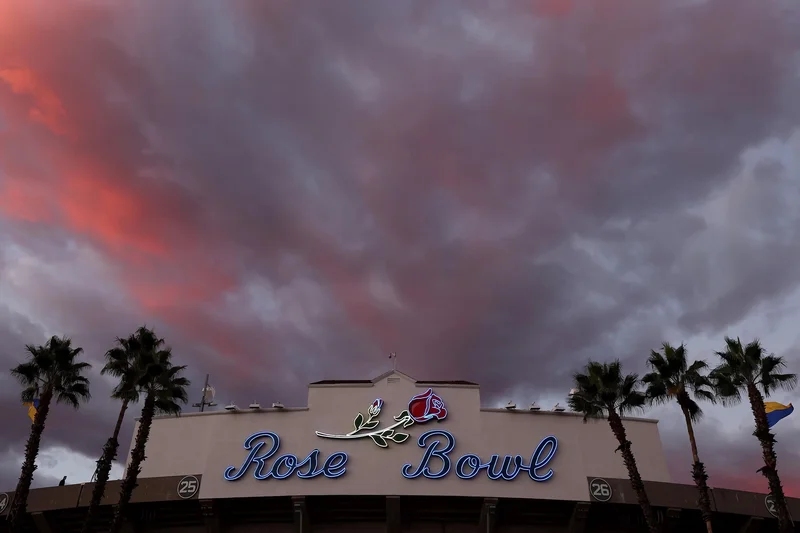
CEO Jens Weiden explains how financial discipline, historic preservation and the Los Angeles Olympic Games are reshaping one of America's most iconic sports venues for its next century.
(This is part 2 of a 2-part story based on a Forbes exclusive interview with Jens Weiden July 9, 2026. All quotes are taken directly from a transcript of the interview.)
Nearly every city dreams of hosting the Olympic Games.
Those hopes are tempered by cautionary tales that have often happened after the Olympic flame is put out.
From abandoned venues in Athens to a 30-year debt burden on the city of Montreal, the Olympics have too often left behind financial wreckage and monuments with uncertain futures. The construction costs may generate headlines, but the long-term economics frequently can become an albatross.
The Rose Bowl has chosen a different path. For Rose Bowl Operating Company CEO Jens Weiden, that distinction reflects years of careful planning rather than Olympic good fortune.
"One of the things when I took over as CEO that became very apparent is that in order to make the changes we wanted to make, we really needed to control our own destiny," Weiden said during an exclusive interview.
That philosophy has become the financial foundation behind an ambitious $80 million Lasting Legacy capital campaign, a multi-year effort designed not simply to modernize the Rose Bowl but to ensure that one of America's most celebrated sporting landmarks remains competitive for decades to come.
Controlling The Rose Bowl's Destiny
Unlike privately owned sports franchises, municipally owned venues must often compete with every other civic priority for public funding—from police and fire protection to roads, parks and housing. Weiden understood early that relying solely on public financing would never provide the flexibility necessary to keep the Rose Bowl competitive.
"There was no silver bullet," he explained.
Instead, the organization attacked the problem from multiple directions: Increasing annual event capacity; Growing enterprise revenue; Building partnerships with Pasadena's hotel industry through tourism assessments; Working with Sacramento and Washington to secure legislative support; And creating dedicated funding streams that recycle sales tax generated at Rose Bowl events back into stadium improvements. The strategy was an incremental approach with transformative results.
A balanced operating budget.
For most businesses, balanced budgets are expected. For a municipally owned National Historic Landmark competing against billion-dollar entertainment complexes, they are extraordinary.
Financial Independence Changes Everything
Once the Rose Bowl demonstrated financial stability, an entirely different conversation began with donors, elected officials, and private partners. Instead of asking for a rescue, the organization began offering opportunities.
"We're almost like a startup," Weiden explained. Rather than asking supporters to save the Rose Bowl, management could invite them to participate in a solvent organization gaining momentum. That shift dramatically altered fundraising.
Private citizens now contribute to preserving a municipally owned landmark. Political leaders increasingly view investments in the Rose Bowl as investments in regional tourism and economic development rather than subsidies. Even Pasadena Mayor Victor Gordo, Weiden noted, has remarked that while few residents write checks for City Hall, many willingly invest in preserving the Rose Bowl because of its emotional connection to the community.
Modernizing Without Erasing History
The easiest way to modernize a stadium is often to demolish it. The Rose Bowl has rejected that option. Instead, every renovation must navigate a delicate balance between improving the fan experience and preserving the architectural integrity of one of the nation's few National Historic Landmarks dedicated to sports.
"Everything that we do," Weiden said, "we have to be very thoughtful to make sure that we don't lose what makes this place special."
That philosophy is evident throughout the current capital campaign. The new South Field Club, scheduled to debut before UCLA's 2026 football season, will provide premium hospitality for approximately 1,000 guests while creating a dramatic player entrance that enhances both recruiting and game-day atmosphere.
Future phases include replacing aging bench seating with wider, more comfortable seats that increase legroom from today's cramped 27-inch spacing while adding new vertical aisles to improve accessibility and circulation throughout the stadium. A new state-of-the-art video board is also planned, enhancing both fan engagement and the growing importance of instant replay review in modern football. Each project modernizes the experience without fundamentally altering the character that generations of fans recognize instantly.
LA28's Legacy Begins Before The Opening Ceremony
Much has been written about Los Angeles staging a "no-build Olympics." Rather than spending billions constructing temporary venues, LA28 is investing in existing facilities that already define Southern California's sporting landscape.
The Rose Bowl is among the clearest examples.
The stadium will host Olympic soccer in 2028—its third Olympic Games after 1932 and 1984—joining only the Los Angeles Memorial Coliseum as a venue to achieve that rare distinction. For Weiden, the significance extends well beyond two weeks of competition. LA28's investment will improve security infrastructure, lighting, operational systems and other long-term enhancements that remain in Pasadena long after the Olympic athletes depart.
"The legacy of these Games isn't just that people attended events," Weiden said. "The legacy is that these buildings are left in a better place than when the Games arrived."
The Olympics become a catalyst for preservation rather than replacement.
More Than A Sports Venue
Perhaps the interview's most revealing moment had nothing to do with football, concerts or Olympic soccer.
It centered on the Eaton Fire.
When devastating wildfires threatened nearby communities in January of 2025, the Rose Bowl quickly transformed into the command center for emergency response. Within minutes, Pasadena Fire Department officials established operations inside the stadium complex. More than 3,000 firefighters and first responders lived on-site for weeks. Trucks were repaired and refueled. Medical operations were established. Meals were served. The Rose Bowl became one of Southern California's most important emergency facilities almost overnight. That experience reinforced Weiden's belief that municipally owned stadiums provide value extending far beyond sports.
They're civic assets.
They're emergency infrastructure.
They're community gathering places.
A Blueprint For The Next Century
As Los Angeles prepares to welcome the world in 2028, attention will understandably focus on athletes chasing Olympic medals. But another story is quietly unfolding in Pasadena. It is the story of a stadium refusing to become obsolete. Rather than chasing architectural trends or attempting to imitate newer competitors, the Rose Bowl has embraced a strategy rooted in financial discipline, adaptive reuse and authentic placemaking.
Built in 1922 for a single football game each year, it now hosts hundreds of events, welcomes millions of visitors and stands poised to host its third Olympic Games without losing the character that has made it one of the most beloved venues in world sport. That may ultimately become Jens Weiden's greatest achievement. He isn't simply renovating a stadium. He's proving that history, when paired with thoughtful leadership and solid business strategy, can become one of the most valuable competitive advantages of all. And when the Olympic torch returns to Pasadena in 2028, the Rose Bowl won't just celebrate another chapter in its remarkable history.
It will stand as compelling evidence that sometimes the most innovative venue in sports can also be one of its oldest.