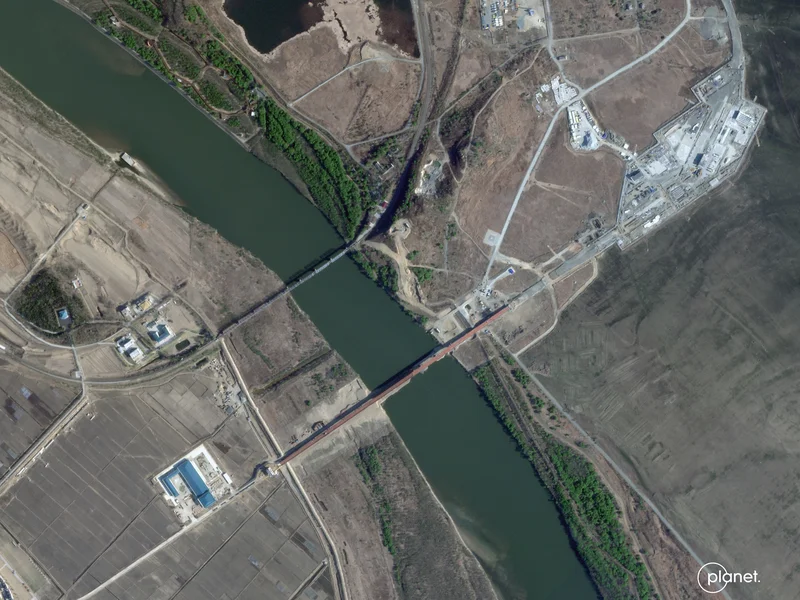
Russia and North Korea are finalizing their first direct road link: a bridge over the Tumen River that will connect the Russian town of Khasan with North Korea’s Tumangang. The project was due to open on June 19, coinciding with the second anniversary of the strategic partnership treaty signed by Russian leader Vladimir Putin and his North Korean counterpart Kim Jong-un, which includes a mutual defense pact in the event of aggression.
However, delays in building the Russian facilities have forced the opening to be postponed, according to several analyses based on satellite imagery. Although no new date has been set, the crossing will facilitate the movement of goods and people between the two allied countries, which have tightened political, economic, and military ties since the start of the war in Ukraine.
The crossing is located in a remote border strip near the point where Russia, North Korea, and China meet, and the structure is practically complete. An analysis of satellite images taken on June 25 and published by the organization 38 North (linked to the U.S. Stimson Center research institute) shows that North Korea has finished, at least externally, the customs warehouse, a large parking area, access roads, and the checkpoint.
By contrast, on the Russian bank the border complex (designed to be at least three times larger than the North Korean side) remains under construction and there are no significant advances visible at the entry point or on some of the access roads, so 38 North judges it unlikely that the crossing will enter service in the short term.
The whole complex measures 4.7 kilometers (2.9 miles), including access roads, while the bridge itself is about 1,000 meters long and has two lanes, each six meters wide. On the Russian side a customs control facility is being built with 10 inspection lanes and a daily capacity to process up to 300 vehicles and 2,850 people.
Moscow and Pyongyang have presented the bridge as a bet on trade and tourism. According to Russian authorities, the new route will cut transport costs and shorten the journey between Vladivostok and Rason — the North Korean special economic zone that includes Tumangang — by about 320 kilometers (200 miles).
But an investigation by the Ukrainian human rights organization Truth Hounds, seen by the British newspaper The Guardian, questions whether those arguments alone justify a project estimated to cost around nine billion rubles — over $110 million — as originally budgeted. The most recent available estimate of bilateral trade, from the Russian Association of Exporters and Importers, put exchanges at barely $34 million in 2024.
Truth Hounds also doubts that tourism justifies the investment. North Korea keeps its borders closed to foreign visitors, with the only exception being organized groups from Russia that follow strict itineraries and are always accompanied by guides. In 2025 there were only 5,075 tourist trips by Russian citizens to the closed-off Asian country, according to Russian border statistics. Organized trips from China — which before the pandemic accounted for more than 90% of foreign tourists — have still not resumed.
For that reason, Truth Hounds believes the infrastructure primarily answers to a strategic logic, since it could serve as a logistical corridor, less exposed to Western surveillance, for moving soldiers, construction brigades, and military materiel toward Russia and technology and supplies in the opposite direction. Trucks provide far fewer clues about their contents than railcars, can be loaded and unloaded more quickly and can then travel on a much larger network. Rail transport, by contrast, depends on a small number of stations and sidings where convoys remain within range of satellites for longer.
The new road is being built about 500 meters south of the Friendship Bridge, opened in 1959 and until now the only land link between the two countries. Trains run over it between the border stations of Khasan and Tumangang, whose banks have been under scrutiny for years by researchers using satellite images to try to identify possible weapons transfers.
That monitoring detected a sharp increase in traffic soon after Kim and Putin accelerated their rapprochement in 2023. According to the Multilateral Sanctions Monitoring Team (MSMT), North Korea has since sent more than 20,000 containers to Russia with ammunition and military materiel. In 2024 alone, shipments may have included up to nine million artillery and rocket rounds, as well as at least a hundred ballistic missiles.
The first deliveries were made by rail, although later ships handled the bulk of transport. Missiles, their launchers and other sensitive equipment have continued to travel mainly by train or military aircraft. The MSMT is an independent body made up of 11 countries — including South Korea, Japan, the United States, France and the United Kingdom — that monitors any breaches by Pyongyang of UN Security Council sanctions.
North Koreans in Ukraine
The collaboration between the two allies took another step with the dispatch of soldiers, which both governments confirmed in 2025. It is estimated that around 14,000 North Korean personnel were sent in the autumn of 2024 to Russia’s Kursk region after Ukrainian forces occupied part of the territory. South Korean intelligence services estimate that about 2,000 North Korean soldiers died in combat.
Ukrainian President Volodymyr Zelenskiy warned on Saturday that Russia is now preparing to incorporate another 30,000 North Korean soldiers, and said that facilities to host them have been under construction since June in Russia’s Voronezh region. Zelenskiy also said Pyongyang plans to deliver additional ballistic missile launchers to Moscow. “Russia is helping North Korea learn how to wage war, improve its weapons and gain real combat experience using them. That poses a threat to every Asian country within the range of North Korean missiles,” the Ukrainian leader said. The Kremlin has declined to comment on Zelenskiy’s statements.
The MSMT also maintains that Russia has provided North Korea with air defense systems, advanced electronic warfare equipment, and quantities of refined oil beyond the limit imposed by the United Nations. The use of North Korean weapons against Ukrainian cities would have allowed Pyongyang to gather data on their performance and improve the accuracy of its missiles, while its troops would have gained combat experience they could hardly have obtained within their own borders. According to findings previewed by The Guardian from the Truth Hounds report, the new bridge would add a faster, more flexible and harder-to-monitor route to that cooperation.