- Do you have a story? Email: jon.brady@dailymail.co.uk
- FULL REPORT: Population hits 62m as births dip to lowest level since 1978
- See more Daily Mail on Google - save us as a Preferred Source
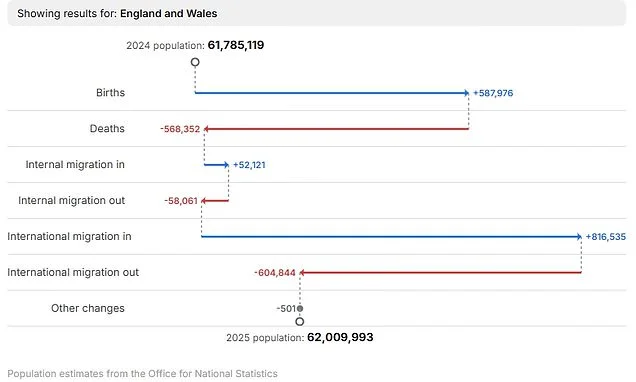
The population of England and Wales is estimated to have hit 62million for the first time ever – driven largely by international migration.
Projections from the Office for National Statistics (ONS) suggest the country's population grew by 224,000 from 61.78m to reach almost 62.01m as of June 2025.
And the number of births is almost being outstripped by the number of deaths: almost 588,000 births against just over 568,000 deaths.
It's the lowest number of annual births since 1978 and comes amidst dwindling fertility rates below the 'replacement-level' needed to maintain a steady population.
More people entered the UK from other countries than left: some 816,000 people entering against almost 605,000 leaving to live abroad. Net international migration was 211,700, a sharp fall from 612,500 in the year to mid-2024.
And the ONS said all regions of England recorded population spikes except London, where the population declined by 0.29 per cent due to a rise in the number of residents moving to other parts of the UK.
The data is published by the UK's official statistics body across reams of spreadsheets – which the Daily Mail has crunched to create an interactive tool showing how the population has changed in your area.
By entering your postcode below, you can see how births, deaths, internal migration – people moving into and out of your local area – and international migration have affected where you live.
Population growth continues to outstrip predictions less than a decade old that England and Wales would not hit 60million people until 2029.
The official statistics highlight the extent to which England and Wales are becoming an ageing population, with adults having fewer children while people live for longer amid advances in medicine and living standards.
In a sign of the extent to which people are living longer, the official data found there were around 15,172 people aged over 100 across the two countries.
This was up from 14,635 in 2024 (3.7 per cent) and 12,472 in 2015 (21.6 per cent).
The number of people aged 105 or more increased by more than a third (34 per cent) to 709, compared with 529 in 2024.
The ONS data also projected that there were 581,400 people aged 90 or over last year, up from 564,300 (3 per cent) the year before and 500,000 (16.3 per cent) in 2015.
Men now make up 34.1 per cent of the over-90 population and 18.8 per cent of the over-100 population. For every man aged over 100, there were 4.3 women.
Nigel Henretty, of the ONS, said: 'Migration has been the main driver of population change in England and Wales for the past quarter of a century.
'While that has continued to be the case, the recent fall in migration has led to the smallest population growth since the height of the pandemic.
'London saw the first population decrease since 2021 and the population of Wales fell for the first time in a decade.'