Good news everyone - it seems that the reason AI hasn't yet resulted in less work and more leisure time, as promised by multiple "evangelists" and AI "experts" is that we just love working too darn much.
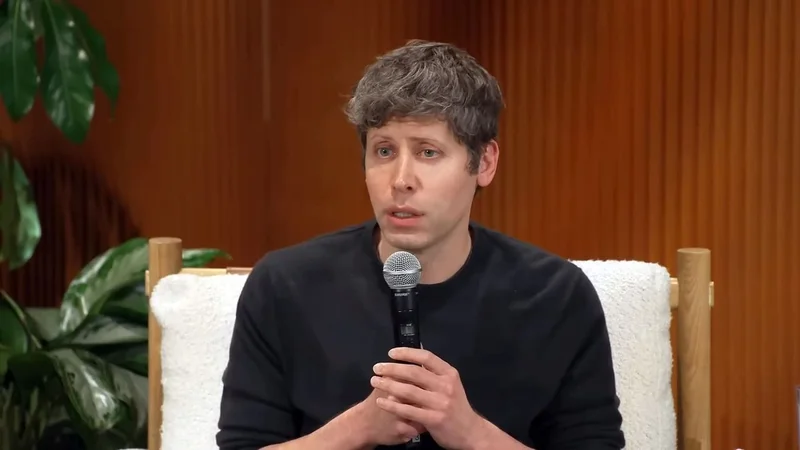
That's according to OpenAI CEO and America's next top (AI) model whisperer Sam Altman, who has declared that people are just really big fans of grinding away and competing with others.
Speaking on the Relentless podcast, Altman told host Ti Morse that in fact, he doesn't expect a change in society or working practices for quite some time, despite widespread promises that AI would boost our productivity and efficiency across the board.
AI "won't change" work - yet
"Technology, for a long time, has been promising people that they're going to work less and they're going to have all this leisure," Altman said.
"But somehow we never get the promise of the four-hour workweek at mass scale in society," he added. "And I don't expect AI to change that."
It's a remarkably candid admission from the leader of a company which is explicitly setting out to solve some of the world's biggest problems - whether personal or work-related - with AI.
In fact, Altman pointed out that we do have more free time and luxuries today than at any point in history - but this has led to increased expectations from many people.
"We always want more," Altman added, "we think of new things to do, to create for each other, to want for ourselves. It's like a relative game. People are very focused on how they're doing relative to other people."
"I think we're all going to be much busier than we thought we were supposed to be in a post-superintelligence world. We're still going to complain about it, but secretly we're going to be happy," Altman concluded.
I'm not so sure about that - but I'm happy to be proved wrong.
Play it again, Sam
I'm not so sure about that - but I'm happy to be proved wrong.
That's because Altman has been pretty vocal on the future of AI in the workplace for some time, with his viewpoints often changing depending on the situation.
For starters, he recently revealed OpenAI's future strategy would be not to automate everything but to allow people to make better decisions as AI improves their lives, particularly as it expects an AGI world to be here by 2028.
"Entirely automating everything is not the future we want", Altman declared, as he described how OpenAI is now looking to opens a "third phase" and aims to build technology "to benefit everyone".
In May 2026, Altman also criticized companies blaming job cuts on AI - but did admit the technology has some accountability in displacing human workers.
"I would expect that the real impact of AI on jobs, in the next few years, to begin to be palpable," Altman explained, adding that "Of course we'll find new kinds of jobs."
Days later, Altman said he would be "delighted to be wrong" about the effect of AI on human roles, hitting out at claims the increasing global usage of AI technology worldwide will lead to a "jobs apocalypse".
"I thought there would have been more impact on entry-level white-collar jobs being eliminated by now than has actually happened," Altman said, who also admitted that while he believed OpenAI has been "roughly right" on the technological predictions it made when it launched ChatGPT in 2022, they were "pretty wrong" on the social and economic implications.
At the time of writing, 252 companies have announced job cuts in 2026 so far, leading to 124,255 employees losing their roles (via Layoffs.fyi) - people who, I suppose, do now have a lot more free time than they expected.
Mike Moore is Deputy Editor at TechRadar Pro. He has worked as a B2B and B2C tech journalist for over a decade, including at one of the UK's leading national newspapers and fellow Future title ITProPortal. When he's not keeping track of all the latest enterprise and workplace trends, he can most likely be found watching, following or taking part in some kind of sport.