The Madhya Pradesh government on Wednesday (July 29, 2026) increased the limit for moong procurement from 25% to 60% of the total crop, following a meeting between State Agriculture Minister Aidal Singh Kansana and farmer representatives.
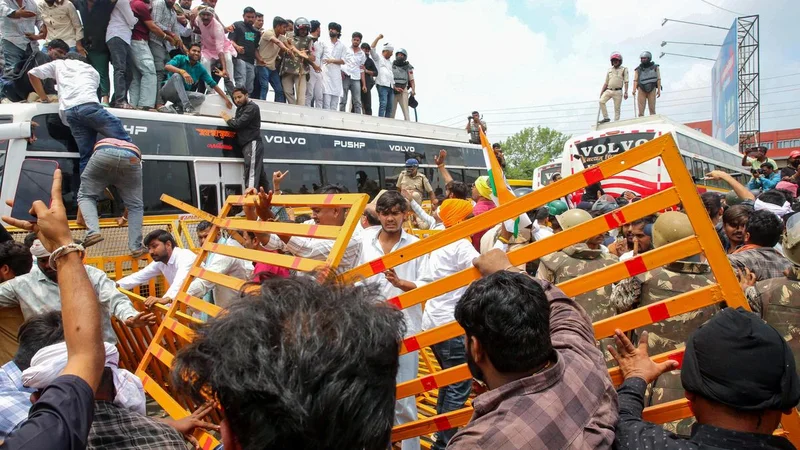
The decision comes as nearly 2,000 farmers, who breached police barricades to reach the State capital, set up camp near Chief Minister Mohan Yadav’s residence.
“In districts like Narmadapuram, Sehore, and Harda, this will amount to around 3 quintals per acre. The decision will be implemented immediately, and efforts will be made to benefit the maximum number of farmers,” Mr. Kansana said.
He added that the procurement slot booking deadline has been extended to August 10, while the procurement deadline has been moved from August 10 to August 20.
Additionally, the State government has suspended the MSP e-token system for fertiliser distribution. “A high-level committee under the chairmanship of the Chief Minister’s Agricultural Production Commission will be formed to review the system and suggest necessary reforms,” the Minister added.
However, Subodh Raikhere, a farmer representative, dismissed the move as an attempt to “pacify” the protest ahead of the Assembly by-election in Datia on Thursday (July 30, 2026). He stated that the farmers would continue to camp in Bhopal and decide on their next course of action tomorrow after consulting all 19 involved organisations.
“This is a lollypop to end the movement because of the Datia election. We stand by our demand of 100% procurement,” he told reporters.
How events unfolded
Earlier in the day, farmers, carrying bedding, cooking essentials, and other provisions anticipating an extended stay, breached police barricades on the Narmadapuram road and blockades at multiple points before entering the city.
By evening, the protesters had reached Polytechnic Square, less than a kilometre from the Chief Minister’s residence, prompting authorities to block the route with buses and barricades.
The farmers, representing at least 19 organisations, including the Samyukta Kisan Morcha (SKM), resumed their march on Wednesday (July 30, 2026) afternoon after a meeting between farmer leaders and the State Agriculture Minister proved futile.
Farmers from Bhopal, Narmadapuram, Vidisha, and Raisen have been marching towards the capital since Monday (July 27, 2026) as part of the ‘Kisan Kranti Padyatra’ (farmer revolution footmarch).
Procurement disparity
The Union Government had earlier agreed to purchase 4.54 lakh metric tonnes of moong from Madhya Pradesh at a minimum support price (MSP) of ₹8,780 per quintal for the 2026-27 marketing season. This quota is significantly lower than the total estimated production of 20.16 lakh metric tonnes, capping government procurement at approximately 25%.
The State has asked the Centre to increase the procurement limit to more than 8 lakh metric tonnes, with Mr. Kansana writing to Mr. Chouhan to that end.
In response to Mr. Kansana’s letter, Mr. Chouhan on Wednesday (July 29, 2026) wrote to Chief Minister Yadav stating that, as per the scheme, the Union Government can only purchase up to 25% of the crop from the State and that any additional procurement from farmers is done by the States.
“According to data received by the Central Government as of July 29, 2026, the procurement of moong in the State stands at approximately 60,000 metric tonnes. Therefore, keeping the broader interests of the farmers in mind, it is requested that the State Government kindly ensure the prompt procurement of moong,” he said, adding that even in previous years, the State Government has made timely additional procurement.
During the Budget Session in February, Mr. Chouhan had informed the Rajya Sabha that the Union Government intended to ensure 100% procurement of tur (pigeon pea), masoor (lentil), and urad (black gram). “Whatever quantity farmers produce and wish to sell, the Centre will procure in full,” he had said, according to a statement from the Union Ministry of Agriculture & Farmers Welfare.
Dependence on moong
Earlier, farmer leaders said the government purchases only 1.2 to 1.5 quintals per acre at the MSP. With yields this season reaching 4–5 quintals per acre, farmers are forced to sell the surplus in the open market at ₹4,000–5,000 per quintal.
Badal Saroj, general secretary of the All India Kisan Sabha and a member of the SKM, told The Hindu that moong is vital to the regional economy.
“Since it is a profitable crop, a large part of the region’s agricultural economy depends on it. Good production due to favourable natural factors this year has prompted farmers to demand complete procurement,” he said.
He added that the agitation will continue until the government guarantees full procurement and begins purchasing. “Shivraj Singh Chouhan had promised complete procurement when he was the CM and again when he became [Union] Agriculture Minister. CM Mohan Yadav has also made similar promises, but nobody has acted on it,” he added.
Student support
The protest has also drawn support from students.
“Students were protesting just days ago and now farmers are here. The government held debates on Hindu-Muslim issues in the recent Assembly session. This shows that those in power do not understand the pain of farmers. Shivraj ji talks about AI, drones, and scientific farming, but in his own State, farmers still struggle to get fertiliser properly,” said Rohit Bharti, a political science student in Bhopal.
He said he has joined the protest because he comes from a farming family and understands the issues they face.
The farmers’ march also prompted the police to call for additional forces and deploy measures such as water cannons, in addition to diverting traffic on various routes. The district administration also declared holidays for various educational institutions along the route of the march.
Published - July 30, 2026 12:40 am IST